




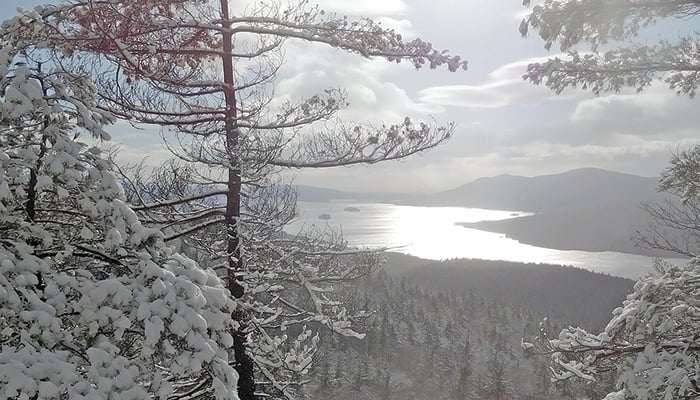
Last week, the Trump administration announced its plan to formally revoke the 25-year-old Roadless Rule, thereby ending protections for nearly 45 million acres of national forests.
The existing policy was working fine, which is why 99% of comments submitted last year on repealing the roadless rule supported keeping it intact. The roadless rule currently protects 62,000 acres (out of 2.84M acres) of national forest in Minnesota’s Superior and Chippewa.
 At Game Fair, Republican candidate for governor Lisa Demuth – in response to a question about the ‘no-net-gain’-of-public-lands clause in her party’s platform – said Minnesota needs more quality public lands versus quantity.
First, I fundamentally disagree with that notion. A lowland field of unmanaged scrub plants is better than a subdivision with flooded basements or a soybean field that washes out every three years. Moreover, why doesn’t the quality-versus-quantity argument apply to roads?
Numerous sources, including former USFS Chief Mike Dombeck, have pointed out that the nation’s 370,000 miles of national forest roads have a $10-billion-plus maintenance backlog. Traveling to Alaska early this month, I learned about the effort to build the Ambler Road across some of the wildest country left in America.
En route, we stopped in Coldfoot Camp, which the Dalton Highway passes through from Fairbanks up to Prudhoe Bay. I chatted with motorcyclists and folks in 4WDs heading to the coast. Their vehicles (and the bikers themselves) were coated in mud from the pothole-laden, mostly gravel “highway.” This country spends mind-boggling amounts of time and money maintaining existing roads. We don’t need more.
MORE COVERAGE FROM MINNESOTA OUTDOOR NEWS:
Natural foods vary as Minnesota’s bear season arrives
Labs, the most popular bird dog in America, have an interesting past
C.B. Bylander: What’s the best model for firearms safety training?
Roadless does not mean unmanaged or wilderness. The existing rule allows for reducing hazardous fuels, habitat work, and grazing. The USDA trumpeted in its press release the need to manage fire, but the data does not support the theory that we must rescind roadless to fight fires.
We have more fire activity where there are roads and people. Per a report from onX, roadless areas have accounted for only 3% of all wildfire ignition in the past 50 years.
The public has until Sept. 21 to comment on the plan to eliminate the existing policy. The original rule happened after 600 public meetings and in response to 1.6 million public comments, but here we are… another battle. Why can’t this administration listen to the people who currently use these lands for public recreation year-round? Presumably because we don’t finance campaigns.
Hunters and anglers can make a difference on public policy.
Thanks to groups like Ducks Unlimited and Delta Waterfowl (and 211,000 comments from readers like you over two weeks), we got the U.S. Fish and Wildlife Service to halt action on reviewing restrictions on the wetland easements you and I fund with our Duck Stamp dollars. North Dakota Sen. Kevin Kramer didn’t like it, even calling DU “environmental extremists” on Twitter, but thankfully, the lunacy of eviscerating voluntary wetland easements was too much for the Trump USFWS.
Building more expensive roads in the few remaining areas where some of us walk is a no-brainer, too. Conservationists have faced many calls to action during Trump 2.0, but this one is a big fight.
Groups like Backcountry Hunters and Anglers and Trout Unlimited have action alerts on their web pages where you can learn more and link to file comments. For more info, onX also has a great new Public Land Comment Hub.
To comment, or (if you have time) to read hundreds of pages of government documents supporting the rescission, visit www.regulations.gov, then search for docket number FS-2025-0001.
Please make your voice heard on this one, folks.
Minnesota DNR not implementing three-duck bag option
The Minnesota DNR on Thursday said it will not be implementing a proposed three-bird “splash-duck” option for Minnesota waterfowlers.
Outdoor horoscopes for this week
Aries (March 21-April 19): Pheasant season has you fired up, but your dog has noticed you skipped every preseason walk in
Best time to target that big buck? Don’t wait for the rut
Rut-crazed bucks may be easier to encounter, but for a specific buck, early season may be better.
There’s no

2 thoughts on “Outdoor Insights: We don’t need more roads in wild places”
This current administration is a complete farce when it comes to environmental issues. From the loss of navigable waters regs to trying to open the roadless areas for timber and mineral harvest is ridiculous. And our representatives in the house and senate turn a deaf ear to all. Hopefully this all changes in November.
Here in Wisconsin’s Chequamegan/Nicolet National Forest we have hundreds of miles of roads that need long overdue maintenance. The US Forest Service (FS) doesn’t have the dollars to do that maintenance. So the roads that the FS spent hundred of thousands of dollars to build are now over grown with brush, full of deep ruts and/or generally impassible. The undoing of the Roadless Area Initiative is nothing but an attempt by the Trump Administration to open up all Federal Lands to developers to extract timber and minerals.