


Princeton, Minn. — Passionate Minnesota bowhunters often travel out of state to kickstart their deer season because of the opportunity to shoot a buck in velvet.
Even in states like the Dakotas with late August or early September openers, a short window exists to capitalize before most bucks become hard-horned.
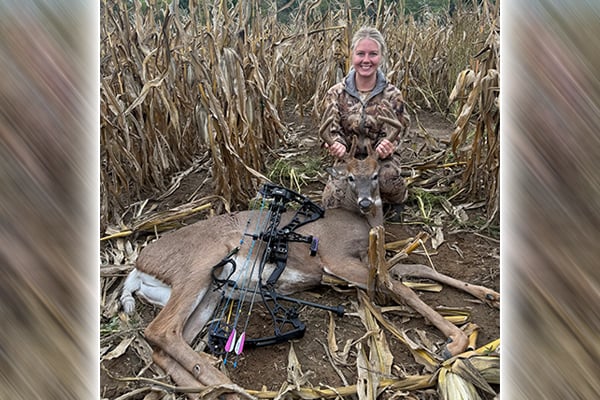
Minnesota’s opener falls in mid-to-late September when a big velvet buck is not even on a hunter’s radar. But on Sept. 20, the second day of the state’s 2026 archery season, Kaylee Selisker shot a 10-pointer in Mille Lacs County that remained in full velvet. Making this unique occurrence even more memorable? It was her first deer.
“I know it’s so rare, and the fact that it’s a 10-point and in velvet, it’s not that I’ll never be satisfied (with future deer),” she said. “I’ll always be satisfied, but for that to be my first deer is such a crazy, crazy experience.”
Selisker, 22 years old from Princeton and a nursing student at St. Cloud State University, was hunting with her fiance, Noah Temp, on property owned by her brother and his girlfriend in central Minnesota. Selisker and Temp were hunting in separate stands not far from each other where two swamps overlooked the edge of a field in standing corn.
They hunted opener evening, Sept. 19, but did not see much.
“Our trail cams had picked up a lot of deer the whole two weeks before opener but then all the deer just disappeared,” she said. “I didn’t really want to go out Sunday because we didn’t see anything Saturday. But we went out Sunday at like 4 and we realized the farmer had combined a whole trail of corn just on the outer edge.”
MORE WHITETAIL COVERAGE FROM OUTDOOR NEWS:
How temperature changes cause the wind to move, and what that means to whitetail hunters
Wild game left in your freezer? Great recipes to try before refilling this fall
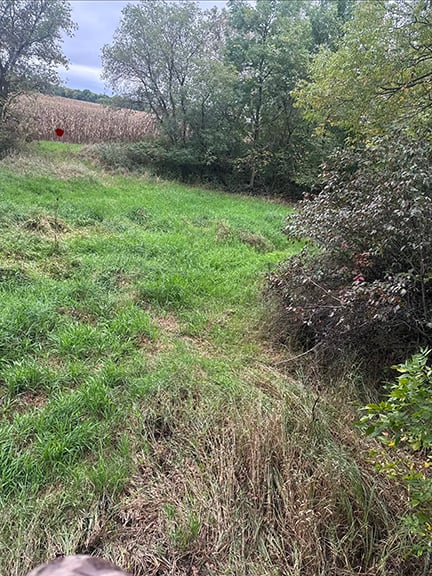
That freshly-combined corn and the leftover cobs on the ground gave them confidence that deer might feed on that edge that evening. Before Temp left to get into his stand, he used his rangefinder from the field edge to range where Selisker was in her ladder stand for an exact yardage of where deer might travel.
“He ranged me at 50 yards and then another 40 and 35 in different areas,” Selisker said. “I was thinking in my head, ‘I’m not going to shoot that. There’s no way I’m going to shoot 50 yards.’”
Selisker had practiced shooting out to that yardage and knew the bottom pin on her sight was set for 50 yards. She settled in for the hunt as excitement built.
“I was just really praying in my head because I had never gotten a deer,” she said. “It had just always been a dream to get a deer, and I sat for 20 minutes. I was on my phone texting Noah. I just wanted to get my first deer out of the way, so I said if I see a big doe I’m going to shoot it.”
Selisker was sending that message when she saw the buck come out of the corn.
“He came out and I was just like, ‘Oh, my gosh, this is my opportunity,’” she said. “I put my phone down, grabbed my bow and there were two openings that I could shoot. He walked down the trail, I drew my bow and he started to walk past that second opening, but he was 50 yards away. I meeped (to stop him) and he stopped broadside.”
Selisker settled her 50-yard pin and released an arrow that landed true.
“I heard it pop. I knew I hit him and I just started tearing up,” she said. “He took off running down the trail toward Noah’s stand… Noah saw him go down. That’s when I called him and he said he saw him crash into the corn.”
They followed an easy blood trail to the buck, and that’s when they realized the rarity of the deer. They had not seen the buck on their cameras before the hunt.
“When I shot him I didn’t even know he was in velvet,” Selisker said. “He just came out of nowhere. I was extremely shocked and Noah was extremely shocked.”
How rare is it?
The huge majority of bowhunters will hunt a lifetime without ever seeing a velvet buck during the Minnesota season.
“It’s definitely rare,” said Paul Burr, deer coordinator for the DNR’s Big Game Program. “Testosterone levels dictate when velvet dries up and peels off, and testosterone levels are governed by photoperiod. But, as with most biological processes, individual variation exists.”
Kip Adams, a certified wildlife biologist and chief conservation officer with the National Deer Association, expected to see a much smaller buck in the photo when he received an email from Outdoor News with the image.
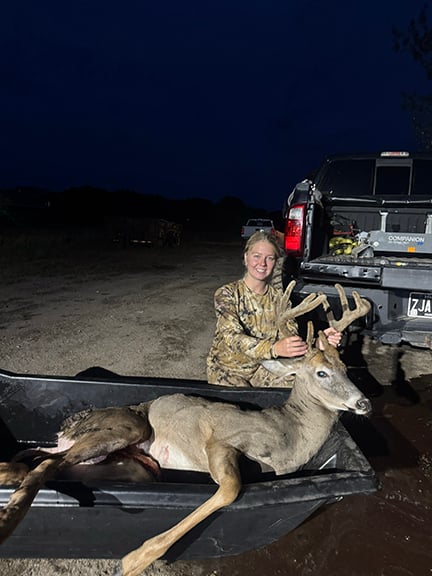
“Most deer that still have velvet on right now tend to be small antlered deer and in many cases they’re actually not bucks,” Adams said. “They’re does that had a little more testosterone and were able to grow antlers, but not enough testosterone to harden them or shed that velvet. When I saw the email, I fully expected it to be small antlered and thought this is going to be a doe. The picture opened up and I thought, ‘Holy smokes!’”
Adams said a hormonal imbalance, for one reason or another, did not let this buck shed its velvet in a typical timeframe.
“That might be an injury to the testicles. It may be one of those testicles never descended properly so it’s internal,” he said. “Might be something else that we don’t know of for sure that’s causing some type of hormonal imbalance. What we do know is if you have a deer in say a research facility, if it’s not getting the appropriate testosterone, this is what happens. It’s definitely a testosterone issue in the wild.”
Adams called it an extremely rare occurrence.
“We get pictures of a few of these each year, but literally a handful. Like less than five deer that you see or hear about online over the U.S.,” he said. “There’s somewhere between 30-35 million deer out there right now. We kill about 3 million antlered bucks a year nationally and there’s probably less than five that you would see like this.”
Incredibly grateful
Selisker said they did not notice any type of injury or anything abnormal while field dressing the deer. She says each day she’s learning more and more about the rarity of the buck.
Her father, Joe, said he first had Kaylee sit in the bowstand with him when she was about 12 years old. “We saw deer and she was hooked,” Joe said. “I’m so excited for her.”
Kaylee continued to see deer during bow hunts over the years, but had never quite connected on an opportunity. Little did she know how worth the wait her first punched tag would be.
“Just the amount of gratefulness I feel getting him,” she said. “The way we hunt too is we’re so appreciative. We ate his roast this week. We butchered him ourselves. It was the first deer we butchered up ourselves, too, because usually we send them off (to be processed). I literally teared up and it was just so crazy because I felt the energy in the air. I was just praying the whole time in the stand. It was such a crazy experience.”
Video: Maximize your efficiency during the whitetail rut
Eric Morken just got back from his annual trip during the whitetail rut where he filled three buck tags with
Be aggressive when trying to tag a big-woods bruiser buck
It’s been tough sledding for deer hunters in northern Minnesota in recent years, although deer numbers seem to be creeping
Bloomington angler tops Minnesota’s C&R steelhead record
Duluth, Minn. — Minnesota has a new steelhead catch-and-release record after Ryan Pierce of Bloomington reeled in a 33-inch fish
