




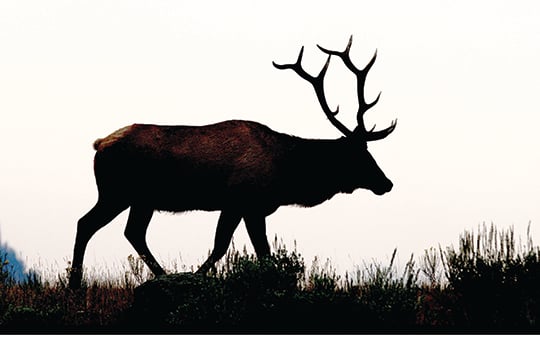
Minnesota’s elk population has been in the news, starting with the state offering 12 tags in 2026 to harvest animals in the northwest. The DNR currently has no elk coordinator, and efforts to create a new elk herd in the northeast have stalled thanks to a dispute between the Fond du Lac and Red Lake bands.
 This scribe has border envy as Wisconsin’s two elk herds show steady growth and love from the Badger State public – state and tribal. For a bowhunting publication in 1995, I reported on Wisconsin’s launch of its “Clam Lake herd” about 180 miles northeast of the Twin Cities. After creating an elk plan in 1989, Wisconsin translocated 25 Michigan elk in 1995.
That herd grew in fits and starts for 20 years until wildlife managers there supplemented them with new genetic stock from Kentucky (an eastern state that now has 10,000 wild elk!). Those 150 animals reinvigorated Wisconsin’s stock, and today, our neighbor to the east boasts more than 600 cows, bulls, and calves in two herds – the Northern Elk Management Zone (formerly Clam Lake), and the Central Elk Management Zone near Black River Falls.
That latter contains over 200 animals just 50 miles from my favorite border town, Winona. While emphasizing that growing the herd remains a priority, Wisconsin is offering 20 elk hunting tags this year – 12 in the northern herd and eight near Black River.
Per the 2026 elk survey, Minnesota has about 90 animals between our Grygla and Kittson-Central herds. At 313 animals, the Caribou-Vita herd is larger, and they ignore the international border. The herd spends much of its time in Manitoba, but its range includes a piece of northeast Kittson County and a sliver of Roseau.
During the 2026 elk survey, all of that herd was in Manitoba. Despite having a smaller elk population than Wisconsin, we tripled the number of 2026 elks tags (12) for state hunters compared to 2025 (4). Last winter, Minnesota Public Radio posted a story, “State elk populations stagnate, researchers look into why.”
MORE COVERAGE FROM MINNESOTA OUTDOOR NEWS:
Outlook optimistic for Minnesota’s 2026 pheasant hatch
Five hunting breeds that are great dogs in the field and the house
Minnesota’s LCCMR reviews, advances 116 projects totaling $152M for ’27
Can someone reconcile that for me?
DNR Wildlife Section Manager Dave Trauba explained the challenges with managing these large members of the deer family.
State law (demanded by ag interests and friendly local legislators) restricts the number of elk in the region, and the Grygla and border herds both saw increases in size estimates from 2025.
“In my years working with Minnesota wildlife, this has been a really challenging one because everyone wants a part of these elk,” Trauba said. “It’s such a balance. Our ag producers would like us to be much more aggressive with management.”
Will the state fill its elk biologist position? In March, Kelsie LaSharr took a biologist post with a nonprofit in Utah. Plans to fill that job remain on hold as the section reviews multiple vacancies and evaluates priorities, including a possible new moose plan (something this scribe demanded here not long ago…)
As for the theory to move some of those northwestern elk to establish a northeastern herd – where the habitat looks like northern Wisconsin – Trauba says that effort is not dead. Per last week’s Outdoor News story, that’s contingent on the two tribal entities and the state forging an agreement.
An elk study of the northwestern herd remains underway, too, led by Amanda McGraw, the DNR’s lead deer, moose, and elk research scientist. Finally, could we get elk from somewhere else in the nation to create a northeastern herd? Minnesota law in the CWD era prohibits the state or private sector from importing elk.
Given the growing CWD footprint across the country, our northwestern elk remain the best option for building a northeastern herd. To the DNR and bands, this writer offers a simple plea: Put aside minor differences and short-term inconveniences and let’s establish a northeast herd.
Ohio’s Outdoor Calendar
A look at upcoming outdoor-related events from across Ohio published in the Sept. 22, 2026 edition of Outdoor News.

Ohio Cuffs & Collars: Stolen black walnut tree from Wallace O’Dowd Wildlife Area
Ohio cuffs and collars are field reports from the Division of Wildlife. These reports are from the Sept. 25, 2026
H2Ohio wetland to benefit St. Marys
As part of Ohio Gov. Mike DeWine’s H2Ohio Initiative, the Ohio DNR (ODNR) and the city of St. Marys held

2 thoughts on “Outdoor Insights: Looking into Minnesota’s elk issues”
Nice article Rob. I worked with Fond du Lac in 2025 to develop vegetation restoration plans for elk habitat. Current vegetation, due to the lack of herbivores and fire, is too poor to support healthy populations of large herbivores, deer, moose, elk, caribou. It’s sad to see moose research focused on symptoms, ticks, brainworm, too many deer, and virulent carnivory, instead of causes, e.g., loss of keystone processes (LKPs), i.e., biomass reduction via foodwebs and cultural fire that maintianied oligotrophic conditions to the benefit of edible native vegetation. As Leopold said, the vegetation is now “left to rot by worm and weevil”, soil go eutrophic, vegetation becomes toxic. Interesting to note, by paleoecology and phylogeny, evolutionary advanced vegetation became increasingly more edible to feed mammal herbivores. Of course!
Ticks, brainworm, deer and wolves have always lived with moose, so what has changed? Data from the DNR big game registration shows the highest moose harvest (Ely) also occurred with the highest deer harvest (Ely). Likewise, any real herbivore ecologist will tell you carnivores have no impact on herbivores numbers, in the end it’s the vegetation (see McNaughton). Carnivores merely weed out the sick, weak, old, diseased, and mutated herbivores to maximize herbivore numbers for generations of carnivores to come (the great H.T. Odum 2007).
LKPs results is a positive feedback that can be summarized as, “terrestrial eutrophication and afforestation (TEA)”, triggering trophic cascades, favoring primitive, toxic, nitrophilic plants over advanced, edible plants. Increases in pestilence and disease (ticks, deer flies, slugs, CWD) are manifestations of trophic cascades and stressed populations. At least 95% of what we call “invasive species (IS)” are merely symptoms of TEA. Europe is 30 years ahead of North America in understanding the relationship between LKPs, eutrophication, IS, pestilence, disease, and declines in native spp., even though it started here with D. Tillman at UM-Cedar Creek Science Preserve (mid 1980s – early 2000s).
It seems resource professionals are trained to dart moose, draw blood, count numbers, but not trained to understand complexities associated with dynamic ecosystems, fast and slow variables, C.S. Holling, H.T. Odum style. In the end, this form of natural resource management, pulling levers behind green curtains, invariably destroys the entity it sought to preserve, see Holling’s classic, “Command and Control and the Pathology of Natural Resource Management (1996). Sometimes I suspect the amount of $$ MN has, via LCCMR, LSOHF allows us to throw money at problems while avoiding thinking about it.
I think we need a complete overhaul of the DNR, a seemingly entitled group of ‘experts’, and the expert trap (Harvard Business School).
Keep scribing, Rob.
McNaughton, S.J. 1984. Grazing Lawns: animals in herds, plant forms, and coevolution. American Naturalist, Vol. 124, pp. 863.
McNaughton, S.J. 1985. Ecology of a Grazing Ecosystem: The Serengeti. Ecological Monographs, Vol. 55, No. 3.
McNaughton, S. J., Ruess, R. W., & Seagle, S. W. (1988). Large mammals and process dynamics in African ecosystems. BioScience, 38(11), 794-800.
McNaughton, S.J. 1993. Grasses and grazers, Science and Management. Ecological Applications, Vol. 3, No. 1.
Don’t provide additional biomass for the wolf population without considering the balance for a healthy ecosystem. Is it any wonder that elk populations have stagnated there? Predation is a major factor and will likely continue to limit overall elk herd growth. Without a canine distemper outbreak, mange or when ESA restrictions are removed, state wildlife biologists will be frustrated to manage elk to a sustainable level. I’m an elk and wolf supporter but in my opinion, wolves have reached their social carrying capacity in the northern tier, especially where prime wolf territory meets human habitats and farming region. Public opinion for people living in wolf country is changing negatively. Think twice about the long-term implications before acting on this.