




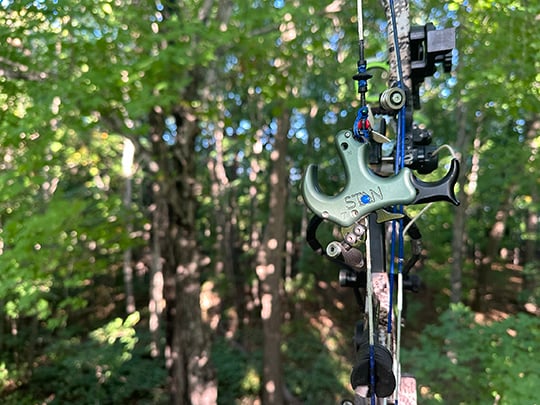
P.J. Reilly has likely shot as many release aids as almost anybody in the archery world.
Now in his 14th year with Lancaster Archery Supply, Reilly is a public face for the huge archery retailer based in Lancaster, Pa. He is an avid bowhunter and has written “best-of” gear reviews on releases based on his testing, along with hosting countless video reviews for Lancaster’s social media channels.
Reilly figures he has shot more than 100 release aids. So what is the top quality that he is looking for out of a good release for bowhunters?
“I think (comfort) is at the top,” Reilly said. “We see people who get releases that are too big for their hand and they don’t realize it. If it’s not comfortable, you’re always going to be fighting issues.”
For many, the process of picking a release is as simple as grabbing one off the shelf based on the price tag without much other thought. If it’s not a good fit, it can lead to inconsistencies with the shot that may turn into missed opportunities in the field.
Here’s what to look for in a release to make sure it fits you and, in turn, helps you shoot tighter groups and be a more confident hunter.
Options and where to start
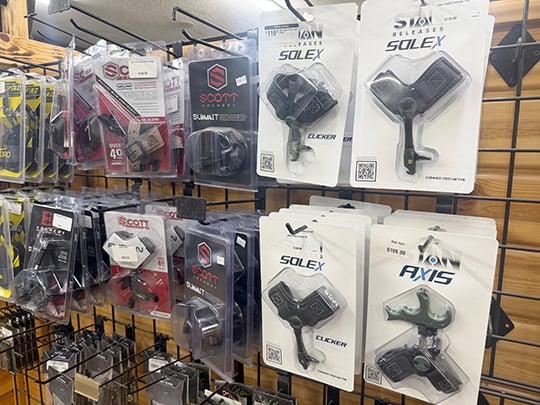
There are four main styles of releases from which to choose.
Index finger: These are attached to a wrist strap and activated by pulling a trigger with your index finger.
Popular in the hunting space and with new archers.
Thumb button: A popular handheld release for hunting and target archery; the trigger is activated with the thumb instead of the index finger.
Hinge: The release operates without a physical trigger as archers rotate their hand to fire the release (more common in target archery or training).
Resistance: These releases use a safety while drawing the bow that prevents it from firing prematurely. Once anchored in, the safety is released and the archer pulls through the shot, applying resistance to fire the arrow at a set pulling weight.
There are hundreds of releases from which to choose, so how do you narrow the field?
“Honestly, for a hunter getting a first release, I would go with a wrist-strap index finger,” Reilly said. “That’s going to be the simplest one. I think thumb buttons, any of the handhelds, I’d like to see somebody have some experience first.”
Reilly said that for two reasons. One, activating a trigger with an index finger is similar to firing a gun, and most people understand that concept well.
“Then the wrist strap helps you draw the bow,” Reilly said. “With a handheld, the whole weight of the bow is on your fingers. With a wrist strap, you’re using your arm.”
Brandon Looman, manager of the Archery Country bow shop in Waite Park, Minn., said most hunters they see are choosing between an index finger or thumb button. With a high-end price of around $200, index finger releases are less expensive than top-of-the-line thumb buttons, which will cost $250 to $350.
“If you’re not willing to spend that much, my recommendation is to just stay in a wrist strap then,” Looman said. “Usually your $100 handhelds are on the sloppier side. You don’t have as much adjustment capabilities. The parts and components aren’t as good, so they’re usually sloppier with more (trigger) travel. Any time you have a release that has more travel and it’s sloppier, that typically will lead to more punching or flinching on the trigger.”
What features matter?
The amount of travel in the trigger refers to the distance the trigger moves before the release fires. Trigger tension is the amount of force required to activate it.
Some people who focus on working their way through the movement that leads to the arrow firing may want some travel in the trigger. Many don’t want to feel any movement.
“I want no travel,” Reilly said. “When I press on it, I want that thing to go. Then I like some adjustment in the amount of tension that it takes. I like a little bit more tension. I don’t want that trigger super hot. Your fingers get cold while hunting and bad things can happen.”
MORE GEAR COVERAGE FROM OUTDOOR NEWS:
Gear review: First impressions of the Carbon Synergy climbing sticks from Latitude Outdoors
A beginner’s guide to building your own hunting arrows
Anglers rediscover vintage fishing gear
Many top-end releases allow for fine-scale adjustments that allow archers to set the trigger exactly how they want it by experimenting.
“A lot of (what you’re paying for with a high-end release) are better parts, better durability, but more than that you’re getting more adjustment within the trigger,” Looman said. “So your sensitivity, your travel. You could adjust the travel right out of that thing so there’s no travel, or you can put travel into it and really fine-tune it perfectly for you.”
Reilly also wants a release that attaches easily to the D-loop while hunting.
“Some of the thumb button releases you have to actually pinch the jaws with your fingers to get it to close,” he said. “I don’t want to mess with that when I’m bowhunting. I want something simple where you get the jaws at the D-loop and you push a button and they close on it or something that’s fairly simple to connect to the D-loop.”
Jaws on a release are either spring loaded or operate off a sear to open. Spring-loaded releases tend to be less expensive, but Reilly prefers the consistency of a sear release with a single jaw.
“You can have a double jaw where both jaws move,” he said. “I don’t like those because through time one jaw can move differently from the other, which is going to create different releases of the D-loop. With a single jaw that closes against a solid post, your D-loop is coming off that solid post the same way every time. With the spring-loaded release, there is travel before that jaw opens enough to release the D-loop. With the sear, I take all the travel out and as soon as you apply the right amount of pressure, it just flies open. It’s more consistent.”
Find your fit
Like Reilly, Looman emphasized that archers should shoot a release that fits them.
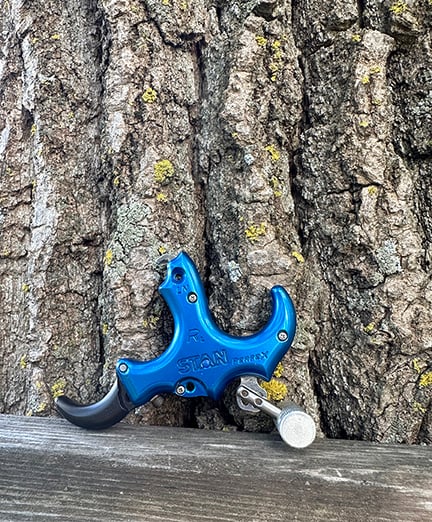
He encourages customers to try multiple releases – thumb and index fingers. He follows the same approach when testing new releases by shooting them at about 5 yards, where his focus is on what the release feels like in his hand.
“Some of it for me is the actual trigger itself,” Looman said. “You’ll see some of these triggers have a straight trigger, some are curled back a little bit, and a lot of it is how your finger fits into that trigger. When I shoot a wrist strap, I’m in my second knuckle on my index finger. I’m really burying my finger, wrapping that thing way around so I can keep it locked there and then I just pull instead of manipulation with my finger.”
The tip of the index finger is incredibly sensitive, and that can become an issue. It’s fairly common to see archers shoot with the trigger positioned above the knuckle near the tip. Over time, this can lead to flinching and punching the trigger in anticipation of the shot going off.
Positioning the trigger in a less sensitive area deeper on the index finger like Looman does can help alleviate that, but the tendency to punch the trigger with an index finger is also why some archers switch to a thumb-button release.
“It’s one of the slowest moving fingers you have,” Looman said. “With your thumb, most people will control the trigger in a more proper way because it’s a less sensitive finger. So activating with a thumb is less punchy, less anxiety typically than your index finger.”
Some thumb button releases allow for complete adjustment, not just in trigger travel and tension settings, but also with multiple-sized trigger barrels, finger extensions (two-, three-, four-finger options), and the ability to set the height, angle, and tilt of the trigger.
“That’s one of the biggest advantages of spending the higher-end money, whether it’s a wrist-strap or a handheld,” Looman said. “Yeah it’s a more durable release, a better feeling release, but you have way more adjustment to make it perfect for you.”
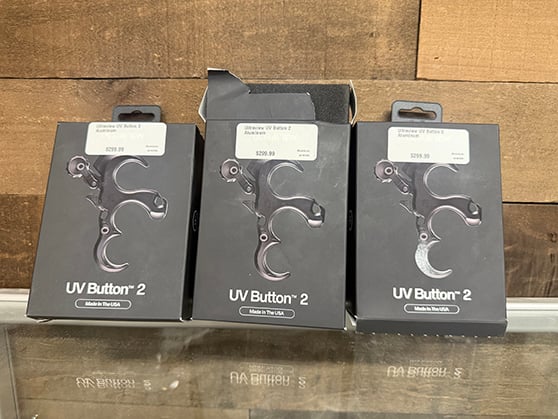
Some of their favorite releases
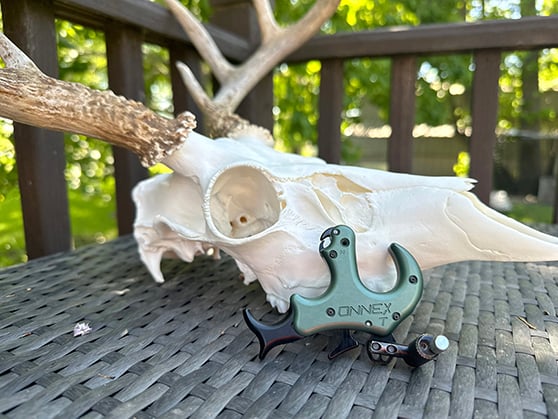
Looman said three thumb button releases stand out to him right now: The Stan OnneX, Stan SX4, and Ultraview Button 2.
“With the Stan OnneX, when you buy that one, you’re getting a two-finger release, a three-finger and four-finger all in one. You get all the parts and pieces with it so you can choose what you want,” he said. “You get a big barrel and small barrel. You get a different length stem. That’s our go-to here because you can really make it into anything you’d want.”
Looman said a good budget-friendly index-finger release is the Tru-Fire Hardcore 2.0.
“It’s (less than $100) and it comes with multiple triggers, so you have a straighter trigger and a more curled trigger,” he said. “That’s a really good release. Spot Hogg Wiseguy is a good one, and then the Stan SoleX is the one we probably sell the most of.”
The Stan SoleX and OnneX also come in clicker models. These were developed in collaboration with Joel Turner of Shot-IQ and are designed to reinforce a controlled shot process for archers who want the deliberate feedback of an audible “click” before the release fires.
Reilly will use the T.R.U. Ball Execute V2 index finger as his primary hunting release this fall.
“I think that’s the best index finger release on the market right now,” he said. “The double sear, the weight of the head, the fact you can get this (trigger) fairly heavy, just how I like it. Just real precision in a release that some of the best target archers in the world think enough of that they’re using it in competition.”
Reilly has almost a dozen release aids that he owns and encourages archers to experiment with different releases to really understand what works best for them.

Pennsylvania’s hunting license sales down so far this year
Hunting license sales are down nearly 4.5% at the end of August, although Pennsylvania Game Commission officials believe there is
Origin of road-killed armadillo in southwest Ohio a mystery
An armadillo found as roadkill in southwest Ohio has researchers scratching their collective heads wondering from where the non-native mammal

Bowhunt gets started in Ohio with additional opportunity in CWD surveillance area
Hunters in Ohio’s chronic wasting disease (CWD) surveillance area have additional dates this season to pursue white-tailed deer. The Ohio
