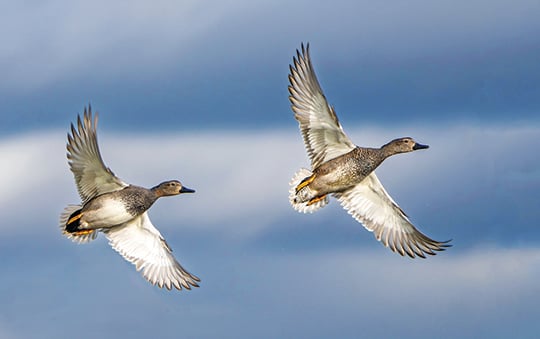
"We believe this proposal is an attempt, and not an effective one, to increase duck hunter numbers – with no science backing it," writes the authors. (Stock photo)
Commentary by Dave Rave and Ray Norrgard / Duck Summit Work Group
The Minnesota DNR is proposing a new, optional three-duck bag limit that would allow hunters to harvest three ducks of any species daily. The Duck Summit Group has discussed this proposal, and most of our members oppose this option.
The goal of the Duck Summit (DS) back in March was to have waterfowl professionals discuss regulations, and then participants were surveyed on their support of possible regulation changes. The overwhelming majority of DS participants supported eliminating September duck seasons, moving the regular opener to October 1, and reducing the hen mallard bag to one. This three-duck bag proposal does none of these, while increasing the hen mallard bag from two to three.
At the DS there was a talk about Adaptive Harvest Management. AHM uses complicated mathematical models based on duck breeding populations and other biologic variables to determine annual waterfowl regulations. This is how restrictive bags on hen mallards, canvasbacks, redheads, and scaup are determined.
After 27 years of AHM, the DNR is offering a “new” bag limit – three ducks including any of these restricted birds. What happened to the models, and why is it now “OK” for some hunters to shoot a limit of three restricted birds while everyone else is limited to two?
Nate Huck, DNR migratory game-bird consultant, said, “Duck identification can be difficult and could prevent potential hunters from getting into waterfowl hunting.”
The DNR is thus proposing this three-bird bag as an attempt to recruit new hunters. This is a worthy goal, but where is the science behind this proposal, when we have been told for years that AHM’s models scientifically keep populations healthy by restricting harvest?
This is particularly troubling in Minnesota, where our duck populations are at all-time lows. We believe this proposal does nothing to maintain local duck populations and may actually hurt them. Very few Minnesota hunters shoot more than three ducks in a hunt, so decreasing the bag from six to three will not save ducks.
However, this regulation might encourage hunters to shoot hens, as there will be no consequence to shooting hen mallards, and thus could increase hen harvest.
RELATED VIDEO FROM OUTDOOR NEWS:
We also believe this new proposal may remove much of the history and skill from the sport of duck hunting. By reducing the limit to a straight three-bird “splash” limit, duck identification skills would no longer be needed.
Hunters would not need to identify ducks in hand – never mind in the air. This proposal turns ducks into nothing more than targets, in part because there would be no consequences to shooting ducks in darkness or fog, when many hunters might otherwise pass ducks because they cannot identify them.
Additionally, some hunters might use a combination of three-bird and six-bird limits to increase their daily bag on restricted species. For example, a four-hunter group – two with three-bird limits and two with regular limits – could shoot 10 hen mallards, or 8 scaup (even when scaup limits are 1), or go to Thief Lake and take 10 redheads, plus another 8 additional ducks.
Technically, every hunter is supposed to shoot their own birds, but we all know this is not reality. Further, when hunters do not need to know what they are shooting, non-game birds like grebes and loons will be shot.
We believe this proposal is an attempt, and not an effective one, to increase duck hunter numbers – with no science backing it. It won’t work. The only way to increase duck hunter numbers is to increase duck numbers in the fall. Regulations that allow or encourage more hens to be shot won’t accomplish that goal, which should be the DNR’s primary concern.
This piece represents the views of the Duck Summit Work Group, including the authors.
SUBSCRIBER CONTENT
Read this article now. Create a free Outdoor News account.
Create a free account below to get instant access to this article, thousands of Outdoor News stories, and our digital editions. Your 1-month trial starts the moment you sign up.
In order to help the duck populations in MN the DNR needs to go back to reasonable seasons. No youth hunt. No teal season. No early goose season. Have a single season and start in October like it used to be. These early seasons ans special hunts just drive the ducks out early. Also seasons such as early teal just cause confusion and hunters shooting everything.
Sign up for the Outdoor News Weekly Newsletter and get 2 months of FREE access to OutdoorNews.com – packed with hunting, fishing, and conservation news. No Catch.
This offer includes digital access only (not the printed edition)
PLEASE READ
Accessing Your Full Subscription Just Got Easier. Introducing Single Sign On.
We’ve simplified things. Now you only need one password to access all your Outdoor News digital content.
Here’s how it works:
Click Continue below.
You’ll be taken to the OutdoorNews.com sign-in screen.
Don’t have an account yet? Create one—it’s quick!
After signing in, click the E-Edition Login button again. When the pop-up appears, just click Continue.
You’ll either:
Land on the e-edition selection screen (you’re in!)
Be sent to a help page if we didn’t detect a subscription.
If you hit the help page, follow the directions so you don’t miss out on any of our great content.
We know you love the outdoors—now we want to make OutdoorNews.com the ultimate destination for all things hunting, fishing, and conservation.
Take our brief 3 minute survey to share your thoughts, and help us build the best outdoor website on the planet. As a thank you, we’ll send you a special offer!
Together, we can make OutdoorNews.com even better.
For a limited time, you can get full access to breaking news, all original Outdoor News stories and updates from the entire Great Lakes Region and beyond, the most up-to-date fishing & hunting reports, lake maps, photo & video galleries, the latest gear, wild game cooking tips and recipes, fishing & hunting tips from pros and experts, bonus web content and much, much more, all on your smartphone, tablet or desktop For just a buck per month!
Some restrictions apply. Not valid with other promotions. $1 per month for 6 months (you will be billed $6) and then your subscription will renew at standard subscription rates. For more information see Terms and Conditions. This offer only applies to OutdoorNews.com and not for any Outdoor News print subscriptions. Offer valid thru 3/31/23.





2 thoughts on “Commentary: Three-bird duck proposal doesn’t address Minnesota’s bigger waterfowling issues”
In order to help the duck populations in MN the DNR needs to go back to reasonable seasons. No youth hunt. No teal season. No early goose season. Have a single season and start in October like it used to be. These early seasons ans special hunts just drive the ducks out early. Also seasons such as early teal just cause confusion and hunters shooting everything.
No thanks, gramps