




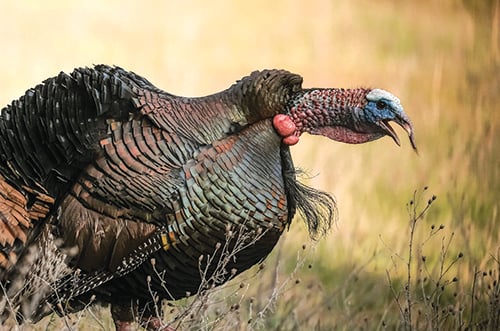
The story of the wild turkey in Minnesota and at a national level is an amazing tale, but is also an often frustrating story to watch unfold.
That was my initial thought after talking with DNR Upland Gamebird Consultant Roy Churchwell about Minnesota possibly increasing its bag limit to two birds during the spring season, at least for areas where the best bird numbers exist.
 Twenty-nine turkeys from Missouri were released into southeast Minnesota’s Houston County in the early 1970s. Aided by additional releases, turkeys can now be found all over the state.
I grew up in southwest Minnesota and never saw turkeys in the 1990s. By around 2015, bird numbers had exploded along the river bottoms.
Gobbles rang out from every direction as I hunted in central Minnesota last spring. I pulled the trigger an hour into the opener and thought about a great hunt at a time when talk about turkeys on a national level focuses on declining populations, especially in the southeast U.S.
Even in Minnesota, questions exist about birds in some areas.
“Southeastern Minnesota for a while did very well,” said Dr. Andrew Gregory, who grew up on a farm near Mazeppa. “We’re not as certain they have as many turkeys down there as they used to. Some have suggested that the populations in those original strongholds have kind of started to diminish.”
Gregory, an assistant professor in conservation biology and landscape ecology at the University of North Texas, is leading new research in Minnesota on turkeys tagged from the Three Rivers Park District in Hennepin County.
“I don’t think we want a one-size-fits-all prescription,” Gregory said about a two-bird limit in Minnesota. “That’s the takeaway with everything I’ve seen over the years in the different states and the different management approaches. We should be cognizant of what the local population can hold. Maybe different zones should have different limits put in place.”
Agreed. There are places in Minnesota that could support a two-bird limit in the spring when only male birds are shot. But things can change quickly with turkey populations.
“I can recall hunts two decades ago where there were so many birds gobbling in so many different directions, I didn’t know where to go,” said Dr. Michael Chamberlain, one of the country’s leading turkey researchers, during an interview last fall. “Now you will not find that situation across 99% of the southeastern United States.”
MORE TURKEY COVERAGE FROM OUTDOOR NEWS:
Ohio’s South Zone spring turkey season gets a little later start this year; here’s why
Know the kill zone with your gobbler gun
Copycat and cover calling can close the deal on spring gobblers
Some have attempted to draw the link between declining hen survival and the population declines being observed.
“The overwhelming body of research across the past two decades has pointed to poor recruitment being the primary driver of the declines,” Chamberlain told me recently. “We recently completed an analysis using nearly a decade of data clearly showing that increases in female survival would fail to reverse declines in a population we’ve been studying. Rather, improvements to poult-per-hen ratios were found to be the way to reverse such declines.”
In some areas, it’s a small percentage of hens that successfully produce poults. Habitat degradation, disease, predation, untimely weather events – many factors impact recruitment.
I’m on board with a two-bird limit in Minnesota, but with some guardrails. Don’t allow two birds to be shot on the same day. Maybe a second bird could only be shot during a later hunt period.
We also have to implement a method for watching turkeys closely across the state. Currently, the DNR does not have a great way to monitor population trends.
Churchwell said the agency is focused on changing that. Part of future turkey research that Gregory hopes to lead across Minnesota (this still needs funding to move forward) would assess the efficacy of different monitoring protocols across different landscapes.
“There are about four survey methods we’re going to be testing out and seeing if there’s a more regional efficacy for some, which one is best and most cost effective overall,” Gregory said.
Minnesota is currently a model of what’s working when it comes to turkeys. Let’s enjoy the moment as hunters while also being proactive to maintain or even improve on status quo.
“Seek ways to conserve habitats to ensure the persistence of these areas that turkeys are thriving in,” Chamberlain said last fall. “Do what you can to make sure that landscape is conserved. If it’s not, you could be where we are in the South pretty quickly.”
Bait sites versus food plots: Michigan study helps assess deer disease risks
The Michigan Natural Resources Commission spent time at its October meeting reviewing research on deer behavior at bait sites and
Star Watch: Naming the moon’s craters
What would you have to do to get a crater on the Moon named after you? First you would have
Michigan DNR seeks CWD samples from five counties
Michigan wildlife officials are asking deer hunters in five southwestern Lower Peninsula counties to help determine whether chronic wasting disease

10 thoughts on “Another View: A two-bird bag limit for Minnesota spring turkeys? A bit of caution advised”
Leave well enough alone. The state has a good thing going. Don’t screw the turkey bag limited up. One turkey is enough. All it takes is too have a disease or bad snow storms.
If nobody asked for it don’t pass it! It would be just like the rifles in the slug zone.Nobody asked for it so they got a baffoon Governor to pass it.Nobody knows the laws or who will enforce them.
I for one was sure as hell asking for the rifle seer season it was a joke that we were the only state out of all the shotgun only states that hadn’t gone to either rifle or strait wall calibers
I can varmint hunt with a rifle in the slug zone – why shouldn’t a hunter be allowed the same firearm during deer season?
That’s not true Iowa is a shot gun only state . Also parts of Ohio is also among a few others .it’s not so much about what’s better for killing a deer like that is the main reason . No they need think about the heavily populated areas . And all the careless hunters now days . Where I hunt there is no one else . But on the other side of the valley is private and state land and it sounds like a damn war going on over there during gun hunting . Not some where I want to be around if there all using rifles. Nor any gun as far as that goes. Wreckles hunters.
For one there’s not hundreds of hunters at that time like deer hunting . I look at like this if you have problem s killing a deer with a shot gun then how do you think a rifle would think a rifle would be any different. I have hunted with both and I can say I have dropped more deer with a slug then a rifle . Every one I shot with rifle except one I had to put another round in them .
One shotgun tag and one bow tag?
Why does the DNR build public shooting ranges instead of funding private clubs? Almost every state has free, DNR built, public shooting ranges. The Target Practice and Marksmanship Training Support Act (H.R. 1222) amends the Pittman-Robertson Wildlife Restoration Act to facilitate the construction and expansion of public target ranges. It increases federal funding flexibility, allowing states to use more Pittman-Robertson funds (up to 90%) for range development. That means it only costs the DNR 10% of the total build cost. It is almost free to build. What is the DNR doing?
Excellent comment. Strong facts supporting your opinion and providing a solution to a problem we have in MN.
Private ranges get busy prior to season openers but hardly reflect the population participating. Range congestion, range fees, busy fall, whatever the reason may be many people annually dial in weapons every fall on unsuitable public land vs privately owned ranges. Without a designated area and proper backdrops safely limiting the bullet flight from people illegally sighting in weapons(rifles cartridges or shotgun slugs) on public land its amazing more people aren’t injured. Somehow more than once Ive had several hot rounds zip by goosebump close while bowhunting from people sighting in on public land. In camouflage perched in a tree I wouldn’t expect to be seen. Getting down and trying to get out of the area while people are actively shooting is scarier than just keeping the tree trunk between the shooters and myself best I can. We definitely could use a few safe designated public ranges throughout our great sportsperson friendly Minnesota. Just my 69 cents worth of opinion.
I would like to keep the limit to one bird. Some areas have higher bird populations but that doesn’t mean we should increase harvest. Plus, the number of hunters from out of state is growing. If we increased the limit to two, these hunters would flock to Minnesota in groups and work hard to fill all of their tags. It’s happening in Wisconsin now. I don’t want that to happen here. I am happy with one bird a year. Let’s keep the limit to one bird.