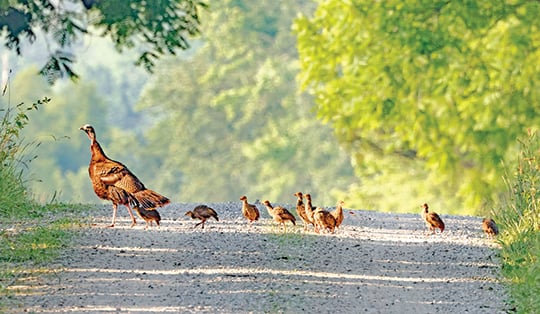
Lansing — Turkey hens pay the price for keeping the ecology ball rolling, so to speak.
A recently published study on female wild turkeys shows how different stages of reproduction influence the survival of hens and what that means for the long-term health of turkey populations.
One of the most interesting findings from the study is that hen survival rates appear relatively strong, even in areas where productivity has declined. This leads some scientists to believe that current population challenges may be driven more by nest success and poult survival than by adult hen mortality.
The research is based on a decade of data from GPS-tagged birds. To understand how reproduction affects survival, researchers monitored 942 female wild turkeys between 2014 and 2023 across study sites in Louisiana, Georgia, and South Carolina.
Each bird was fitted with a GPS transmitter that recorded movements throughout the breeding season. Researchers then tracked survival and reproductive behavior during the most critical months of the year, from March through August.
Scientists evaluated survival across several reproductive stages: egg laying, incubation, brood-rearing, and periods when hens were not actively reproducing.
MORE TURKEY COVERAGE FROM OUTDOOR NEWS:
Copycat and cover calling can close the deal on spring gobblers
Wild turkey hunting’s great debate: How much calling is too much calling?
Up your consistency with these turkey decoying tips
The research revealed that hens actively engaged in reproduction had slightly lower survival rates than hens that were not nesting or raising poults.
Across the breeding season, reproductively active hens had about 67 to 69% survival while non-reproductive hens had about 76% survival.
In other words, hens investing energy into nesting and raising poults faced greater mortality risk.
A hen spends long periods on the ground incubating eggs, often remaining on the nest overnight for weeks. This behavior reduces movement and increases vulnerability to predators.
Researchers found that daily survival rates were lowest while hens were incubating nests, and the risk increased as incubation progressed.
Toward the end of the roughly four-week incubation period, hens become increasingly committed to the nest, spending more time sitting on eggs and taking fewer breaks.
Biologists believe this reflects a behavioral strategy sometimes called “terminal investment.” As hatching approaches, hens are less willing to abandon the nest, even when risk increases.
Survival costs associated with brood-rearing, particularly during the first two weeks after hatching, were high, too. Wild turkey poults cannot fly for about two weeks. During that time hens must roost on the ground with their poults and must constantly move to find insects and food.
Whether renesting affects survival is another aspect of the look at turkey hens. Wild turkeys often attempt another nest if the first fails. But each attempt requires more energy and exposes the hen to predators again. The study found that hens making multiple nesting attempts tended to have slightly lower survival, reinforcing the idea that reproductive effort carries cumulative costs.
Wild turkey populations in many parts of the country have experienced declines in productivity over the past two decades, with fewer poults surviving each year. Understanding how reproduction affects hen survival helps biologists answer critical questions about the importance of improving nesting and brood habitat.
“This study shows that reproduction does carry survival costs for hens, but it also reminds us that adult female survival in these populations remains relatively strong for a ground-nesting bird,” said Patrick Wightman, NWTF director of research. “That suggests improving nest success and poult survival may be just as important as adult survival when it comes to sustaining turkey populations.”