




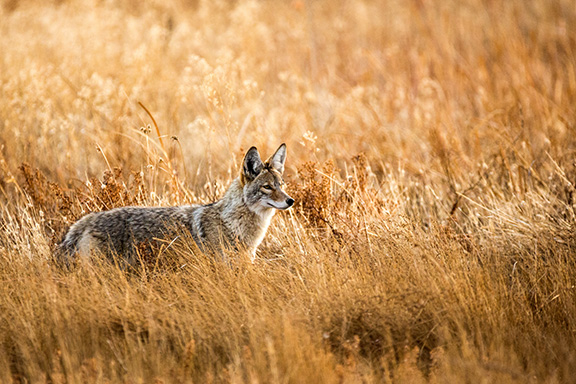
South Dakota’s wildlife management commission has voted to end the state’s nest predator trapping program and replace it with a youth-only program and a separate coyote bounty, after lawmakers again raised concerns with the original program.
The Nest Predator Bounty Program, funded by license dollars, paid $10 per tail for raccoons, skunks, badgers, opossums, and red foxes during the upland bird nesting season.
 Public comments opposing the program, however, have poured in since its 2019 inception, with critics arguing that it is cruel, unproven scientifically, and a poor use of licensing funds.
Sen. Tim Reed, R-Brookings, sponsored a bill this legislative session that would have barred the state from paying bounties for animals taken for nest-predation control, effectively ending the Nest Predator Bounty Program.
But the Senate Agriculture and Natural Resources Committee defeated Reed’s bill, arguing the issue would be better addressed through the South Dakota Game, Fish, and Parks Commission.
Senators suggested refocusing the program on youth, reducing spending, and reallocating funds toward habitat improvements. The committee discussed sending the wildlife commission a letter laying out its suggested changes, but Sen. Tom Pischke, R-Dell Rapids, who chairs the committee, said that did not happen because the commission already had acted.
The March 3 letter said the committee wanted the program limited to children 17 and younger, capped at 25 tails per child, and cut from about $500,000 to $250,000.
MORE COVERAGE FROM OUTDOOR NEWS:
Talk of a two-bird limit for Minnesota’s spring turkey season taking place
Big event for Minnesota waterfowlers as Duck Summit is set for March 27-28
The commission’s March resolution rescinds its 2023 approval of the Nest Predator Bounty Program through 2026. In its place, the state will run a “Youth Trapping Recruitment Program” from March 1 to July 1 for residents aged 17 and younger, paying $10 per tail for raccoons, skunks, badgers, opossums, and red foxes, with a cap of $200,000. Adults will no longer be paid for nest predator tails.
The commission also created a “Coyote Bounty Program” for all residents from April 1 to July 1. It will pay $30 per tail, capped at $300,000, with the department saying the change keeps the overall effort within the existing $500,000 budget while shifting more of the focus toward youth recruitment and coyote control.
Reed called the South Dakota Game, Fish and Parks Commission’s changes “a good start.”
Pischke said he can’t speak on behalf of the entire Senate committee, “but I do appreciate the changes.”
Advocates of ending the program are less appreciative.

George Vandel, vice president of the South Dakota Wildlife Federation and a retired state wildlife biologist, testified in favor of Reed’s bill.
Vandel said the wildlife commission handled the change with too little transparency. He said the coyote bounty was presented as an informational item – rather than an administrative proposal – then approved as a resolution without meaningful public notice or public comment, despite involving $500,000 in licensing dollars.
Vandel said the state wildlife commission was the proper place to address the issue, but his broader objection remains unchanged. He said bounty programs, whether for youth engagement or for coyotes exclusively, do not reduce predator numbers enough to meaningfully boost wildlife populations.
“Bounty programs can’t work, never will work, and are basically a total waste of money,” Vandel said.
Vandel said the new coyote and youth engagement bounties are still “a total waste of money” and argued the state is still spending public wildlife dollars on an approach he considers biologically unjustified.
Game, Fish, and Parks leaders have defended predator removal as beneficial at the local level and said the Nest Predator Bounty Program was successful in engaging youth in trapping.
In total, 342,743 nest predators have been removed since the original bounty program’s inception.
GFP Commission meeting
The S.D. Game, Fish and Parks Commission held its March meeting at the State Library in Pierre on March 5-6. Among topics finalized were:
• The commission created a “No Wake Zone” on Iron Creek Lake in Lawrence County. Iron Creek Lake is a 24-acre impoundment, and the no wake zone will address safety, user conflict, and shoreline erosion concerns.
• The commission removed refuge status from Lake Albert Waterfowl Refuge. The Lake Albert Waterfowl Refuge was comprised of private property owned by eight landowners. The landowners formally requested that their property be removed from the waterfowl refuge status and provided signed consents to remove their property. Removing refuge status means landowner control over hunting access on their property will be restored.

Way less land for hunting spurs action from Pennsylvania Game Commission
The Pennsylvania Game Commission has overhauled its Hunter Access Program this year in an effort to boost declining landowner participation
Where do big bucks go when they vanish?
Over the course of our three-months-plus bowhunting season, seeing just one wall-hanger buck can be cause for celebration. Trophy proportioned
WI Daily Update: Tips for catching cohos on river mouths of Superior
This is a great time of year to chase coho salmon on the river mouths on Lake Superior. Tim Lesmeister
