




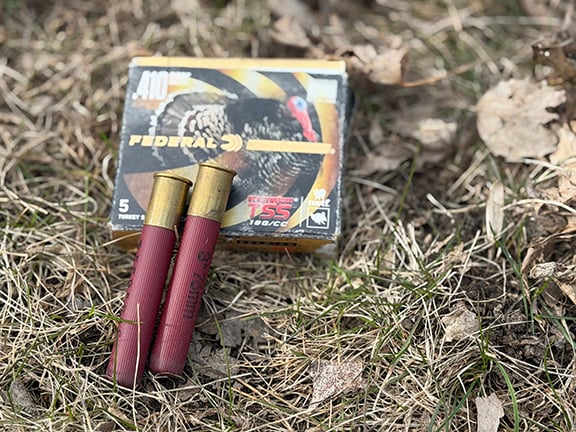
The Minnesota and federal governments are debating lead ammo and fishing tackle again. The state Senate Environment committee held an informational hearing on the topic on March 5.
Still available at the committee’s webpage, there are no fewer than 19 documents that nonprofits and other citizens filed as testimony for and against regulating lead. Read them here, then scroll to the March 5 hearing. You can click a link there to watch the hearing, too.
 Meanwhile, in the U.S. Congress, the House approved legislation last Wednesday to protect the use of lead ammunition and fish tackle on public lands and waters. House Resolution 556, the “Protecting Access for Hunters and Anglers Act,” authored by Rep. Robert Wittman (R-Va.), would prevent rulemaking to prohibit lead bullets, fishing hooks, and other related tools on certain federal lands.
That bill passed 215-202, with seven Democrats voting in favor and one Republican (from Pennsylvania) voting against. All four Minnesota Republican reps supported the bill; all four Minnesota Democrats voted against.
Bill authors say federal agencies are imposing restrictions on lead through administrative rule. The Obama and Biden administrations indeed previously advocated for limiting lead ammo and tackle on wildlife refuges. The bill’s language includes exceptions allowing lead regulations if federal agencies can prove that lead from ammo or fishing tackle is the primary cause of wildlife population declines in a specific area.
Regulations could move forward if the state’s fish and wildlife agency approves. Gun groups support the legislation, and environmental-leaning groups oppose it.
MORE COVERAGE FROM MINNESOTA OUTDOOR NEWS:
Roy Churchwell brings experiences from West to role as Minnesota DNR’s upland gamebird consultant
Gun legislation, northeast elk reintroduction stew at Minnesota Capitol
Latest Minnesota moose survey shows increase from 2025
For decades, I’ve seen every argument for and against lead. My default has remained consistent. Lead is a neurotoxin. Greek and Roman writers knew that during the Classical age, and modern science has recognized that fact for 150 years.
Lead and living tissue simply don’t mix. For that reason, I generally support the notion that we should be phasing it out, and I don’t want lead residue in wild game I serve my family. My bird hunting uses exclusively nontoxics, and my copper bullets ensure that no eagle or other scavenger will pick up lead from my whitetail gutpile. Those are personal choices, ones that I hope more hunters will choose.
RELATED COMMENTARY:
Ryan Rothstein: Why I switched to copper (and steel) ammunition
Where population-level effects exist for a species, I believe lead bans are fair game. The feds made the right decision banning lead for waterfowl hunting decades ago. If the southwestern United States is going to have California condors, hunters can’t be leaving gutpiles with chunks of lead in them.
But should that argument extend to eagles? In my lifetime, we’ve seen a remarkable recovery of bald eagles, and I believe it’s wrong to use an expanding species like bald eagles as a poster child to support a lead bullet ban.
Julia Ponder, the former director of the U of M’s Raptor Center, who testified on March 5, debated that point with me by phone a couple weeks ago. She doesn’t believe we have strong enough eagle census data to declare definitely that bald eagle populations are rapidly expanding.
She doesn’t believe that eagles are in trouble right now, but worries that immunosuppression from lead exposure compounded with other issues like avian flu could create population-level problems long term. The tipping point to push a species into decline is lower than people realize, she said, and lead in the environment is a factor that our society can control.
The sporting community has supported a gradual-phase-out of lead as consumers choose nontoxic alternatives. I support that, but in my career, I’ve observed that regulation ultimately moves the needle on this issue. Hunters need to demand cheaper nontoxics, then actually buy them. Otherwise, our dwindling numbers may hold less sway when the next lead shot ban hits the Legislature.
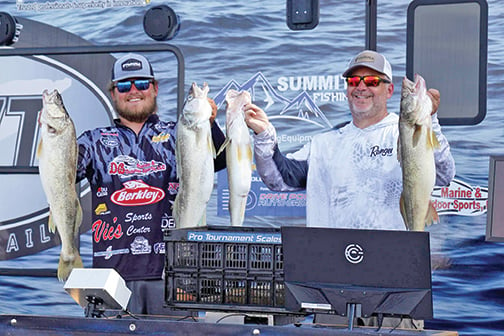
Fall is the perfect time to catch Lake Erie’s giant walleyes; here’s what to focus on
Anglers who are prepared to face some colder weather can catch lunker walleyes. For the past decade, walleye fishing derbies
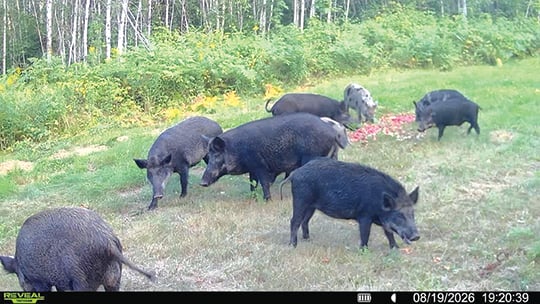
Upper Peninsula landowner provides evidence feral pigs have established there
A population of feral pigs that escaped from a game farm have become established in southern Marquette County, based on
Big waterfront project in Lorain, Ohio, to benefit anglers
When the Hot Waters Boat Launch reopened in the City of Lorain on May 22, it was just one milestone
