St. Paul — The northeast Minnesota moose population remains stable, holding near similar levels recorded in recent years. The latest 2026 survey estimates 4,470 moose, an 11% increase from last year.
“It’s certainly not a bad sign, especially after what we saw from 2009 to 2013; you don’t want to see that sharp drop like that,” said Seth Goreham, wildlife research manager. “When you start seeing a population that’s stabilizing, you’re saying, ‘We’re doing something OK.’ Or at least we’re not doing something that’s damaging a population. Of course we would like to see that start to increase, but stabilizing is not a bad thing.”
The agency says that results suggest that after a steep decline from a population estimate of 8,000 in 2009, Minnesota’s moose population appears to have somewhat leveled.
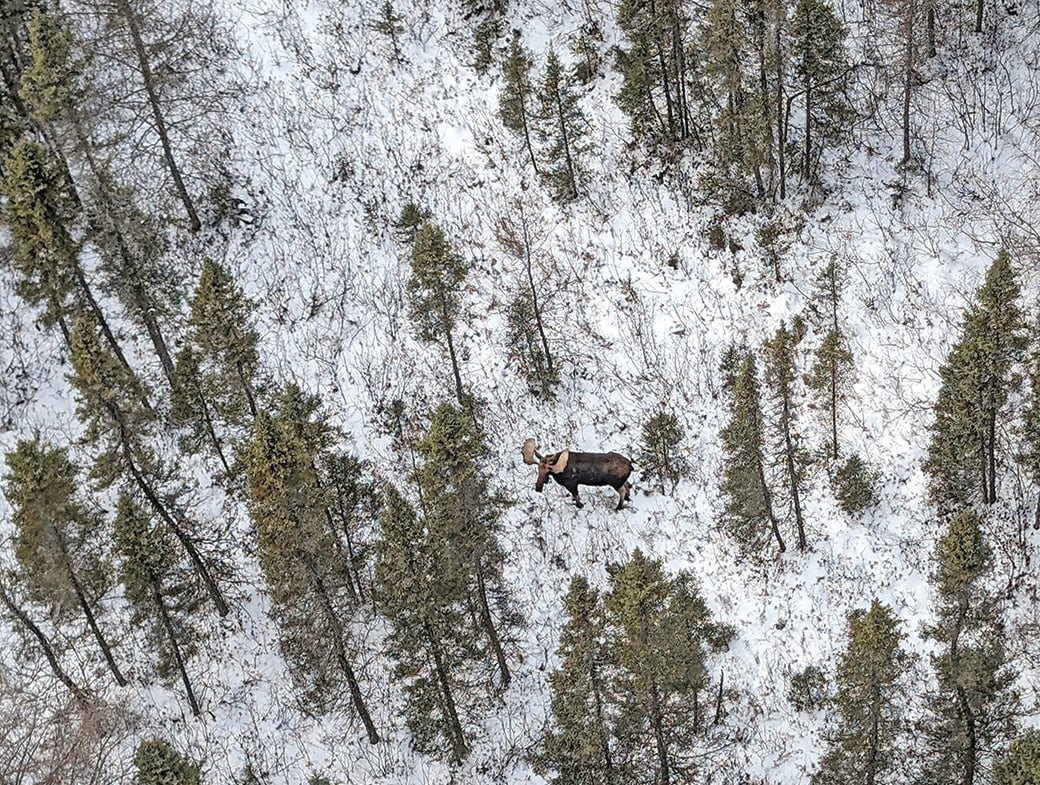
The DNR conducted the 2026 survey in collaboration with pilots and Fond du Lac tribal biologists from Jan. 7 to Jan. 29. Crews flew helicopters 200 to 300 feet above ground across survey plots over a dense forest canopy. At least 8 inches of snow is needed for accurate counts; this year, 45 of 53 plots met that threshold – 90%-plus of the study area.
Observers counted 358 moose, averaging 8.6 moose per occupied plot.
RELATED STORY:
Study of juvenile moose set to begin in northeast Minnesota this winter
Researchers are testing infrared cameras mounted on fixed-wing aircraft to improve visibility beneath the forest canopy. While promising, the technology remains a few years away from full, accurate use in surveys.
Biologists continue to study calf survival, a key factor in long-term population growth. While adult cows remain in good condition, calf survival rates remain low. The calf-to-cow ratio rose slightly to 0.44, up from 0.41 last year.
In partnership with the 1854 Treaty Authority and the Grand Portage Band, the DNR is collaring adult and juvenile moose to better understand survival rates and causes of mortality. Researchers also aim to determine whether current calf survival rates can support population growth.
MORE COVERAGE FROM MINNESOTA OUTDOOR NEWS:
Gun legislation, northeast elk reintroduction stew at Minnesota Capitol
Roy Churchwell brings experiences from West to role as Minnesota DNR’s upland gamebird consultant
Minnesota’s spring sturgeon fishing offers a crack at the fish of a lifetime
Crews aimed to collar 80 juveniles born last spring and successfully collared 60 – 22 males and 38 females.
“There’s a big information gap on young nine-month to 3-year-old cows on when they first reproduce, when they calve, their calving success, how long they stay with the moms, things like that,” Goreham said. “It can help us get into land management and what’s the best habitat we need to be aiming for if we want to succeed and grow their population.”
The multi-year study began last year. Researchers will monitor collared moose this spring to track calving and plan to capture and collar more animals next winter.
The survey is available on the Minnesota DNR’s moose management webpage.