





Stream trout anglers are largely creatures of habit.
I say largely because there are exceptions to every rule. Still, the stream trout anglers I’ve fished with and learned from over the years adhere to a very strict angling script, with little or no coloring outside the lines.

They fish certain streams, and certain runs from those certain streams, over and over again. Ditto for hatches on those streams. Ditto for fly selection during those hatches. Many even take the same trips year after year, repeating all of the above. Success, after all, breeds routine.
On most occasions, fishing so-called pocket water isn’t part of the plan. Fishing traditional longer runs – with riffles and pools – is preferred.
“Pocket water often gets passed over, but it shouldn’t,” said Carl Haensel, of Duluth, Minn., a fly-fishing guide who focuses primarily on waters along Minnesota’s North Shore and in northern Wisconsin. “It’s fishing in faster water. It’s fishing with a lot of current. It’s a little more complicated than fishing, say, slower-moving spring creeks with textbook riffles and runs. Pocket water is often lightly fished. When everything else is getting hammered, pocket water offers some opportunity. That’s why you shouldn’t pass it up.”
TROUT COVERAGE FROM OUTDOOR NEWS:
Trout season opening day still a big deal for many Pennsylvania anglers
Michigan fly-fishing school has the blueprint after 55 years of teaching
Trout anglers loving the fishing experience Pennsylvania’s Little Juniata River has to offer
Definition
What is pocket water? Here’s one definition: Pocket water is an area where a stream’s current is impacted by boulders, logs and other objects to create fast, turbulent current as well as soft, calmer “pockets” of where trout readily position themselves in order to feed more efficiently. Think of each pocket as a miniature pool, which can vary in size, for example, based on the size of the boulder creating the pocket. Some pockets are as big as a basketball, while others are as big as a small car.
“You can find pocket water on streams and rivers across the world,” said Haensel, author of Fly Fishing Minnesota. “Pocket water is readily available in mountain streams, on some larger western rivers, in the freestone streams where I guide a lot along the North Shore of Minnesota, and in spring creeks everywhere in varying degrees.”
As a young angler as well as a newly minted fly-fishing guide, Haensel learned that he always had an ace in the hole with pocket water when traditional riffles and runs didn’t produce fish.
“I learned that pocket water, which can vary greatly based on the depth and velocity of stream and the size of the boulders, is a place where I could always put clients on fish. Those spots just doesn’t get hit as hard.”
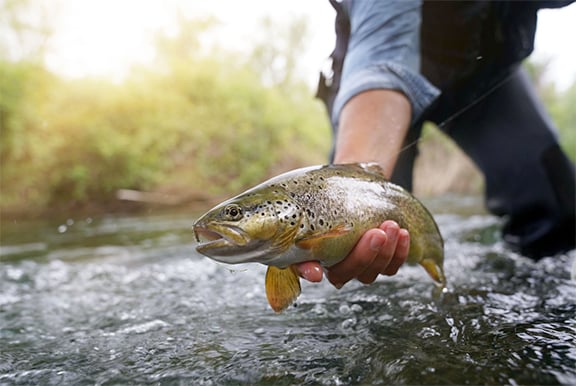
Reading water
Like all stream-trout fishing, reading water well is key, though doing so can present significant challenges for novices. That’s especially true in rivers with what guides call “boulder gardens.”
Loosely translated, those are runs with multiple boulders, which can make reading that water vexing. Most guides and experienced pocket water anglers say fly fishermen should survey the scene before they jump into the water and start casting. Especially in reaches with boulder gardens, guides say to break the river into smaller sections.
Find the current breaks and/or seams between fast and slower moving water and visualize casting in those soft areas. For an easier explanation, think of a stream run with a single protruding boulder. Trout will hold in front of, on each side of, and a couple feet behind each bolder. Trout prefer these lies because they provide a steady supply of food.
“They want to expend as little energy as possible,” said Haensel of feeding trout. “They stay out of the current as a way to rest and wait for food to be delivered to them. Since the water is fast and often choppy around the pocket, trout feel safe from predators because they’re harder to see. As a result, they often eat with abandon.”
Proper presentation
Successful angling in pocket water requires precise casting and a drag-free drift. You want your fly to drift as naturally as possible – just like the real thing.
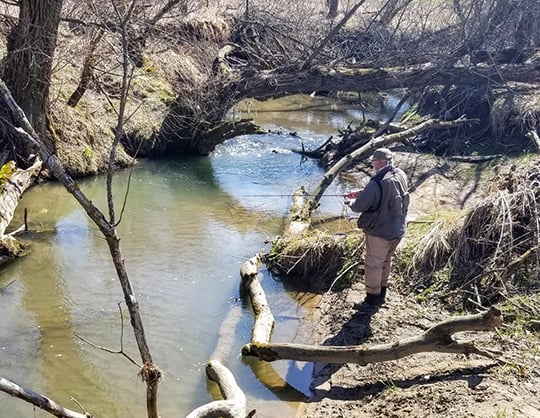
In many cases, the fast water and current surrounding a pocket will catch your fly, sucking it under. That’s just part of doing business. That’s why Haensel often has his clients wade as closely to a boulder as possible before casting. He says shorter, more precise casts are preferable to longer, cinematic casts.
“I say get close; if you spook a few fish doing that, that’s OK,” Haensel said. “You want casts that are as accurate as possible, and that generally means shorter casts.”
Most guides recommend shorter leaders (7 feet, give or take) and more sturdy tippet material. Flies, or combinations of flies (using a dry fly with a nymph dropper is common), vary. Fly selection is less important because you’re most often not fishing a specific hatch. Many anglers use larger dry-fly patterns so they can more easily see the fly. When you cast, hold the rod tip high (keeping the fly line and leader out of the water as much as possible to prevent drag) and watch as it moves through the pocket.
“The presentation is key,” said Haensel, echoing other experienced pocket water anglers. “Strikes happen fast and you have to react quickly. It can be an exhilarating way to fish.”
Smallie pockets?
Fishing pocket water isn’t the exclusive domain of trout anglers, however. Other fish, like smallmouth bass, can be caught, at least occasionally and often adjacent to traditional “pockets” that trout use to target insects and other food.
“As a rule, smallmouths don’t sit and feed like trout do,” said Tim Landwehr, owner of Tight Lines Fly Fishing Company in De Pere, Wis. “They roam. They hunt. They target. But occasionally it can happen, especially on the softer edge water.”
Landwehr, co-author of Smallmouth: Modern Fly-Fishing Methods, Tactics and Techniques, said most smallmouth waters he fishes in Wisconsin – deeper-running rivers, generally speaking – don’t have classic pocket water. However, he has at least one river that he guides on that has trout and smallmouth bass. Pocket water, too.
“You won’t find smallmouths in the fast water,” he said. “You’ll find smallies in the slack water near pocket water often closer to a stream bank. In those situations, they can be very aggressive.”
Conclusion
If you’re new to fishing pocket water and want to learn, the online world is your friend.
YouTube is littered with how-to videos, some better than others. Many are produced by guides and/or fly shop owners and provide visual learning tools that words in a story are hard to compete with.
Perhaps the best way to first learn how to identify pocket water and then properly fish it is to hire a guide or find a mentor who can teach you the basics of the craft. But at some point, you have to match wits with the water and do it on your own.
Indeed, one of the glories of fly fishing for trout is coming to a stream with a baseline of knowledge and putting it into practice. Failure is inevitable; fishing pocket water can be a riddle wrapped in a mystery inside an enigma. But you will learn, and success is as sweet as honey.
That builds confidence. But you’ll never get there unless you throw away the creature-of-habit script, color outside the lines and give it a try.
Reach Tori J. McCormick at torimccormick33@gmail.com.
Minnesota DNR working to fix bug in mobile app by Oct. 4
Thanks to a recent update to the Electronic Licensing System from vendor PayIt Outdoors, the Minnesota DNR’s new mobile licensing
First deer for 22-year-old archer is a rarity in Minnesota — a 10-pointer still in velvet
Passionate Minnesota bowhunters often travel out of state to kickstart their deer season because of the opportunity to shoot a
Michigan DNR asks public to report sick deer as EHD surfaces
Michigan’s archery deer season opened Oct. 1 with some questions about the state’s deer herd.
The DNR has noted
