Outdoor News may earn revenue from products shown on this page by participating in affiliate programs. This comes at no extra cost to you. Click here to learn more.
I was rooting around the cabinet where I store some of my hunting equipment and discovered boxes of rifled slugs and turkey loads. The sabot rifle slugs are leftovers from the day when only shotguns were legal for hunting deer in the Southern Tier of New York; the turkey loads are another story.
As a long-time turkey hunter, I’m always on the lookout for ways to increase my success, and the evolution of loads specifically designed for hunting turkeys rank at the top of my list. I have loads with pellets made of different materials that allow the ethical taking of turkeys at extended ranges, and in my experience, they are all good, but loads with pellets made of Tungsten Super Shot (TSS) may be the best of the lot.
It’s the high density of the pellet material that makes TSS more lethal at longer ranges, and it allows hunters to drop a shot size to increase the number of pellets in the load, thus producing tighter patterns. Additionally, TSS shot delivers more pellet energy and deeper pellet penetration on birds as large as a tom turkey.
MORE TURKEY COVERAGE FROM OUTDOOR NEWS:
Despite dip from 2025, Minnesota turkey hunters on pace for top-three harvest
The best turkey tip I ever got…
Looking for a late-season longbeard? Better understand the diverse diet of turkeys
As good as this material is for dropping a big tom, it does have its downside, and that’s price. I’ve seen it priced as high as $131.99 for five rounds and, and that’s before tax. For the mathematically challenged, that comes out to more than $28.00 per shot!
Shells containing TSS shot are expensive due to the high cost of raw, imported tungsten, significant import tariffs, and high manufacturing costs. Because their extreme density allows for a smaller shot size and denser patterns at longer range, there is a high demand for limited supplies. Fortunately, in my opinion, there are alternatives, and they kill turkeys just as dead.
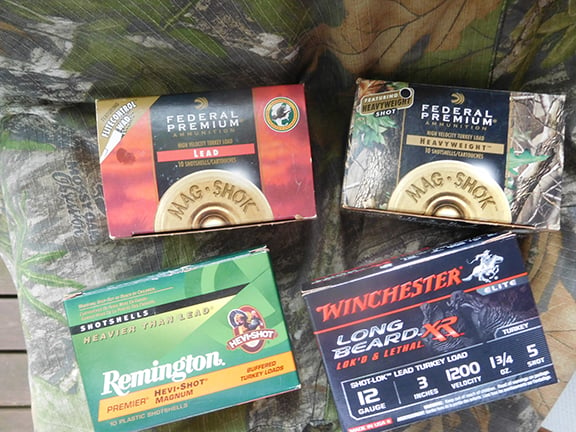
For the budget-minded, Federal offers its Premium Grand Slam Copper Plated turkey ammunition that leaves the muzzle at a blazing 1300 feet per second, while Remington offers hunters its Premier Magnum Hevi-Shot 12-gauge loads that push 2 ounces of number 6 shot downrange at over 1200 feet per second.
I’ve been using Winchester’s 12-gauge Longbeard XR ammunition for the past several seasons because I was impressed with how it performed out of my Remington 870. I had the original 870 barrel cut down to make it easier to navigate thick cover and had it fitted with a Briley screw-in extra-full turkey choke.
I found that the Longbeard XR ammunition offered really tight patterns at ranges of 45 yards. A hardened resin fully encapsulates the shot pellets and disintegrates after the shot, enabling the pellets to leave the barrel perfectly round.
Pellets that aren’t deformed by passage through the barrel fly truer and produce an extremely tight downrange pattern. The nice part of these loads is that they offer the knockdown power of the heavier-than-lead loads at a fraction of the price of TSS.
With the number of new loads designed specifically for hunting turkeys, some may wonder which loads are best. My advice is to use the load that patterns the best from your particular shotgun.
It may be a good idea to tie in with several turkey hunting friends and buy different brands of ammunition with various shot size to see firsthand which loads offer the tightest pattern at a given range.
Any brand of ammunition will drop a turkey dead in its tracks as long as the bird is in range of the effective shot pattern. The key is to know the maximum range of the shells you choose to use.