




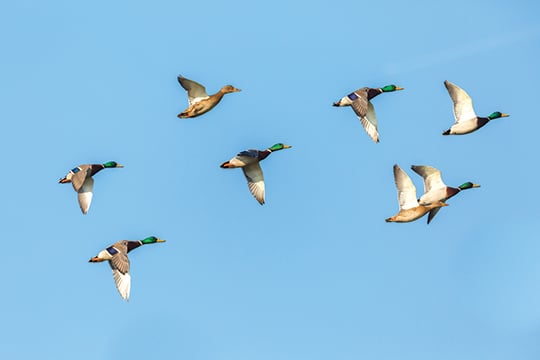
Madison — Wisconsin’s duck and goose hunters now know the potential hunting season regulations for the next five years; yet unknown is what the regulation framework from the U.S. Fish and Wildlife Service (USFWS) will be for each of those years.
At the Natural Resources Board’s (NRB) April 15 meeting, the members approved most of a proposed emergency rule from the Department of Natural Resources (DNR) that includes options for season lengths and bag limits for 2026 through 2030. Taylor Finger, DNR migratory bird specialist, said this will eliminate the need for the DNR to come to the NRB with emergency rule proposals every year.
The DNR must submit its selection for regulations by May 1.
“We’ve structured a rule that allows us to incorporate all the bag limit options for a 30-day or 45-day (or 60-day) hypothetical season, that could change at a federal level,” Finger said.
Finger said the DNR had “unanimous support” from its partners for the proposal.
The DNR proposed three changes from the past:
• The Mississippi River Canada goose season will revert from opening on Sept. 16 to the historically opener, and now will open with the duck season.
• The season has been 60 days long since 1997; however, the rule includes options for 30-day and 45-day seasons if that is only what is offered by USFWS. This would apply for each of the three duck zones (north, south, and open water).
• Eliminate concealment regulations for waterfowl hunting when hunting further than 3 feet from shore. Currently hunters need at least 50% concealment by natural, rooted vegetation when viewed from one direction.
Finger said that several partner groups, the Wisconsin Waterfowl Association, Conservation Congress, and Wisconsin Wildlife Federation got together and spurred the request to eliminate this rule, which would help remove enforcement questions.
What is controversial about this proposal is that it would allow open-water hunting on most lakes (excluding the Mississippi River and Lake Michigan) throughout the state. Finger said that a literature review showed that unless the lake does not allow boats to go through, these open-water areas do not function as a refuge.
Finger outlined many opportunities the public had to provide input on regulation proposals.
MORE WATERFOWL COVERAGE FROM OUTDOOR NEWS:
Commentary: Conservation beyond the balance sheet
Minnesota’s waterfowl season frameworks take shape for this fall
Pennsylvania expected to remove conservation order season for light geese in spring ’27
Public concerns
Twelve persons commented on the regulations, three in favor and nine against, with elimination of the concealment regulation drawing controversy. People hadn’t realized that not requiring concealment would allow open-water hunting on most lakes throughout the state.
Conservation Congress Migratory Committee Chair Mike Britton, Wisconsin Waterfowl Association’s Brad Heidel, and Cody Kamrowski, of the Wisconsin Wildlife Federation, spoke in favor. Britton said the committee vote on eliminating the concealment rule was close, but was approved. Heidel said WWA supported simplifying the concealment regulation, but removing it from the emergency rule.
“Put that through a longer process with more public input,” Heidel said.
Linn Duesterbeck, of Fort Atkinson, Mark Meyer of Milton, Tad and Jeri Shumaker of Koshkonong, Jim Ramos, of Barneveld, Charlie Kisow, of the Carcajou Shooting club of Lake Koshkonong, Rick Persson of Fort Atkinson, John Richter of Sayner, and Rick Wachowiak of Muskego all opposed the change that would allow open-water hunting.
Wachowiak said increasing access for hunters is good, but open-water hunting will disenfranchise those who hunt shorelines, as people hunting from boats will be right out in front. He quoted Finger’s comments that open-water hunting on the Mississippi River is not allowed because biologists didn’t want to move the canvasbacks out. That is exactly what would happen on the lake that Wachowiak hunts.
He said the proposal needs more input from fishermen, birders and lakeshore owners to have a balance on use of the resource.
Duesterbeck said he was from a family of three generations of duck hunters, and he strongly opposed the rule.
“I have researched their minutes and the words open-water hunting have not been used,” Duesterbeck said. He said the rule did not involve enough public involvement.
Tad Schumaker said he is an avid hunter, but hunting on open water will harass birds, which will move away.
Ramos, an avid waterfowler, said the words “open water” was not used in the proposals. He is concerned birds will not have rest areas to keep them in the vicinity for other hunters.
“There is more to waterfowling than killing ducks,” Ramos said.
Richter has hunted ducks over decoys for 65 years. He urged opening the proposal to a broader audience.

Board member Bill Smith had questions over elimination of the concealment requirement, but Finger said the water is a public resource and there was no reason to keep the regulation for concealment on the books.
Finger said hunters still need to be 100 yards from an occupied dwelling, and there was 70% support for the proposed rule.
Smith said that he heard “loud and clear some of the concerns of riparian property owners.”
DNR law enforcement added that simplification is easier for wardens and hunters, but the DNR Bureau of Law Enforcement did not request the change.
NRB member Robin Schmidt said that it was more of a cultural issue than a biological issue.
Smith said he was uncomfortable that many people said they had not had enough input and people were surprised by the change in open water hunting that was being rammed through. Smith made a motion to remove the concealment portion of the emergency rule, and encouraged the DNR to take the concealment issue out to get more input from the public.
The board unanimously approved removal of the concealment language (thus keeping the current concealment rule when hunting more than 3 feet from shore and not expanding open-water hunting other than where it is already allowed), and the remainder of the emergency rule was approved.
Ralph Loos: Michigan’s reliable hunting traditions got an update (upgrade?) this season
More than any other collection of like-minded individuals, hunters tend to get stuck in their ways — and I say

Findlay Reservoirs support walleyes and saugeyes in northwest Ohio
An angler could do much worse than the pair of reservoirs at Findlay in northwest Ohio.
The latest offering
Ohio’s Outdoor Calendar
A look at upcoming outdoor-related events from across Ohio published in the Sept. 22, 2026 edition of Outdoor News.
