




Home » Home Page News » Should we leave wakeboats in our wake in Minnesota?
Should we leave wakeboats in our wake in Minnesota?
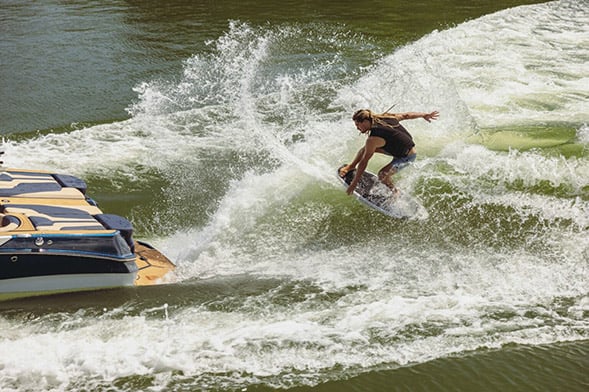
I recently viewed a disturbing video by scientists Jeff Marr and Andy Riesgraf from the University of Minnesota. They studied the effects of wakeboats on aquatic ecosystems, concentrating on Lake Minnetonka in the Twin Cities west metro.
In case you weren’t sure (because every boat leaves a wake), a wakeboat is, as its name suggests, a large, heavy boat that sits deeper in the water than the average boat, and creates a large wake for those wanting to “surf” behind it – known as “wake sports.” In fact, you don’t even need a tow rope once underway; you can surf along in the wake produced by the boat.
The U of M video (watch it below) chronicled the ecological and environmental damage done by these boats to aquatic ecosystems, homes to the fish that are sought by the 1.5 million people who buy Minnesota fishing licenses each year.
RELATED STORY FROM OUTDOOR NEWS:
Minnesota study shows importance of using wakeboats in water deeper than 20 feet
Many of us are unaware of the variety and complexity of life beneath the water’s surface, a sort of out-of-sight, out-of-mind issue. But we have only to consider the effects of high winds on forests (condolences to Bemidji) to realize that life beneath the water’s surface is also vulnerable to both natural events and man-made influences. Especially vulnerable is the lake bottom, a key component of the aquatic food web.
Although a “normal” boat going too fast in shallow water disturbs the bottom, a wake boat does this times 10.
Marr and Riesgraf studied the effects of seven different types of power boats. The researchers showed that when wakeboats were driven over underwater cameras and monitors placed 14 feet deep, the boats left a wide swath of disturbance, whereas a power boat on plane had very little effect.
A wakeboat produces pressure waves, bubbles from the exhaust, and propeller wash – all of which stir up the bottom and disrupt invertebrates, fish nests, plant life, and enhance the release of phosphorous, which worsens algal blooms. These pleasure craft are not friends of the lake bottom ecosystem.
Sponsors of wakeboats suggest their effects on lake health are minimal, especially at depths of 14 feet or greater, and that wakeboats increase oxygen mixing – although lake scientists consider the latter a minimal benefit at best, far outweighed by the negative effects.
MORE COVERAGE FROM MINNESOTA OUTDOOR NEWS:
Minnesota’s deer harvest surpasses state’s total from 2024; Wisconsin also ahead of last year’s pace
Frigid weather aiding formation of ice for eager anglers across Minnesota
Keep it Clean grants awarded to Minnesota soil and water conservation districts
In a 2022 scientific study by Endicott Fay and colleagues in the Journal of Water Resource and Protection, it claims that wakeboats are safe at depths of 10 feet and 200 feet or more away from shore (a U of M previous study stated 500 feet), and that wakeboats should be no-wake in shallower depths.
Good luck with that. In my opinion, people do not estimate distances on water all too well. My wife sees two boats approaching one another a half-mile away and thinks a collision is imminent.
Contrary to industry-backed claims, the U of MN report suggests that wakeboats are only “safe” at depths of 20 feet or more. They also acknowledge that all boats can damage the lake bottom: I’ll slow down in shallow water.
Possibly the most dramatic negative effect of a wakeboat passing overhead, Marr and Riesgraf showed that finer bottom sediments stirred up by the wakeboats were still not resettled for up to an hour after the boat passed. This can’t be good for lake health.
With any scientific study comes the question of whether the authors have any conflicts of interest. Fay and colleagues are employees of Cotty Fay Marine Design, Inc., and Mercury Marine. Their funding came from National Marine Manufacturers Association.
A quick look at the funder’s website reveals that, “NMMA is a unifying force and powerful voice for the recreational boating industry, working to strengthen and grow boating and protect the interests of its member companies.”
I will not accuse the authors of doing anything but reporting what they thought were valid inferences from their study. But I wondered about NMMA’s concern for environmental impacts on our lakes, so I did a bit of digging.
In Fay and colleagues’ paper (“Numerical study of the impact of wake surfing on inland bodies of water”) I searched for the words “vegetation,” “aquatic,” “invertebrate,” “fish,” “ecosystem,” “environment,” and found nothing.
Instead, as the title implies, the article is about the physics of waves produced by wakeboats, with lots of equations (if that’s your thing) but nothing about ecological and environmental effects of wakeboats. It is fair to ask where the findings of the U of M and other researchers are leading.
In Minnesota, property owners voted to ban wakeboats on Caribou Lake in Cook County. And there is movement to ban wakeboats on small and shallow lakes, and parts of the Mississippi River.
I’d vote in favor of banning them on “my” lake, Leech Lake, as the entire part of the lake where I reside is 20 feet or less.
I don’t envy Minnesota DNR personnel who are tasked with considering how, or if, to regulate things we do to our celebrated lakes, like forward-facing sonar, aquatic vegetation removal, muskie stocking, and walleye harvest. Now, add wakeboats.
Because we regulate where things such as off-road vehicles can be operated, it seems like we should have and enforce some strict rules about wakeboats. The evidence seems unambiguous that wakeboats are detrimental to lake health.
SUBSCRIBER CONTENT
Read this article now.
Create a free Outdoor News account.
Create a free account below to get instant access to this article, thousands of Outdoor News stories, and our digital editions. Your 1-month trial starts the moment you sign up.
No credit card required
No credit card required
Subscriber? Login Here.
Share on Social
Hand-Picked For You
Pennsylvania Mixed Bag: Docks removed early at Lake Wallenpaupack
Pennsylvania’s hunting license sales down so far this year
EHD in Michigan’s deer herd concentrated to four counties so far
Michigan’s statewide fishing and hunting report on Sept. 18, 2026
Partnerships help preserve public lands, habitat for Minnesota’s prairie chickens
Dan Small Outdoors Radio: Show 2138
Related Articles

Pennsylvania Mixed Bag: Docks removed early at Lake Wallenpaupack
The Pennsylvania Fish & Boat Commission recently announced that public boat docks at the Mangan Cove Access on Lake Wallenpaupack,
EHD in Michigan’s deer herd concentrated to four counties so far
The Michigan DNR has confirmed epizootic hemorrhagic disease in four counties so far in 2026, with plenty more tests pending

Dan Small Outdoors Radio: Show 2138
Indiana hunter scores a huge black bear in northern Wisconsin. Jeff heads to Cass Lake, Minn. for a Masters Walleye

3 thoughts on “Should we leave wakeboats in our wake in Minnesota?”
Not only are the below water and shoreline impacts an issue but wake boats also negatively impact recreational users on the surface. I have to slow down to a crawl every time I encounter a wake from one of these boats or risk getting pounded…I can only imagine what canoes and kayaks have to deal with, not to mention paddle boards. Seems like we are giving up a lot for a very few…I would favor banning them on Lake Minnetonka as there is no way to adequately enforce speed, depth, or location violations out on the lake on a consistent basis. If you want to get behind a boat on the water, then ski. Enough already with these out of control behemoths.
Bass shoreline fishing in my 18′ Lund Alaskan and had a wakeboat pass in the middle of a decent sized lake and still got my boat rocked aggressively side to side.
I would say it should have been done a long time ago. They should have them in certain large lakes away from others nothing good happens when you see one loud music and no understanding of space could have the hole lake and yet they have to drive right next to ya. It’s clear if you don’t want erosion or bottoms of lakes disrupted there’s got to be a change.