





The days of steel hang-on treestands and screw-in steps are mostly long gone. Today’s deer hunter is far more likely to climb into a cushy ladder stand, or set up in a cozy box blind.
While our setups have gotten more comfortable, they have also become far less mobile. This is one of the reasons food plots are so popular. After all, if you can’t move to the deer, you should move the deer to you.
But you can move to the deer, you just need the right mobile setup. Fortunately, the go-to-them wave has swept across the archery scene, and quality offerings are widely available.
Featherweight stands
If you want the lightest option on the market for parking your butt in a tree all day in November, you can’t do better than a tree saddle.
They aren’t for everyone, though, and for a couple pounds more you can hang a stand. There are options on the market that weigh from about six to 10 pounds, but there are some sacrifices to be made.
First off, they aren’t cheap. The kinds of materials needed to lighten up treestands cost a lot more, whether that’s carbon fiber or aluminum. There will also generally be a lot less material to go around, meaning don’t expect to have a ton of room on your stand platform.
These are purpose-built stands, with the goal being that you should be able to carry them in anywhere, and set them up very quietly.
MORE WHITETAIL COVERAGE FROM OUTDOOR NEWS:
Should you shoot single-bevel broadheads? Here’s what to consider
The evolution of the amazing .308 family of hunting rounds
While they might run you upwards of $250 to $300, these stands are generally made to last. If you take care of them, they’ll give you a mobile advantage for many, many seasons. You’ll also notice, that a lot of them allow for multiple leveling options, can be outfitted to attach your climbing sticks for ease in carrying, and are designed with the task in mind.
Lightweight stands are generally thought of as a tool best used by the hang-and-bang public land bowhunting crowd, but there are plenty of use-cases for them.
Maybe you want to set up with a youngster, so that you can observe them but don’t want to haul in a double ladder stand. Maybe you feel you’ve burned out your go-to spots on your lease, and want to look over a few areas you generally ignore, but have a good feeling about.
Or maybe you’re heading out on your first out-of-state hunt, and you need to be able to get in quietly and set up in a new tree every day.
Whatever the reason, the market has you covered, but you’ll also need to consider climbing sticks.
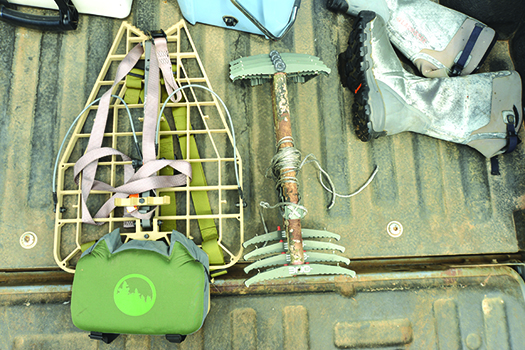
(Nearly) weightless ascent
When you look at the climbing stick category, you can find everything from small carbon-fiber options (affiliate link) to steel beasts that could be used as boat anchors. Obviously if you’re going the lightweight stand route, you’re going to want to keep your sticks manageable, otherwise what’s the point?
Again, just like with stands, the materials used in climbing sticks make all of the difference. There are a few carbon-fiber options on the market that weigh around a pound or two per stick. That means you can get to deer killing height for no more than about eight pounds of gear. Add in a similar weighted stand, and you’re still under the overall weight of a lot of the stand options on the market.
The thing is, carbon fiber sticks are expensive. They are an investment, but they last forever, and are so easy to set up it’s almost like cheating. Some of them can be modified with aiders, which reduces the need for as many sticks. This can cut down on costs, but isn’t for everyone.
Worth It?
The thing about putting together a really good mobile setup is it’s hard to understand how convenient and quiet it will be – until you use it.
Strapping your entire setup to a daypack and carrying it a half-mile in without feeling the burn in your traps is amazing. It’s when you start to hang them that the investment really seems worth it, however.
Maneuvering lightweight sticks and a stand into place, adjusting them, and generally doing what you need to in order to set up super quietly, can be a nightmare with heavier gear. This is when the value of this type of setup really shows, and it’ll be worth every penny, even if you haven’t quite recovered from the sticker shock of the initial purchase.

Stockings boost angling rebirth at Lake Le-Aqua-Na in northwest Illinois
Recent DNR surveys and stocking efforts offer a snapshot of ongoing efforts to boost Lake Le-Aqua-Na a handful of years
Wisconsin Buck & Bear Club president has ideas for growth
The Wisconsin Buck & Bear Club has a new president, with Ben Tilberg filling the role, following the long tenure
Wisconsin fishing-lure maker, Greg Nimmer, carves his own niche
What the heck is a Wolly-Pog? Its creator, Greg Nimmer, isn’t even sure.
To some, it’s an effective topwater
