




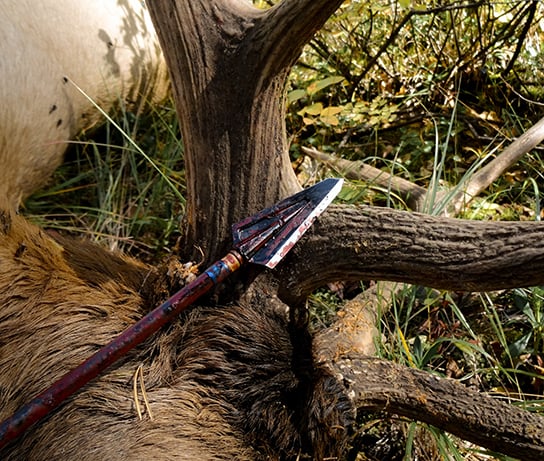
It’d been a frustrating start to the whitetail rut in 2024, but anyone who has hunted long enough knows that fortunes can change quickly in November.
Time in the woods pays off. That’s what I was telling myself on the morning of Nov. 14 when setting up in a tree adjacent to a thick bedding area where multiple trails converge. About 10 a.m., a buck trotted out of the bedding area and went directly to a scrape 15 yards from me.
I drew my bow, settled the pin, and released an arrow that hit its mark. The buck ran about 20 yards, stopped and looked back. Within 15 seconds, it was all over (see video below). No tracking needed.
That kind of reaction had happened in my earlier years of bowhunting on rare occasions, but it has been a much more common occurrence over the past five seasons.
That’s when I switched to using an extremely sharp cut-on-contact single-bevel broadhead. If an arrow is well-placed, deer often die within sight, reacting as if they don’t know what hit them.
“I definitely see really quick kills going through double lungs, and I’m trying to figure out, ‘Man, does a single-bevel make them die faster?’” said Bill Vanderheyden, of Iron Will Outfitters. “Is there more trauma through the lungs? I think that may be a thing, but it’s really hard to prove because no shots are perfectly the same to figure that out.”

Vanderheyden is the owner and chief engineer of Iron Will, which produces single- and double-bevel fixed-blade broadheads. Iron Will heads, along with others on the market, are made with premium steel that helps with overall durability and maintaining a sharp edge all the way through the cut.
“I think having an extremely sharp edge that stays sharp all the way through makes the force to cut so low that (the arrow) zips through that animal really quickly,” Vanderheyden said. “It cuts through so fast that they don’t go very far and look back like, ‘What happened?’ I see that with single- or double-bevels, but that’s been my impression with single-bevels. I have a lot of these shots on film where they’re dead in four to six seconds.”
What exactly is a single-bevel and might it be right for you? Let’s dive into some details.
What to know about single-bevels
Dr. Ed Ashby is the most well-known advocate of single-bevel broadheads. His research can be read in full at the Ashby Bowhunting Foundation website, but here are key features to understand about single-bevel broadheads.
- A single-bevel has a grind on one side of the blade, while the other side is flat to form the cutting edge. This differs from double bevel broadheads that have a grind on both sides of the blade that meet to form the cutting edge.
- What draws many to a single-bevel is that it continues to rotate the arrow as it penetrates. A double bevel stops rotating and cuts straight through as it penetrates.
- Single-bevels come with a right or left bevel. If your arrow has a right helical fletching, get a right bevel broadhead. If you shoot a vane with a left-helical fletch, use a left bevel. Matching the bevel to the arrow’s fletching allows the broadhead to continue rotating through the cut in the same direction the arrow is rotating out of the bow.

What are the benefits?
The benefits of a single-bevel stem from the rotation the pressure on the bevel creates when cutting through an animal.
That rotation can shine in splitting bone and maximizing penetration if you hit hard bone. It also creates large wound channels, doing incredible damage by slicing as it rotates.
Take the time to examine an animal while butchering. You will see that it makes sense why quick kills become common.

“The first time that really stood out to us is my brother, my cousin, and I were doing an elk hunt where we all three killed bulls,” said Tommy Clum, who along with his brother and father, owns Cutthroat Broadheads. “We killed all three of those elk with Cutthroats and none of those elk had any idea they’d been shot. They just stood there… I would be hesitant to say you should expect that every time, but it has been a lot more common than I remember from before.”
The Clum family’s experience with single-bevels started when Tommy was 13 years old and his dad took him and his brother into a traditional archery shop and asked the owner what a good penetrating broadhead would be for his young sons.
“He handed my dad some Grizzly broadheads because they were long and narrow and said these should work,” Clum said. “We had really good luck with those heads.”
Clum has a short draw length and uses a traditional bow. That had him frequently experimenting with many different broadheads over the past 30 years to get the best penetration on big animals.
Clum has settled on an arrow that weighs 550 grains overall with 300 grains up front.
“That has been a dynamite setup for me for elk,” he said. “With penetration always being my No. 1 criteria, on anything elk or bigger it’s been long single-bevel broadheads.”

Eliminating deflection
Where single-bevels have shined for me is in their ability to eliminate deflection.
Too many times over the years there were examples of an arrow deflecting upon hitting ribs, even on close broadside shots. This was clear when examining where the arrow exited, and it bothered me even if an animal died quickly. What if my shot placement would have been a little off? Single-bevels have performed perfectly in eliminating that deflection.
There is no sudden stopping of the arrow’s rotation upon impact, and Vanderheyden believes it also has a lot to do with blade sharpness and durability.
“We see this with both our single-bevel and double-bevel broadheads where the force to cut just stays so low,” he said. “What happens with a lot of broadheads is that force to penetrate is so high that if it hits hide and rib and it doesn’t have a good cut-on-contact (tip), or if things start to bend a little bit, that high force is now going to create deflection.”
Achieving great accuracy
What keeps someone from shooting single-bevels? For some, it’s accuracy concerns with fixed blades.
But accuracy is about more than broadhead choice. It starts with having a well-tuned bow and moves to an individual arrow setup.

“If anyone ever has broadhead flight issues, it’s almost always either their arrow has too weak of a spine or they have too short of a vane,” Bailey Cloud, a technical specialist with Iron Will, once told me. “Those are the two major things I see.”
Shooting a low-profile head can mask some tuning issues in the backyard with better accuracy to the target, but problems can show up in the form of poor penetration or deflection on animals.
“In target archery, only accuracy matters,” Vanderheyden said. “In bow hunting, it’s accuracy and then penetration once you get there. Having great arrow flight is very important.”
My current arrow and bow setup is this:
• Arrows and vanes: Victory Rip TKO arrows in a 300 spine, Iron Will 2.5 vanes.
• Total weight: 500 grains with 210 grains up front (about 17.5% FOC).
• Bow: Bowtech Revolt X with a 63-pound draw weight and 28-inch draw length.
A person’s arrow setup is based on factors such as draw length, the poundage one is pulling, desired FOC and the animal one is hunting. My focus for close shots on whitetails was to create a forgiving setup where I am not as concerned about obtaining crazy high speeds.
Get an arrow testing tool and make sure your arrows and broadheads are spinning true with no wobble. With a well-tuned bow and arrow, I find single-bevels to fly even better than field points. That sounds like hyperbole, but others have seen the same thing.
One theory is that the bevel on the broadhead serves as another steering mechanism in unison with the fletchings. Vanderheyden recently sponsored a University of Colorado study where they tested to see if certain vane designs could improve arrow flight.
“We modeled the double bevel and single-bevel broadheads and looked at the fluid dynamics there,” he said. “You do get a little bit of rotational torque through air with a single-bevel. It’s small compared to how much your vanes are creating the rotation. It doesn’t hurt having that front one to rotate also when the back is driving the rotation with the vanes.”
Edge chatter

The primary concern some have with single-bevels is that the edge has a higher chance of becoming damaged compared to a double bevel of similar steel quality, thus losing some of its sharpness through the cut if it happens.
“With the edge, all the pressure is on one side (as it penetrates) and if you hit something really hard it’s more likely to chip that edge or chatter,” Vanderheyden said.
So does the risk outweigh the reward? That’s up for each individual to decide. Some companies that manufacture single-bevels are confident enough in them to offer lifetime warranties.
“It’s rare enough that I have never seen that happen firsthand,” Clum said of edge chipping, “but because we sell so many broadheads and we offer a no-questions asked warranty in hunting situations, we get some broadheads back from time to time… It’s also part of the reason we went to S7 steel as an option. With the S7 steel, maybe we’ve seen one or two in all the years we’ve offered it. The S7 just doesn’t chip.”
In shooting almost 20 deer over the last five years with single-bevels, I have seen what I would call edge chatter on two occasions. One came when the blade cut through the thick ridge on the front scapula bone, and the other likely happened while burying in the ground. Both deer died very quickly after the arrows had pass-throughs.
Final considerations
Renewed interest in single-bevels has led to more companies producing them, so what should a hunter think about when deciding what head to go with?
Shapes range from short and wide sizes to long and narrow. Some who want to maximize penetration on the largest game animals go the long, narrow route.
I have had great results shooting a wide single-bevel with a bleeder blade (that also has a single-bevel grind) on whitetails. There’s been zero penetration issues with these.

The advantages I have noticed? Huge wound channels, really quick kills and some great blood trails as long as the shot is well-placed.
Both Clum and Vanderheyden spoke about the importance of a durable, cut-on-contact tip. No. 1 on Dr. Ashby’s list of 12 factors that enhance arrow penetration is structural integrity, which applies to every aspect of the arrow. That starts with the tip.
“Even a tiny tip-bend, such as a slight tip curl, results in an average penetration loss of 14%,” Ashby notes from his research.
I use a broadhead with a tanto tip and have never seen any damage.
“If you’re considering single-bevels I think that should be high on the list of consideration is tip design,” Clum said.
Steel quality also matters to me. Some say having a head with premium steel (or even using a single-bevel in general) matters more on big animals like elk, moose or caribou.
I have heard too many stories and watched too many deer hunting videos where an animal is lost due to deflection or little penetration. Bucks in the Upper Midwest are big-bodied animals that deserve similar respect when it comes to these decisions. I don’t risk it.
Premium parts and the manufacturing process are where the high cost comes from for the most expensive broadheads. But what a hunter gets is a single-bevel that minimizes the risk of edge chatter to stay sharp through the cut and a broadhead that is reusable.
Even on the hardest steel, I have had great luck getting heads back to deadly sharp by using the Precision Adjust Elite sharpener from Work Sharp (affiliate link). There is some sticker shock on the initial purchase of a broadhead like this, but the heads can save you money over the long haul, especially if you’re someone who shoots multiple animals a year.
One of the broadheads in my quiver has killed four whitetails and is ready to go for the 2025 season. That’s a broadhead worth a bit of maintenance and every penny put into it.
Dan Small Outdoors Radio: Show 2138
Indiana hunter scores a huge black bear in northern Wisconsin. Jeff heads to Cass Lake, Minn. for a Masters Walleye
Way less land for hunting spurs action from Pennsylvania Game Commission
The Pennsylvania Game Commission has overhauled its Hunter Access Program this year in an effort to boost declining landowner participation
Where do big bucks go when they vanish?
Over the course of our three-months-plus bowhunting season, seeing just one wall-hanger buck can be cause for celebration. Trophy proportioned
