




Editor’s note: The Will County Forest Preserve recently released its first installment of a Wild Science Q&A interview series. In it, we meet Andres Ortega, aquatic resources supervisor for the Forest Preserve District of DuPage County. Ortega is working with Will County staff on an ambitious effort to restore a native mussel species that has vanished from DuPage County waterways.
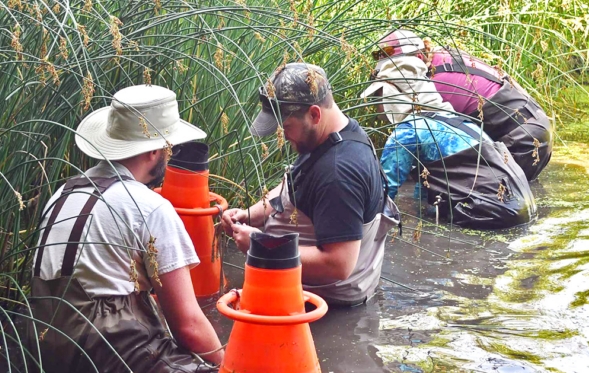
Joliet, Ill. — On a sultry summer day in early July, four forest preserve employees strapped on chest-high waders and gingerly stepped into Spring Creek to search for female mussels that could be pregnant this fall.
They kneeled in the creek and methodically ran their hands through the mud searching for something hard. Sometimes they found rocks, other times, mussels. After the foray was finished, the group netted more than a dozen mussels of several different species.
The hope was to find a specific mussel species that has vanished, scientifically known as extirpated, from DuPage County but is present in Spring Creek in Will County. Those Will County mussels could help restock DuPage County’s creeks via a research collaboration between the two forest preserve districts.
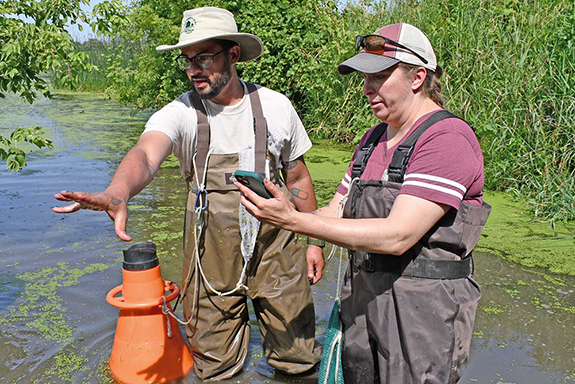
The group searching for mussels included the Forest Preserve District of DuPage County’s Andres Ortega, aquatic resources supervisor, and Jim Intihar, mussel ecologist; and the Forest Preserve District of Will County’s Barbara Sherwood, restoration ecologist, and Becky Blankenship, wildlife ecologist.
Here, Ortega that explains the collaboration and the reasons why it’s important to strengthen mussel populations in area water bodies.
Q: What is the goal of your research project?
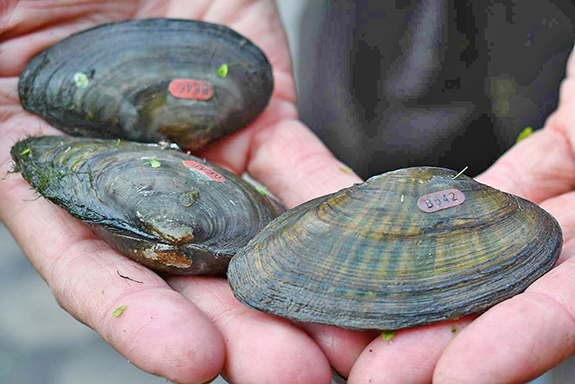
Ortega: Staff at the Forest Preserve District of DuPage County’s Urban Stream Research Center actively propagate native freshwater mussels in our lab, for release in regional waterways. Our goals for these propagations and subsequent releases are to augment currently existing but declining native freshwater mussel populations in the region and reintroduce locally extirpated species. Historically in DuPage County there were 18 known species of freshwater mussels, while only nine are now believed to exist in the county. The other nine, including ellipse, have been extirpated from DuPage County but can still be found in the wider northeastern Illinois region.
MORE COVERAGE FROM ILLINOIS OUTDOOR NEWS:
Ralph Loos: Making deer hunting ‘easier’ strategy is missing a vital piece in Illinois
Challenges facing lesser scaup show restoration needs in Pool 19 of the Mississippi River
Endowment seen as source for Illinois state park funding needs
Q: Why are you surveying mussels in Will County?
Ortega: This July survey in Spring Creek will help us source potential broodstock for a propagation this fall. We are looking to reintroduce ellipse mussels to DuPage County, using genetics from the same Des Plaines River watershed. Since this species no longer exists within DuPage County, we’ve requested a permit from the Forest Preserve District of Will County to collect gravid (pregnant) ellipse mussels, propagate them at our research center, and then release half of the propagated individuals back into Will County and the other half in DuPage County. If the released ellipse mussels survive, this will be the first known reintroduction of an extirpated freshwater mussel species in DuPage County.
Q: How long has this study been taking place?
Ortega: During a similar survey in 2023 in Will County, we collected and propagated gravid cylindrical papershell mussels, a rare species in DuPage County. The survivors of this cohort were released in Will County and DuPage County 2024. A state requirement for released mussels is that they be surveyed twice within a 5-year period post release.
So, while research center staff are on-site searching for gravid ellipse mussels, we also performed a survey of the previously released cylindrical papershell. This survey will help to determine their survivorship and growth after release.
Q: How many mussels did you locate while in Spring Creek in July and what kind were they?
Ortega: We found 13 mussels and a total of five different species. They were two cylindrical papershell, three ellipse, one giant floater, five lilliput and two slippershell.
Q: Did you find enough female ellipse mussels for the fall propagation? If not, what will you do next?
Ortega: We would prefer to find more. While we can, and have, run propagations with only one to two female mussels, we prefer using about five to ensure enough genetic diversity in the propagated juveniles.
We are planning on returning to the site again sometime within the summer to see if we can find the fourth ellipse that we originally tagged as well as new individuals.
If that doesn’t work out, we’re hoping to work with Will County staff to revise our permit and get access into other potential source locations, to get up to five females before the propagation in the fall.
Q: Why are mussels in decline?
Ortega: Likely the most significant for mussels are going to be habitat degradation and declining water quality. What were once clean, meandering streams with runs, riffles, pools, etc., are now very channelized waterways that lack habitat diversity and are very fast moving. This is a hard environment for mussels to survive in. Water quality has also declined throughout the region, often due to anthropogenic factors such as runoff and point source pollution. One of the causes of mussel declines that are more specific to aquatic habitats are dams.
A dam, even a lowhead dam which are common in our area, acts as a significant impediment to the movement of mussels and host fish, and we often find that mussel and fish diversity declines significantly upstream of a dam. The extirpation of species is often due to the issues above, and is most likely to affect more sensitive and less robust species. In DuPage County alone we’ve lost a full half of the species that were historically known to exist here, with only nine of the 18 having populations in the county. Those nine are generally the more robust, more tolerant species that can better withstand poor water conditions.
Q: Why is your work important?
Ortega: All freshwater mussels are critically important to the health and quality of the streams and rivers they exist in.
They are a model organism for providing an ecosystem service. An adult freshwater mussel is thought to be capable of filtering 6-20 gallons of water a day, providing a natural filtration system for our waterways. Unfortunately, all freshwater mussels are in decline, with approximately 50% of all species in Illinois thought to be declining or on the brink of extirpation.
The work we do, including this survey, is intended to reverse these trends.
Outdoor horoscopes for this week
Aries (March 21-April 19): Your urge to charge into the woods at first light is admirable, but the buck you’re after
Bill Hilts, Jr.: Trip on Lake Erie helps remember a friend through a fishing lure
Keeping the memories alive of a friend or loved one is important in the scheme of things when it comes
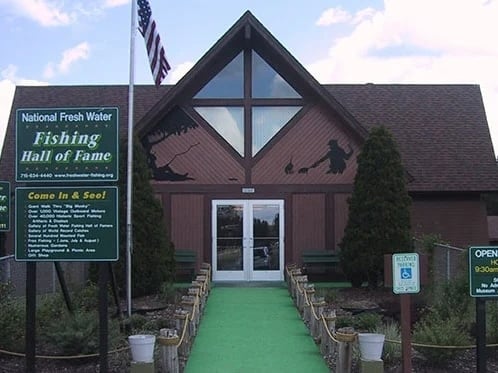
Freshwater Fishing Hall of Fame names class of 2027
The Fresh Water Fishing Hall of Fame, headquartered in Hayward, Wis., has selected seven individuals and one organization to be
