


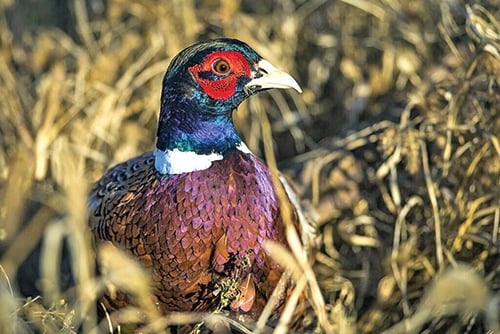
The last month of outdoor affairs in South Dakota included a habitat license-plate program that is generating less money than anticipated, a rejected proposal to allow anglers to harvest large muskies, and an optimistic outlook for the 2026 pheasant season. That’s despite the state’s decision to discontinue its scientific brood count.
Anglers reject a proposed muskellunge harvest
 At the September Game, Fish and Parks Commission – which is appointed by the governor to oversee the department – meeting, the department proposed allowing anglers to keep one muskie per day if the fish measured at least 45 inches.
South Dakota currently requires muskellunge to be released, a rule adopted after muskie anglers advocated for stronger protection in 2018. That’s because muskie anglers want to catch monsters, and an old muskie full of mercury is bad eatin’ anyhow. Plus, very little of the catch is used if one is to make a mount.
The department’s fisheries program has stocked muskies since 1975 and now manages five stocked lake populations, generally at about one fish per five acres.
A fisheries biologist with the department told commissioners that the program has struggled to attract anglers and suggested that allowing harvest of a large fish could increase participation. He also noted that relatively few muskies longer than 45 inches have appeared in department sampling.
Muskie anglers, however, said they’re catching them quite often. Plus, with technology like forward-facing sonar, it is only becoming easier for everyone. They opposed the change.
A petition against the proposal had more than 650 signatures when the vote occurred, with opponents arguing that releasing trophy fish allows them to be caught by multiple anglers. Various outdoor advocacy groups, including the South Dakota Wildlife Federation and the Fargo-Moorhead chapter of Muskies Inc., also testified against the proposal.
The commission ultimately removed the muskie harvest provision from a broader package of proposed regulations, leaving the existing catch-and-release rule intact.
UPLAND BIRD COVERAGE FROM OUTDOOR NEWS:
Five steps to getting ready for roosters right now
What can pheasant hunters expect for the 2026 season? Here’s your Midwest forecast
Minnesota’s 2026 roadside survey shows a 20% jump in pheasants
Ring-necked pheasant numbers promising?
Game, Fish and Parks’ Wildlife Director Tom Kirschenmann told commissioners that conditions appear favorable for the 2026 upland bird hunting season.
Last season, hunters harvested approximately 1.3 million pheasants and about 53,000 prairie grouse, according to Kirschenmann. He said those numbers do not include pen-raised pheasants. How they know that is less clear, given pen-raised birds can leave a shooting preserve.
A pen-raised pheasant can often be identified by a visible hole through the upper nostril that lets light through. That can indicate the past use of antipeck blinders. However, some modern operations use pinless blinders.
For 2026, Kirschenmann said field observations from department employees and landowners indicate strong pheasant numbers across much of the state. He said weather factors that influence pheasant survival and reproduction also have been favorable.
RELATED STORY:
Has South Dakota seen any negative effects from longer pheasant seasons?
Kirschenmann said South Dakota experienced below-average snowfall over the winter, along with relatively normal spring precipitation and temperatures. Mild winter conditions can improve adult survival, while favorable April and May conditions can benefit nesting and chick survival.
Habitat remains the longer-term factor, he said. Weather can cause year-to-year fluctuations, but adequate grassland is what sustains populations over time.
If all this sounds rather speculative relative to the way state wildlife officials did it in the past, that’s because South Dakota no longer conducts the annual brood count that historically provided a direct measure of pheasant production.
The state ended the survey in 2019 after concluding that publishing poor preseason numbers could discourage nonresident hunters from visiting South Dakota. The former system combined observations of hens and broods along established routes with other information to estimate the coming season’s pheasant population. In 2024, the Game, Fish and Parks Commission declined calls to restore the brood count.
Game, Fish and Parks instead relies on hunter harvest surveys, landowner and employee anecdotes, habitat conditions and weather information to produce its preseason outlook.
Regardless, Kirschenmann’s message is that the 2026 upland season is beginning with favorable conditions. The pheasant hunting season begins October 17.
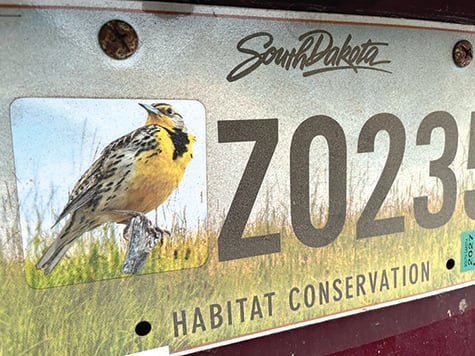
Habitat plates leave money on the table
South Dakota introduced its Habitat Conservation License Plate in March 2025 as a way for residents to support habitat work, even if they do not hunt or fish. But the program has an unusual two-step structure, unlike other states.
The $10 special plate itself does not generate any conservation revenue. That funding goes directly into the state’s highway fund and nowhere else.
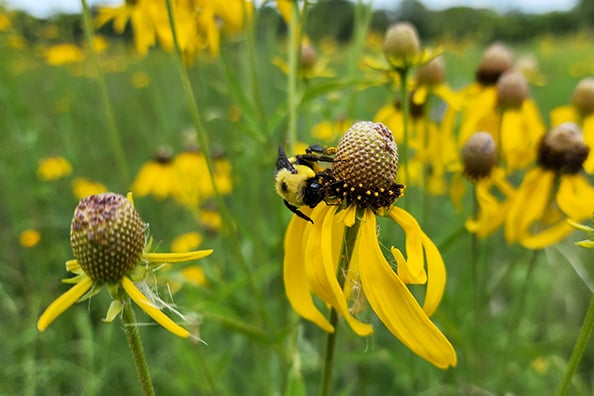
To have a habitat conservation plate that contributes to habitat, drivers must separately purchase a set of sticker-decals from Game, Fish and Parks. The decals cost $50 for a set, or $30 for motorcycles and all-terrain vehicles. It’s the proceeds from those stickers that support projects such as grassland management, tree and shrub planting, native-grass and pollinator habitat and other habitat improvements.
Turns out, having that second step has resulted in a substantial disconnect.
As of August, the state had sold 8,484 more sets of habitat plates than decal sets, according to Game, Fish and Parks data reported by South Dakota Searchlight. That represents roughly $415,000 in potential habitat funding that had not been collected. The state had only sold 4,626 decal sets, generating about $230,000 for conservation.
However, according to state officials, the separate transactions are not simply an administrative preference. The Department of Revenue says the South Dakota Constitution limits how vehicle license and registration fees can be used. Article 11, Section 8 requires those fees to be used for highways and bridges, meaning the state cannot simply combine a conservation contribution with the plate fee and direct the money to habitat, according to the department.
The arrangement contrasts with programs in states such as Minnesota and Iowa, where conservation contributions are incorporated into the purchase or renewal of specialty plates – no additional sticker purchase required.
South Dakota lawmakers who sponsored the program have suggested the state should examine whether its process can be made easier. One of the lawmakers who sponsored the bill to create the plate program said she plans to address the issue during the state’s upcoming 40-day legislative session this winter.
Minnesota’s Lessard-Sams Outdoor Heritage Council advances 57 projects looking for funding
Members of Minnesota’s Lessard-Sams Outdoor Heritage Council recently discussed and took action on recommendations and allocations for the next cycle

Outdoor Insights: Beast of a marathoner runs 26.2 miles (8,390 rods) with a canoe
On Monday, Oct. 5, Travis Meier, 38, of Minneapolis, was fielding calls from Twin Cities media as well as the
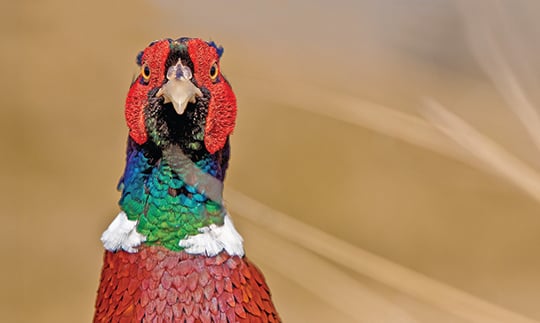
Minnesota’s pheasant season opens with high expectations
Buckle up, Minnesota pheasant hunters: Saturday’s 9 a.m. opener could be the start of one of the best seasons in
