





Albany — To recognize hunters and trappers who legally harvest game species, the New York State Department of Environmental Conservation has launched the inaugural Hunter Achievement Awards program.
 Staring just prior to the spring gobbler season (May 1-31, the program acknowledges hunter success and encourages participation in hunting for conservation. Like the Bureau of Fisheries’ widely popular Angler Achievement Awards, members of the hunting and trapping community can collect commemorative species-specific stickers to celebrate their annual game harvest accomplishments. Hunters can earn them all?
Awards are available for 24 game species that can be hunted or trapped in New York. The HAA full entry rules and submission form can be found on DEC’s Hunter Achievement Awards webpage. Entry forms must be received within 30 days of the season closing date.
Only legal harvests will be considered for award, and applicants must report their deer, bear, and turkey harvests prior to submitting their entry for those species. Each hunter or trapper will be limited to one sticker per species per season, and all submissions must include at least one photograph of the license holder with the harvest.
For more information, visit the DEC website.
June 8-14 Is Invasive Species Awareness Week in New York
Albany — New York Invasive Species Awareness Week (NYISAW) is June 8-14. What is termed as an “action-packed week” aims to boost understanding of the harms invasive species cause, while empowering the public to take action by preventing their spread and helping to manage or mitigate the damage invasive plants, animals, insects, and fungi can cause.
Learn how to identify emerging threats and how to make a difference in your community or backyard. Across the state, organizations are hosting a variety of engaging, hands-on activities, including interpretive hikes, volunteer stewardship days, interactive webinars and family events.
Learn more at: https://nyis.info/ny-invasive-species-awareness-week/.
Harlem Road Fishing and Boating Access In Erie County Reopens
West Seneca, N.Y. — DEC recently announced the formal reopening of the fishing and boating access site located at 880 Harlem Road in West Seneca, Erie County. DEC recently joined the Buffalo Niagara Waterkeeper and other partners for a ribbon cutting ceremony in April 2026 celebrating the completion of the project.
The project includes improvements to the existing public access facility by enhancing the upland and shoreline areas with an Americans with Disabilities Act accessible pedestrian walkway and new fishing deck platform, a staircase with railings, natural shoreline stabilization, and improvements to the paddle craft launch.
Buffalo Niagara Waterkeeper’s Buffalo Blueway project was funded in part with a grant from Empire State Development to enhance public access to waterways by creating a water-based trail system that also connects to the land-based Greenway system. More information about the improvement project is available on the Buffalo Niagara Waterkeeper’s website.
New York State High School Clay Target League State Tournament Is June 5-7
Bridgeport, N.Y. — The New York State High School Clay Target League State Tournament is being held June 5-7, at the New York State Amateur Trapshooting Association’s home grounds – the Bridgeport Rod & Gun Club – near Syracuse. More than 120 high school teams featuring over 1,500 student athletes are expected to compete. Over 6,000 families and supporters are expected to attend.
The league continues to grow both in New York, and nationwide.
In 2025, the USA Clay Target League said 39,069 student athletes from 1,973 high school, college, and homeschool teams participated nationwide, supported by over 11,200 coaches, team staff, and other volunteers. It marked the 30th consecutive season of record-breaking participation since the League was founded in 2008. The nationals will be held July 8-12 in Mason, Michigan.
RMEF Study: Wild Meat Feeds America
Missoula, Mont., — As the New York legislature weighs a bill that could ban donating venison killed by hunters using lead ammunition, the Rocky Mountain Elk Foundation recently announced the completion of a new study that highlights the economic value of wild meat.
The study shows regulated big game hunting in the United States generates 235,760 tons or 519,761,829 pounds of protein per year. Based on a 6-ounce serving size, that equates to 1.39 billion meals.
Researchers estimated that replacing wild, hunter-acquired meat with the equivalent of domestic meat would cost $3.21 billion. This assessment does not take into account the additional economic drivers of hunting, guiding, outfitting and state license sales which all contribute to the GDP, supporting families and in turn putting food on the table.
Researchers drew on state harvest data from hunting seasons spanning from 2014 to 2019 and show wild harvest to be a measurable form of food provision. Wild meat from big game represents 1.44% of all red meat (beef, veal, pork and lamb) available for consumption in America.
Hunters harvested at least 23 big game species for consumption in the U.S., including white-tailed deer, feral hogs, elk, mule deer, moose, pronghorn antelope and black bear.
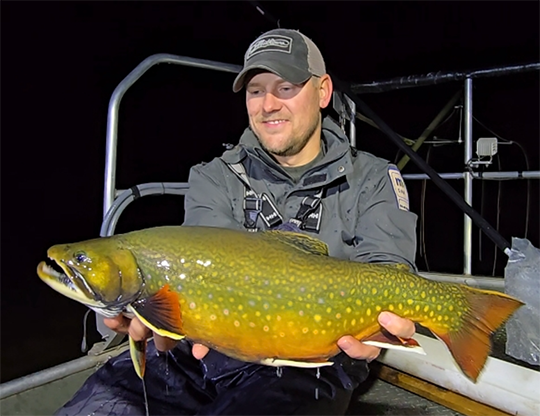
Minnesota DNR seeks to protect Grand Marais’ spawning coaster brookies with possible shutdown of fall fishing
Grand Marais, Minn. — The Minnesota DNR is considering shutting down fall fishing in the harbor of this Lake Superior

Stockings boost angling rebirth at Lake Le-Aqua-Na in northwest Illinois
Recent DNR surveys and stocking efforts offer a snapshot of ongoing efforts to boost Lake Le-Aqua-Na a handful of years

Best method to count Illinois deer herd? AI taking a crack at it
Is AI the answer to sizing up the Illinois deer herd? If nothing else, the technology may at least help
