




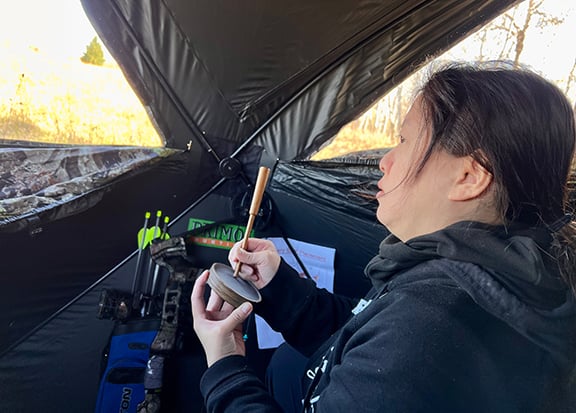
How much to call and how loud to call is a question many turkey hunters face. It’s one of the most hotly-debated topics in the sport.
If you want to get a red-faced dose of powerful opinion, simply advocate for one extreme or the other and watch what happens.
Calling softly and sparingly works. So does calling loud and a lot. This weird reality only serves to entrench beliefs in both camps.
Which approach should you use?
That depends on a few variables.
Start by considering the biggest challenge we face: getting a gobbler close enough to present a shot. We can accomplish this in a few different ways, including sitting silently and waiting for one to walk by. This is known in some circles as the “Charlie Chaplin” school of turkey hunting. (Named after the silent movie actor, in case the reference missed the mark.)
It works. Sit long enough in a spot where you believe turkeys will visit, and you might get a shot. You might also sit there for a very long time with no turkeys.
Unless you simply cannot make authentic sounds on a turkey call, it makes little sense to hunt turkeys like they are deer.
Turkeys do similar things – make similar movements through their home range, especially for a period of a few days – but they are harder to pattern than deer. If you rely on turkeys doing the same thing tomorrow as they did today, you will often be left sitting there watching squirrels.
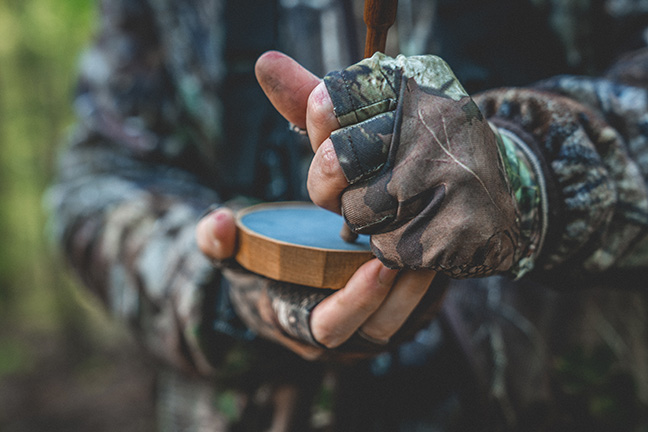
Calling is the difference maker
Most turkey hunters believe that calling is the thing that can tip the odds in their favor, and they are right. Sure, we can walk through a hunting spot and surprise a turkey that’s 20 yards away, but how often? But if we can make good turkey sounds on a call, and that causes a gobbler to sound off and come to the source of the calling, that is a formula for success.
Now we land in the zone of controversy. How often should we call, and how loud? If you call quietly and sparingly, that can work. But you better be on your toes at all times, because toms that come to that style of calling tend to overwhelmingly come in with all their trouble-detecting senses on full alert.
Consider this, also: As gobblers come to the sound of other turkeys, they almost always stop at various times to inspect the ground they might soon be walking on. Because they are insanely good at knowing precisely where calling is coming from, the first place they look is… right where the calling is coming from!
They will freeze in place and watch. If you swivel your head left and right to look for the approaching turkey, or scratch the back of your neck or move your legs, the turkey will see that.
MORE TURKEY COVERAGE FROM OUTDOOR NEWS:
Innovative wild turkey research starting in Minnesota
Up your consistency with these turkey decoying tips
Talk of a two-bird limit for Minnesota’s spring turkey season taking place
A wild turkey is not like a deer; a turkey will not see something it doesn’t like then stand there stomping the ground and snorting. A turkey will not jog a few yards then stop and look back at what it saw, possibly giving you a shot. A turkey will simply bolt.
Think back to hunts where you got a bird to gobble to your calling, then gobbled again and again and you could tell it was getting closer. About the time you figured the turkey would show up and present a shot, all went silent and you never heard from that bird again. Here’s betting the turkey saw you move, and left.
This can happen whether you call sparingly or a lot, softly or loud. But here’s the thing, and it’s the most compelling argument for calling a lot, and louder than most hunters: Calling like an excited turkey is much more likely to get a gobbler to change its travel plans, to come to you regardless of how far away you are, and even if your location is not on the bird’s original route.
Also, the more excited a gobbler becomes, the more its defenses let down, potentially allowing you to get away with some movement as you raise your gun.
Must. Sound. Real.
If you decide to give excited calling a go this spring, the biggest caveat is that your calling must sound real. If your calling does not have the right rhythm, and doesn’t have a tone that speaks to real wild turkeys, it does not help to call more and louder. Does that make sense?
If you don’t sound authentic on a turkey call, whatever sounds you are making will not lure real wild turkeys. This is where the nonsense comes from that wild turkeys somehow become “call shy” and go the other way when they hear a hunter calling.
Yes, sometimes even when a real hen calls to a gobbler on the roost, he will still fly down and choose to walk the other way. That doesn’t mean the hen didn’t sound real, or that the gobbler is call shy. It means the gobbler had been planning to go in a certain direction, and the hen’s calling did not do enough to change his mind.
Now, substitute a hunter who doesn’t sound real and the gobbler will, for sure, go the opposite direction, maybe even if he originally intended to walk right past where the hunter was sitting.
The most important thing you can do is listen to recordings of real wild turkeys (see the one below) and practice your calling until you sound like they do. When you sound real, it’s amazing what turkeys will do in response. Yes, sometimes they still go the other way, but it’s not because they are call shy.
There is no such thing as call shy. There is such a thing as turkeys being turkeys and doing whatever they feel like at the moment. But if you sound real on a call and get a gobbler worked up, you will get a shot more often than Charlie Chaplin would have.

Minnesota artist Bob Hautman wins federal duck stamp contest for fourth time
Minnesota’s own Bob Hautman, from Delano, won the 2026 Federal Duck Stamp Art Contest today with his acrylic painting of
Confirmed cougar makes an even dozen sightings over 25 years
A mountain lion was spotted moving through southern Illinois, and this time wildlife officials believe the big cat crossed west
Illinois bow season opens Oct. 1 with few changes
The DNR has floated the idea of establishing additional Restricted Archery Zones in other parts of the state, but this
