




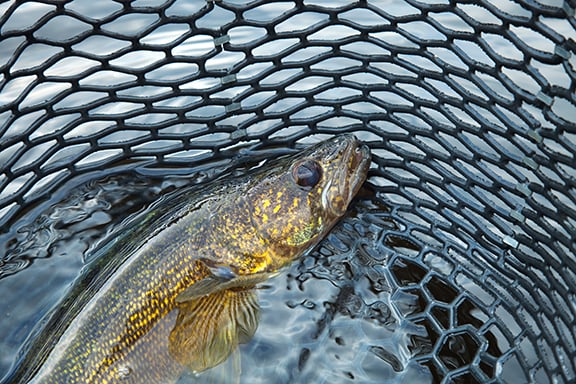
During last month’s Mille Lacs Fisheries Advisory Committee meeting, some chatter erupted about whether the DNR should reconsider its equation for calculating walleye hooking mortality.
Central Minnesota fishing guide Tony Roach noted that modern fishing techniques have changed dramatically in recent years thanks to forward-facing sonar, and he believes that technology may actually benefit fish in the form of lower release mortality. I called Roach last week to flesh out his theory.
 A decade ago on lakes like Mille Lacs, most anglers in summer were live-bait rigging, running spinners, trolling crankbaits via lead-core, or bobber fishing in deeper water. Today, he and many other anglers are working more in shallower areas with plastics and other artificials.
Instead of feeding fish line and hooking them deep, anglers identify shallow or suspended fish, and release them quickly. With fewer fish experiencing barotrauma or gut-hooking, Roach believes more fish are surviving release, and older hooking-mortality equations likely don’t reflect these rapidly evolving angling techniques.
Guides like Roach and the angling public also have learned more about the risks of barotrauma, especially with deep-water crappies. Forward-facing sonar and other electronics allow anglers to identify and avoid pulling fish up from deep water.

“I personally think we’re seeing far less hooking mortality than even 10 years ago. On Mille Lacs, I go out to the mud flats less often. We’re all fishing more inshore. Last summer, I rarely fished deeper than 20 feet,” he said. “For me as an angler, if I’m crappie fishing on a small lake, I don’t even target them deep anymore. Especially during the ice season, we mostly bottom-fished. But with education on barotrauma, we now fish them much shallower.”
During the recent MLFAC meeting, the DNR suggested another hooking-mortality study – examining whether FFS has changed the dynamic – probably isn’t in the cards anytime soon.
Brian Nerbonne, DNR regional fisheries manager, elaborated on the agency’s perspective last week. The agency has conducted two hooking-mortality studies on Mille Lacs, in 2004 and 2016. The latter showed slightly lower hooking mortality (2-3%) with artificial baits than natural ones at lower water temperatures. The main driver of hooking mortality, however, is warm water, and at higher temperatures mortality was similar with live bait and artificials.
“…there is theoretically some potential to change hooking mortality if the mix of baits people are using is different now, at least at cooler times of year. But a change of 2-3% in hooking mortality rate isn’t going to save too many pounds,” Nerbonne said.
MORE FISHING COVERAGE FROM OUTDOOR NEWS:
Minnesota DNR maintains 3-walleye bag limit for open water on Mille Lacs in 2026
Trout have a fatal attraction for ‘fuzzy’ flies
The evolution of legendary Minnesota angler John Peterson
Mille Lacs hooking mortality has fluctuated widely, with a recent high of 62,000 pounds in 2019 and lows of 3,702 and 3,230 pounds in 2022 and 2025, respectively. For argument’s sake, say a new study examining hooking mortality in the FFS era found a substantially larger savings – say 10%. Even in 2019, that’s about 6,200 pounds.
Though we’d prefer those fish were still swimming in the lake – or headed home as frozen fillets – that likely isn’t enough to dramatically change regulations. In a year like last year, with 3,230 pounds, the difference is essentially a rounding error.
The DNR is open to discussing it, but hooking-mortality studies are labor-intensive and involve many variables. With current priorities for DNR Fisheries, a third study would be an expensive and time-consuming undertaking that likely ranks low on the list.
“It would be a substantial undertaking, and with some anglers using FFS to target deeper fish, I’m not sure it’s a given hooking mortality would be less,” Nerbonne said. “I can’t answer what the difference is between a trolled crankbait and a plastic jig, but it would need to be fairly large to affect overall hooking mortality enough for the DNR to change regulations.”

New York Mixed Bag: DEC Info Locator Virtual Mapping Interface Gets An Upgrade
The New York State Department of Environmental Conservation’s online mapping interface, known as the DEC Info Locator, recently got an

Wisconsin letter to the editor: Mr. Durkin, Please Cut the B.S.
Reader-submitted letters to the from Wisconsin Outdoor News.
Got a hankering to build a wooden canoe? Here’s how to do it
“The way of a canoe is the way of the wilderness and of a freedom almost forgotten. It is an
