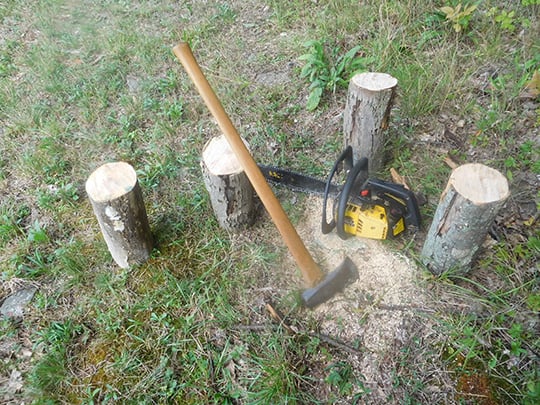
Here we go again. Winter is several months away but I feel the need to be prepared for the cold weather that’s certain to come in New York. It’s early September, and it’s hot, but there was wood to be cut, hauled out of the woods, transported, unloaded, and stacked.
I have other things to do before winter gets here. For me, September means setting trail cameras, clearing brush, scouting potential food sources, and at least one trip down south to take in one of my grandson’s college football games. August walks, September flies.
Fortunately for me, my friend’s farm has, or rather had, numerous ash trees, but no longer. Like everywhere else, the emerald ash borer has made once living trees nothing more than rotting trunks and limbs. Once affected, ash trees decline rapidly and can pose a major safety hazard.
Dead ash trees quickly become brittle, and branches break easily even in a soft breeze or on a calm, clear day. Danger from a fallen ash limb could be anywhere.
Last fall, while deer hunting, I had the top of a large ash trunk crash to the ground a few yards from where I was sitting. It was an exciting experience to say the least. I can only equate it to a person entering a dark room while a red-nosed clown jumps out of a closet, shouting BOO!
MORE COVERAGE FROM NEW YORK OUTDOOR NEWS:
Cormorant sightings on the rise on New York’s Lake George
New ruling now allows simple suppressor sales in 27 states; here’s what to know
New York’s Rockland County opts in on pilot youth deer hunt
There is a difference between woodcutting and cutting trees. The fallen ash trees along the farm’s field edges make for easy picking. I have no need to cut standing trees, the ones already on the ground are enough to fill my pickup. It’s a safe enough endeavor.
To get the job done, all I need is my sharpened chainsaw with enough gas to last the morning and my splitting wedge and maul. I don’t, or rather can’t, lift or move heavy logs like I once did, and thank goodness there’s no need. The dead ash trees are ideal for my purpose, as they split easily and burn well.
The potential of fallen trees or limbs isn’t the only problem I need to consider. It’s the threat of ticks that concerns me as well.
Ticks are most active during warmer months and are likely found in the grassy and wooded areas where I cut firewood. I have several friends who have been diagnosed with Lyme disease, and so far I’ve avoided attracting any of the little menaces by spraying all my clothes with permethrin (affiliate link).
Regardless of the threat of falling limbs and biting insects, what has to be done will get done. When sitting next to my little wood stove next winter, I won’t even remember the inconveniences suffered.