




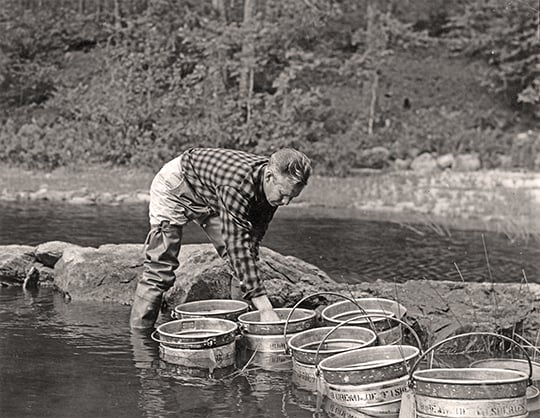
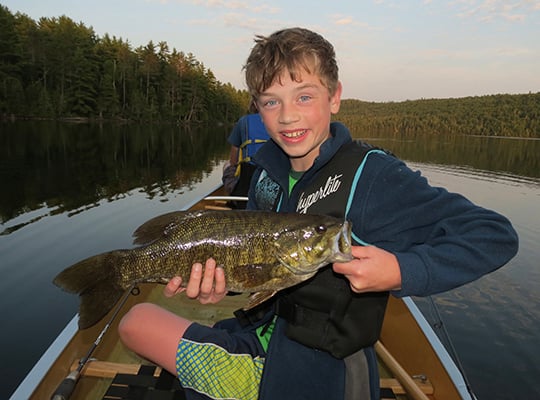
Smallmouth bass are the most popular sportfish in the Boundary Waters Canoe Area Wilderness, possibly trailing only the walleye in time, money, and legend among today’s anglers. But this wasn’t always the case.
As often happens in history, the rise in popularity of smallmouth bass reflects a combination of intentional efforts by both professional and amateur (“bucket”) biologists, as well as the compromises and regulatory quirks shaped by political considerations.
Our story begins at the start of the 20th century, when sport fishing and hunting developed into a leading attraction for visitors to canoe country, many of whom were enjoying more leisure time with the creation of a growing middle class and increased transportation options (railroads, other roads, cars, fly-in resorts, outboard motors) to get them to lakes in northern Minnesota and southern Canada.
Outdoor magazines such as Field & Stream, sensing a demand among their audiences, began to employ freelance writers who wove tales of giant fish in undiscovered waters available to those who wished to throw out a line.
These monsters were typically northern pike, with walleyes, lake trout, sturgeon and lake whitefish running in the top five. A 45-pound Minnesota record pike caught in Basswood Lake in 1929 added to the excitement.
There were no tall tales about catching the world’s largest smallmouth bass in canoe country for the straightforward reason that there were no smallmouth bass in canoe country. They are not native to the region. The waterfalls from the rivers that flowed into Lake Superior stopped them. That was about to change in the late 1930s.
MORE COVERAGE FROM MINNESOTA OUTDOOR NEWS:
Spring wildfires reshaping northern Minnesota forest habitats
Minnesota DNR, license agents prepare for June 9 launch of electronic licensing system
Southern Minnesota fawn study enters its final year
Local civic boosters from communities like Ely, resort owners, outfitters, guides, freelance writers and ordinary anglers – with the help of professional scientists – wanted to increase the scope of fishing options for a growing number of visitors. Walleye, lake trout and especially sturgeon, as turned out, are quite difficult to catch for the novice and experienced angler alike, and the city-bred client who read lengthy, breathless accounts of stringers of giant fish (and saw photographs of massive catches piled strategically in front of outfitters’ signs – some things never change) wanted in on the action.
An answer was available in the smallmouth bass. There is some evidence that white settlers hauled smallmouth from the Mississippi River system into the nearby Lake of the Woods around 1900, and the Ontario Provincial government sanctioned the practice in 1901.
But the stocking effort in what was to become the Boundary Waters didn’t take off until almost 40 years later. (What we think of as the Boundary Waters was less visited than the Rainy Lake region in the early 20th century.)
Among those who participated in the stocking – at the urging of the president of the fishing-focused Izaak Walton League – was the Ely author and activist Sigurd Olson, who had a graduate degree in animal ecology, taught biology at the community college but also owned an outfitting business that catered to fishermen.
“If they take here the way they took in the Lake of the Woods country, we will really have something to be proud of,” Olson wrote of the bass. He brought the first smallmouth shipments to Basswood and Knife lakes in 1940. Specialized railroad cars brought millions of fish into the region.
Most of the stocked fish came from the Mississippi watershed, and soon boosters and resort owners were all in on the introduction of the new species.
The fish are hardy enough to survive transport, rookie anglers can catch them in the heat of the summer, they fight like the dickens, and as it turns out, they spread like soft butter on hot toast. The rocky, clear waters of the Canadian shield lakes were a perfect habitat.
As with the introduction of any non-native species into a new ecosystem, there are winners and losers. The losers in the case of the smallmouth stocking were the mature lake trout and northern pike that lived in smaller lakes. Smallmouth predation probably hurt trout and pike fry, but an important culprit was the additional fishing pressure in the small lakes that grew those native species to larger sizes.
With the additional publicity, more anglers appeared, and more kept and killed larger pike and trout, even while fishing for smallmouth. In the meantime, walleye populations dropped for two decades into the 1970s, but cooler summer temperatures seem to be as responsible as bass predation of walleye young.
Miron Heinselman, the biologist who authored the definitive book on the BWCA ecosystem, wrote: “The final outcome of recent introductions is unknown.” Brook trout populations are another possible victim. The answers are not always easy.
Jump ahead to 1993. A new management plan from the U.S. Forest Service regulated everything from visitor quotas to acceptable transportation systems, including a rule that only native fish can be stocked in BWCA waters. That might have put the kibosh on smallmouth stocking, but for a loophole bigger than a torn gill net.
The plan allowed that non-native fish (smallmouth and some trout) could be restocked if they were previously stocked before 1964. That was the year that the federal government established the Wilderness Act, the forerunner to the BWCA, which contained the usual number of compromises to get it passed and was as good an arbitrary historical marker as any. The 1993 stocking update, with its 1964 exception, became known as the smallmouth bass provision among USFS employees.
Fishing managers gave up or gave in and grandfathered bass as permanent residents.
To be fair to Olson and others who scooped smallies into BWCA waters in the 1940s, they may have justified it by knowing that the bass, while introduced to the Arrowhead region, were common across the rest of Minnesota. And perhaps some had second thoughts.
In 1952, Olson supported a law banning live minnows from being carried into Canada as “undesirable fish” and a “biological hazard.” But he was silent on the smallmouth bass stocking for the rest of his career.
In the end, the Boundary Waters wilderness ecosystem of 2026, smallmouth bass and all, is not the ecosystem of 1901, but no ecosystem is.
Editor’s note: University of St. Thomas professor emeritus Mark Neuzil writes a weekly Substack on what he calls “the small things in nature.” Subscribing or following can happen here, and it is free.
Minnesota’s black bear kill rises to largest total in over two decades
Minnesota’s 2026 bear season now ranks among the tops in state history, with the highest harvest totals in two decades.<br

South Lake balances panfish, pike, and big bass in Michigan’s Washtenaw County
Ten-inch redear sunfish aren’t what most anglers expect to find at the end of their line, but South Lake has
Michigan’s Outdoor Calendar
A look at upcoming outdoor-related events from across Michigan published in the Oct. 23, 2026 edition of Outdoor News.
