Friday, July 17th, 2026

Breaking News for

Sportsmen Since 1968

Search
Friday, July 17th, 2026

Breaking News for

Sportsmen Since 1968

Spongy moth activity is down in New York, but is still on the radar

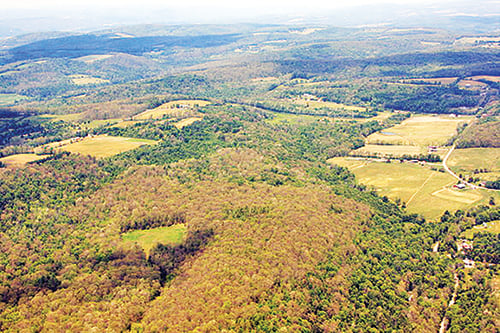
This aerial photo from the Hudson Valley in 2022 shows areas of defoliation from spongy moth caterpillars. (Photo by NYSDEC)

Albany— In the wake of several serious spongy moth (also known as gypsy moth) outbreaks earlier this decade, the New York State Department of Environmental Conservation has provided an update on the situation.

The spongy moth (Lymantria dispar) is a non-native insect from Europe. In New York, spongy moth caterpillars feed on a variety of trees, with oak as their preferred species. Spongy moths have naturalized in New York’s forest communities, which means they are always present in some capacity. In recent years, spongy moth populations have experienced a boom throughout the Northeastern U.S.

DEC first observed growing populations in New York State in 2020 where spongy moth caterpillars defoliated 27,157 acres in the Finger Lakes Region.

In 2021, New York experienced a nearly statewide outbreak, resulting in 682,652 acres of defoliation scattered throughout the state’s oak-heavy forests.

2022 saw a decrease in defoliation in many of the areas that spongy moth had defoliated in 2021; however, 62,458 acres of new defoliation were mapped throughout the middle to lower Hudson Valley.

MORE COVERAGE FROM NEW YORK OUTDOOR NEWS:

Dan Ladd: New York’s lead-tainted venison bill is a head scratcher

New York DEC commissioner discusses crossbows, future projects with outdoor writers group

New York’s whitetail harvest up slightly in 2025-26

The number of defoliated acres in the Hudson Valley continued to grow in 2023 (188,313 acres) and then peaked in 2024 (618,765 acres).

In 2025, spongy moth defoliation in the Hudson Valley saw a sharp decrease, with 66,928 acres of new defoliation.

Typically, trees can recover from a couple of years of defoliation during a spongy moth outbreak. After three consecutive years of defoliation, however, the outbreak can lead to mortality, especially in trees that are stressed from other factors such as poor soils, drought, or those growing on rocky ridges. While the number of defoliated acres were substantially less in 2025, more than 10,000 acres of oak mortality were recorded in the Hudson Valley Region.

2026 Egg mass surveys

In response to the oak mortality in 2025, DEC performed spongy moth egg mass surveys to help predict spongy moth populations and the likelihood of defoliation in 2026.

Surveys in March of 2026 focused on the Finger Lakes and Hudson Valley Regions because forests in these areas had been stressed by defoliation in recent years. Survey results found minimal new egg masses, indicating a significant decline in spongy moth populations.

This reduction is likely the result of early summer rains in 2025, which allowed naturally occurring soil bacterium (Bacillus thuringiensis kurstaki) to thrive.

This bacterium plays a major part in reducing spongy moth populations below outbreak thresholds (where defoliation levels are not a concern).

From these results, DEC does not expect noticeable defoliation in these surveyed areas in 2026.

While DEC predicts a lower population of spongy moth throughout the state, in part due to the boom-bust cyclical nature of the species, it is still important to look for and report population growth. DEC will be conducting statewide aerial surveys throughout New York to search for any new areas of defoliation and ask that the public keep an eye out for any new areas with significant numbers of spongy moth caterpillars.

Spongy moth caterpillars are easier to identify during late May and early June once the caterpillars have their characteristic red and blue dots. If you notice dense numbers of spongy moth caterpillars accompanied by defoliation, please report sightings to foresthealth@dec.ny.gov.

Learn more about spongy moths in New York at the DEC website.

SUBSCRIBER CONTENT

Read this article now.
Create a free Outdoor News account.

Create a free account below to get instant access to this article, thousands of Outdoor News stories, and our digital editions. Your 1-month trial starts the moment you sign up.

Email Address(Required)
Password(Required)
Name
What outdoor activities interest you?(Required)

No credit card required

Share on Social

Facebook
Twitter
LinkedIn
Email

Hand-Picked For You

Related Articles

GET THE OUTDOOR NEWS DELIVERED TO YOUR INBOX

Sign up for the Outdoor News Weekly Newsletter and get 2 months of FREE access to OutdoorNews.com – packed with hunting, fishing, and conservation news. No Catch.

This offer includes digital access only (not the printed edition)

Email Address(Required)
Password(Required)
Name
What outdoor activities interest you?(Required)

PLEASE READ

Accessing Your Full Subscription Just Got Easier. Introducing Single Sign On.

 We’ve simplified things. Now you only need one password to access all your Outdoor News digital content.

Here’s how it works:

  1. Click Continue below.
  2. You’ll be taken to the OutdoorNews.com sign-in screen.
  3. Don’t have an account yet? Create one—it’s quick!
  4. After signing in, click the E-Edition Login button again. When the pop-up appears, just click Continue.
  5. You’ll either:
    1. Land on the e-edition selection screen (you’re in!)
    2. Be sent to a help page if we didn’t detect a subscription.

If you hit the help page, follow the directions so you don’t miss out on any of our great content.

One login. Every edition. Easy.

Let’s get you reading!

PLEASE READ

 We’ve simplified things. Now you only need one password to access all your Outdoor News digital content.

Here’s how it works:

• Click Continue below.

• You’ll be taken to the OutdoorNews.com sign-in screen.

• Don’t have an account yet? Create one—it’s quick!

• After signing in, click the E-Edition Login button again. When the pop-up appears, just click Continue. You’ll either:

  1. Land on the e-edition selection screen (you’re in!)
  2. Be sent to a help page if we didn’t detect a subscription.

If you hit the help page, follow the directions so you don’t miss out on any of our great content.

Help Shape the Future of OutdoorNews.com!

We know you love the outdoors—now we want to make OutdoorNews.com the ultimate destination for all things hunting, fishing, and conservation.

Take our brief 3 minute survey to share your thoughts, and help us build the best outdoor website on the planet. As a thank you, we’ll send you a special offer!

Together, we can make OutdoorNews.com even better.

Introducing The Outdoor News Foundation

For a limited time, you can get full access to breaking news, all original Outdoor News stories and updates from the entire Great Lakes Region and beyond, the most up-to-date fishing & hunting reports, lake maps, photo & video galleries, the latest gear, wild game cooking tips and recipes, fishing & hunting tips from pros and experts, bonus web content and much, much more, all on your smartphone, tablet or desktop For just a buck per month!

Some restrictions apply. Not valid with other promotions. $1 per month for 6 months (you will be billed $6) and then your subscription will renew at standard subscription rates. For more information see Terms and Conditions. This offer only applies to OutdoorNews.com and not for any Outdoor News print subscriptions. Offer valid thru 3/31/23.

Already a subscriber to OutdoorNews.com? Click here to login.