




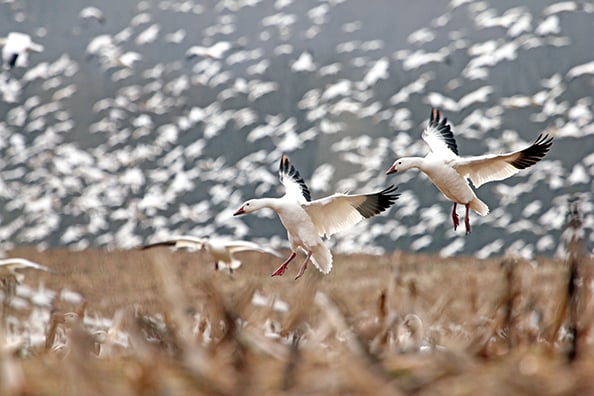
St. Paul — Even several years after his first spring snow goose hunt, Scott Doheny of New Prague, Minn., takes pleasure in recalling the details.
“We found a huge mass of feeding birds my first morning and set ourselves up to pass-shoot them,” said Doheny, an avid waterfowl hunter. “The fog that morning was thick, with very little breeze. I remember getting out of my truck and hearing them get up and start to peel off from the roost. It was deafening. You could almost feel them flying, even though we couldn’t see most of them because of the fog. It was something I had never experienced before. It was something else.”
With the spring “conservation order” hunt opening this month across the upper Midwest (the season opens in Minnesota Feb. 18; see additional details below), Doheny isn’t sure he’ll have time to hunt this spring. But he certainly recommends the season to other waterfowlers, especially those who haven’t experienced the spring migration.
“It’s an incredible spectacle of all waterfowl, not just snow geese,” Doheny said. “I highly recommend going.”
The migration
The midcontinent flock of lesser snow geese migrates primarily through the Central Flyway, which includes the Dakotas.
Many waterfowl hunters in the Upper Midwest, including those from Minnesota and Wisconsin, travel west to hunt the birds every spring. The hunt, first authorized by the U.S. Fish and Wildlife Services in 1999 to address an overabundance of the midcontinent flock, has become a fixture in the hunting lives of many waterfowlers.
Minnesota, which is in the Mississippi Flyway, does get a fair number of snows and blues migrating through the state. During a typical spring, huntable numbers of snow geese have been found near the “Minnesota Bump” in Traverse and Big Stone counties in western Minnesota.
MORE WATERFOWL COVERAGE FROM OUTDOOR NEWS:
Looking for huge spring flocks? Here are four destinations to hunt north-bound snow geese
Fewer hunters are chasing diving ducks each fall; Would tweaking limits bring them back?
In general, most lesser snow geese pass through southwestern and west-central areas of Minnesota, generally west of a line extending from Mankato to Fergus Falls.
“We’re seeing more snow geese every spring move a little bit east into Minnesota,” said DNR Wildlife’s Nate Huck. “Certainly, the western fringe of Minnesota sees birds. But if you want to see tens of thousands of snow geese, you have to go west.”
Over roughly the past decade, waterfowl managers say the spring migration is unraveling faster. The main reason: warmer early springs that are, generally speaking, pushing the main mass of adult snows to their Canadian breeding ground far earlier than when the hunt first started 25 years ago. But every year is different, they acknowledge, with snowpack dictating the speed of the birds’ push north. Few snows, blues or Ross’ geese migrate north of the snow line, regardless of where it is.
“It’s a weather-driven hunt, and a lot depends on much snow there is, when ice-out takes place and even when the frost seal breaks,” Huck said. “All are factors in how fast the migration occurs and how complicated it can get for hunters afield.”
Current conditions
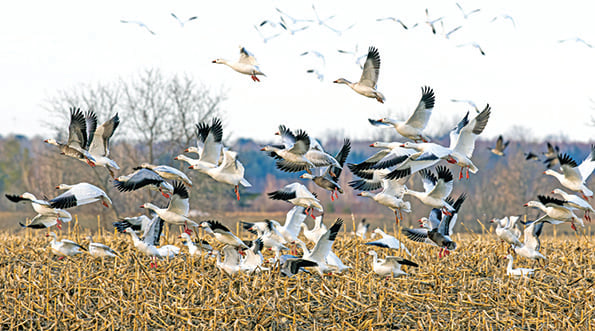
Despite some snowfall last weekend in the Upper Midwest, Huck and other waterfowl managers say it won’t be long before geese start to move into Minnesota and South Dakota. Snows have moved into southern Nebraska, northwest Missouri and parts of Iowa.
While Minnesota sees a fair number of snow and blues during the spring migration, hunt participation is spartan. “We sell roughly 900 to 1,000 permits each year, with 300 to 400 who actually hunt,” Huck said. “Part of it, I think, is that it takes time to scout and find a roost in Minnesota. It’s also harder because there are fewer light geese that migrate through the state each spring.”
S.D. hunting
Don Soderlund is a wildlife officer with the U.S. Fish and Wildlife Service at Sand Lake National Wildlife Refuge northeast of Aberdeen. The refuge is a traditional stopover point for hundreds of thousands of migrating geese each spring.
He says the spring hunt has changed. While he still sees some freelance hunters from Minnesota and elsewhere each spring, the hunt, he said, has become a commercialized affair.
“You’ll see outfitters lease four or five fields in a traditional migration area, which didn’t always happen,” he said. “And hunting ‘traffic’ can be very effective. For some hunters, they’d rather pay than do all the work themselves.”
Still, Soderlund said freelance hunters still can kill birds – and with smaller spreads. “Most outfitters set a lot of decoys, as many as 3,000,” he said. “But if you have a cornfield with sheet water, you can get away with using far fewer decoys. Snow geese like sheet water in ag fields.”
If you plan on hunting South Dakota, Soderlund said there’s very little snow pack in the state. “Unless we get some serious snow over the next month – which can happen – the migration is going to happen fast,” he said.
The good news: last year’s spring production was above average, meaning there will be more juvenile geese for hunters to harvest.
“Adults are just smarter and much tougher to fool,” Soderlund said.
Hunting etiquette
Soderlund and other wildlife officials say hunters need to keep in mind that wet spring conditions can tear up gravel roads, minimum maintenance roads and crop fields.
“We’ve seen some springs where this has happened with wet snow or rain, and that can be a real setback for hunter-landowner relations,” he said. “Tread lightly and don’t leave a footprint. If fields are wet, you have to have a plan to get your decoys in and out of the field. You may not be able to use your truck. Prepare for changing conditions.”
Soderlund also said hunters should be prepared to process their birds, what with liberal bag and possession limits. “When hunters get ideal hunting conditions – strong winds with a low ceiling – they can stack up birds in a hurry… and it’s your responsibility to take care of them legally for transport.”
Bird flu
State animal health officials are still monitoring the highly pathogenic avian influenza – the so-called bird flu, which has been detected in poultry and in wild waterfowl over the past few years.
Snow geese in particular have been hit hard, especially easier-to-hunt juveniles.
Spring hunters are encouraged to take precautions to limit exposure. They include avoiding handling sick birds, wearing rubber or latex gloves when cleaning game, washing hands and equipment thoroughly with hot, soapy water, and cooking meat to internal temperature of 165 degrees.
While infections are rare in dogs, the Minnesota DNR recommends not allowing hunting dogs to retrieve or contact birds that appear sick. Hunters should avoid feeding their dogs raw meat from harvested birds “during times when outbreaks are occurring.” The agency also recommends keeping dogs away from field dressed carcasses and entrails.
- The spring light goose season in Minnesota runs from Feb. 18-April 30. For more information, including hunt requirements and regulations, visit here.
- In South Dakota, the season runs from Feb. 15-May 15. For more information, visit here.
- In North Dakota: Feb. 21-May 10. For more information, visit here.
- The Light Goose Conservation Order in Nebraska began Feb. 10. The dates are: East Zone, Feb. 10-April 15; Rainwater Basin Zone, Feb. 10-April 5 and West Zone, Feb. 10-April 5. For more information, visit OutdoorNebraska.gov.
Ralph Loos: Illinois Outdoor Hall of Fame class has common interest: being useful
You could make a pretty long list of reasons why people get involved in outdoor conservation. Some love hunting. Some
Mixed bag of success as many Minnesota hunters face a wet waterfowl opener
It felt like a “ducky day” in Minnesota for Saturday’s waterfowl opener.
Many hunters shot through rain and strong
Minnesota’s wolf population remains stable, DNR considers new monitoring
Minnesota’s wolf population remained statistically stable within confidence intervals from 2025 across nearly 26,000 square miles of wolf range, but
