




Key points from the story:
- Minnesota DNR leaders say most new outdoor technologies haven’t yet harmed wildlife populations, but tools like forward-facing sonar and trail cameras are raising concerns about fair chase, ethics, and the quality of hunting and fishing experiences.
- Enforcement and wildlife officials highlighted legal and ethical gray areas, especially involving trail cameras, drones, and emerging devices.
- Panelists warned that artificial intelligence may be the next major challenge, with AI-driven wildlife patterning potentially giving hunters unprecedented advantages.
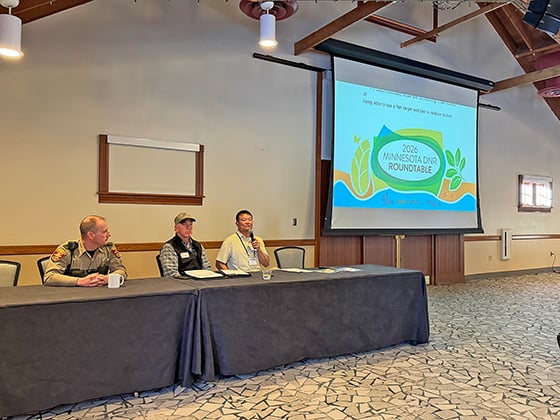
Brooklyn Park, Minn. — At the Minnesota DNR’s 2026 Roundtable last month, one of the final sessions of the day was entitled “Future of Fair Chase and Natural Resource Sustainability.”
The discussion revolved around the role of new technology in the outdoors. Because the technologies discussed are not new, the hour-long panel discussion did not serve to open a new can of worms. It did, however, afford a brief look at how deep the can has already become.
Marc Bacigalupi, the DNR’s northwest regional fisheries manager, spoke about growing the concerns around forward-facing sonar.
“You might be surprised to know that overall, you don’t see that much of an effect. But we also know that the high-level expert anglers are very good at it. We see signals of that in a few different creel surveys,” he said.

Bacigalupi assured the audience that fisheries personnel are good at monitoring populations, and that if fish abundance or size were to decrease, the agency could address those concerns with stricter regulations.
He also cited the work of a technology work group, comprised of citizens, industry experts, guides, and DNR staff. Plans are underway for a website and informational campaigns.
Representing the DNR Wildlife division from the northwest, Regional Manager Blane Klemek’s opening comments focused on the use of trail cameras.
“Back in the day this technology came out that had an infrared beam that would shoot across a game trail and trip a clock. And you could tell that something walked by. And now we have cameras, and cellular cameras,” he said, reflecting on technology’s constant, incremental changes.
He had also brought the comments of area wildlife supervisors on the topic of technology and fair chase, one of whom remarked that cameras have taken the place of what was once considered traditional woodsmanship.
Lt. Col. Robert Gorecki brought the Enforcement perspective, speaking in detail about the potential use of drones for hunting. He said that while using a drone to recover a deer seems like a worthy idea, people take advantage of such an opening in the law.
“Under state law you cannot use an electronic device, such as a drone, to take a deer,” Gorecki stated unequivocally. “So, how do we potentially create legislation to allow the ethical finding of a deer, but balance that with people’s private property rights, their privacy, the potential for hunter or game harassment?”
MORE COVERAGE FROM MINNESOTA OUTDOOR NEWS:
Northeast Minnesota whitetails sporting radio collars as part of new study
Public invited to comment on Minnesota DNR’s proposed harvest limits for native rough fish
Questions from the audience largely reflected concerns over resource management and ethics. Where it came to trail cameras, the scenario of somebody receiving a photo on their phone and hurrying out to intercept a deer came up multiple times.
Gorecki said that was clearly an illegal use of an electronic device. When pressed, he said the law is unclear whether any certain period of time between receiving the photo and taking of that deer is acceptable. Limiting it to separate calendar days would be a possible solution, but would require legislative action.
In a follow-up interview, Gorecki explained the three main principles behind making rules for our outdoor pursuits: public safety, natural resource concerns, and ethics. The impetus for any new law could be one of those, or any combination of all three. Controversy tends to rise proportional to the role of ethics.
“That is a fluid thing in our society; things change, technologies change, and our ethics might not always be shared by every member of the public,” he explained. “Ethics are certainly a tricky thing to try to manage, or manage people’s expectations of, because what you may think is ethical, I may think is unethical.”
Gorecki pointed to hook-setting devices, recently legalized in Minnesota, as a case study for navigating through gray areas. Some may think a mechanical device setting the hook for the angler is a bridge too far, while others do not. It was thought to be a positive move, because the devices offer the potential for less hooking mortality, as compared to tip-ups. But if further mechanization was desired by members of the public, that would trigger hard discussions and probably a stiffer battle.
“That gets into the ethics conversation again. At what point is it sporting? Is it good ethics to have the device hook that thing, pull that fish up, place it on the ice? Now we’re crossing into, as a society, do we still want a human being on the end of the line, reeling that fish up, enjoying catching that fish? At what point is it just harvest, or is it a sport?”
More on the way with AI
While modern fair chase discussions revolve around technologies like advanced sonar and drones, Gorecki said tomorrow’s big discussions will be triggered by artificial intelligence. He explained that, with enough data, deer hunters could harness the power of AI to take patterning to new levels. Even to the point of having an effect on wildlife populations and other hunters.
“These simulators are able to recreate these big bucks’ patterns, where these people know, ‘I got this 20- to 30-minute window tomorrow when that deer is going to come past that stand.’ Now go out one time for an hour and you’re able to get this big buck that people have been chasing for years. It is a concern. And people are already talking about it,” he said, adding that bears would likely be similarly susceptible.
Knowing how to regulate that kind of use of AI, said Gorecki, is going to be an enormous challenge. One that society may not yet be ready to handle. “I think we’re going to continue to have these discussions, and that’s the first step, is having meaningful conversations and trying to find the best path forward,” he said.
In the Roundtable session, Klemek and Bacigalupi echoed the need for discussion and soliciting wide viewpoints when defining and protecting fair chase. While it is difficult to anticipate technological developments, there may be chances to draw ethical boundaries before new products hit the marketplace.
“It’s going to be tough to put the toothpaste back in the tube on forward-facing sonar,” Bacigalupi said. “But maybe there’s some clear lines out there where you could say, ‘this development would be too much.’ Maybe it’s something like autopilot on your boat that’s interfacing with your sonar and chasing a fish. Maybe it’s some other visualization, you know, the virtual reality headgear, or something like that.”
Klemek reminded of the implications of new technologies, as experienced by non-adoptees. “I don’t think most of these things can or do have a negative impact on wildlife populations or habitat that we cannot manage around. What they can do is impact quality of hunting and the experience of other hunters. Impact safety of other hunters. And impact how hunters are perceived by the non-hunting public.”
Roy Heilman is a Minnesota outdoorsman and writer. Read more from him at neveragoosechase.com.
Michigan DNR clarifies rule changes in effect for trout, salmon, sturgeon
Michigan anglers have some additional fishing regulations to keep in mind this fall after the DNR clarified several changes that

Michigan Letters to the Editor: There are some advantages of the Roadless Rule removal
Reader-submitted letters to the editor published in the Sept. 25, 2026 edition of Michigan Outdoor News.
Ralph Loos: Michigan’s reliable hunting traditions got an update (upgrade?) this season
More than any other collection of like-minded individuals, hunters tend to get stuck in their ways — and I say
