




Every once in a while I love a surprise.
Like when a friend gave me a packet of lottery tickets for my birthday and one of Pennsylvania’s pantsless groundhogs came through for a couple of hundred bucks.
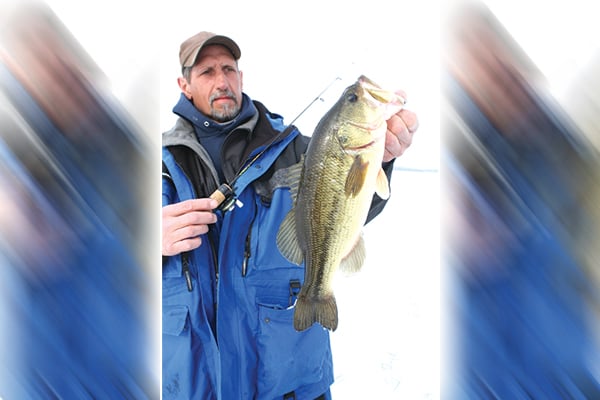
But last winter I had an even greater surprise than a winning Gus. I was ice fishing a farm pond using a 42-inch jigging stick with a 3⁄16-ounce gold spoon when it was hit hard by what turned out to be a 4-pound largemouth. (I was expecting a tiger muskie.)
I doubt that my normal 24-inch ice rod with 2-pound test would have served in the moment, but luckily the longer-than-normal ice rod and 6-pound test handled the bass just fine.
Not wanting to look a gift horse in the mouth, I continued fishing with the flashy spoon and sturdy line, and landed three more largemouths between 2 and 3 pounds. Not a bad haul anywhere but really notable for a pond.
Later the farmer told me he’d been fertilizing the fish in his 3-acre site with hatchery pellets. It all made sense.
Normally, when I pursue largemouths under the ice, I use tip-ups baited with shiners.
That is frequently a winning combination on waters with moderate-size largemouths in Pennsylvania like Mauch Chunk, the Lower Lake of Promised Land State Park and Kaercher Creek Lake.
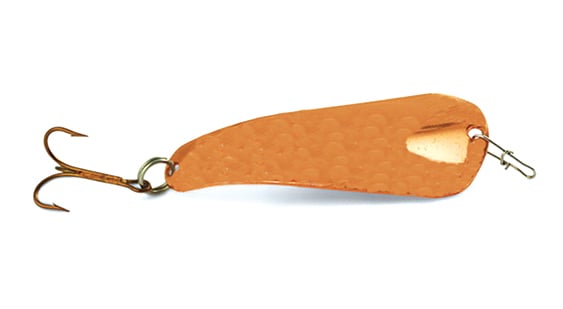
But I also know a gold spoon, with or without an added shiner across its treble hooks, has garnered a bunch of better largemouths on waters across the northern states. So, this farm pond fortune was not a one and done thing.
The advantages of using a stick instead of a tip-up are many. First, I can bounce around from hole to hole, plunking the spoon as I go.
Next, I will carry and use my portable flasher so when I lower the transducer and see a range of moving green blotches, I will concentrate on that area.
This is also a good tactic for lakes with limited structure, places like Holman Lake at Little Buffalo State Park and Lilly Lake in Luzerne County.
MORE ICE FISHING COVERAGE FROM OUTDOOR NEWS:
How to crack January’s mid-season walleye code
Tricks from days gone by still put pike on the ice
North Dakota’s Devils Lake to get stocked adult perch in spring ’26
Next, while a tip-up keeps my shiner offering at one constant depth (unless I add or subtract line off the submerged spool) I can quickly adjust the depth of stick and spoon to incoming sonar marks.
For instance, if I stand over a hole and the sonar screen is blank but then shows a feint signal, at a specific depth away from the cone, I drop the spoon to come closer to the signal – but not right on top of it.
Another advantage using a stick instead of a tip-up is the ability to change the cadence of the bait rather than have it sit statically.
Example: using a stick with spoon and shiner I’ll twitch the double offering ever so slightly, creating flash and vibration. I use the word “twitch” as this is reasonable description for how to work the metal.
With a shiner on the spoon you don’t want to wildly hop or bounce the bait up and down. If you do, it’s likely that the two will foul, with the shiner and treble hook wrapping around the main line.
If, when jigging or twitching the spoon and shiner, the offering suddenly feels out of balance – no longer vibrating as it had – then you’ve probably snagged the line and need to pull it up for repairs.
Still, I highly recommend attaching a medium shiner across the spoon’s treble hook rather than fishing it baitless. For all species – pike, pickerel, bass, trout – baited spoons have outfished a plain spoon for me exponentially.
In addition, I really like to use a spoon with an attached rattle. The rattles are built into the concave design but do not reduce the spoon’s hooking power.
As you only need to create the slightest rattle noise to attract a cold-water largemouth, this again calls for minimum movement of the spoon.
Specifically, I think you should try a slight lateral shake to activate the rattle and keep the cadence reasonable rather than a high vertical lift and drop of the spoon.
Imagine your hand is freezing cold, which it probably is, and the resulting movement is a shaking twitch. Such an action will also keep the shiner shining.
I really like the use of a spoon for the flash it gives off. Even if the spoon is only dangling on the end of the line, revolving slowly in a tight circle, a spoon will flash.
Beside gold spoons, I’ll work a gold spoon with an iridescent lightening flash, red or green, or a colored spoon with a rainbow trout pattern, even if the water has no rainbows.
When I need a break, I’ll set up additional tip-ups with bait, but when raring to go I’ll ply a stick and a spoon for those hard largemouth strikes.

Fall is the perfect time to catch Lake Erie’s giant walleyes; here’s what to focus on
Anglers who are prepared to face some colder weather can catch lunker walleyes. For the past decade, walleye fishing derbies
Upper Peninsula landowner provides evidence feral pigs have established there
A population of feral pigs that escaped from a game farm have become established in southern Marquette County, based on
Big waterfront project in Lorain, Ohio, to benefit anglers
When the Hot Waters Boat Launch reopened in the City of Lorain on May 22, it was just one milestone
