





Bismarck, N.D. — The North Dakota Game and Fish Department is putting the finishing touches on a plan to stock adult yellow perch into Devils Lake next spring, an effort that local tourism officials and area fishing guides advocated for during talks this summer with state natural resources officials, including department director Jeb Williams.
The plan calls for trapping and transporting yellow perch from other North Dakota prairie lakes in an effort to supplement perch numbers in Devils Lake, one of the Upper Midwest’s most popular ice-fishing destinations, especially for jumbo-sized yellow perch. However, perch reproduction and numbers have lagged in recent years, which led to the new plan to boost numbers in Devils Lake.
State fisheries officials have had good success trapping yellow perch from prairie lakes and stocking them in other lakes to create new perch fisheries. What’s less understood, state officials say, is stocking yearling or adult fish in established perch fisheries, especially one as large as Devils.
“The goal is to trap right after ice-out,” said Todd Casper, an NDG&F fisheries biologist who works almost exclusively on Devils Lake. “Perch are early spawners and are easier to locate and trap in spring because they’re in shallower water.”
An early spring stocking effort is also easier on the fish.
“The water is cold, which makes it less stressful on the fish overall,” Casper said. “Hopefully, survival will be high.”
MORE COVERAGE FROM MINNESOTA OUTDOOR NEWS:
U.S. House passes bill to delist nation’s gray wolves
All it takes is one rooster for an inspired old dog
Minnesota study to look at activities of bears, bobcats, coyotes in Duluth area’s urban locations
At roughly 100,000 acres, Devils Lake has about 170 miles of exterior shoreline and is the largest natural lake in North Dakota. The lake, which fluctuates in size depending on annual precipitation, attracts anglers from several Midwestern and Great Lakes states year-round.
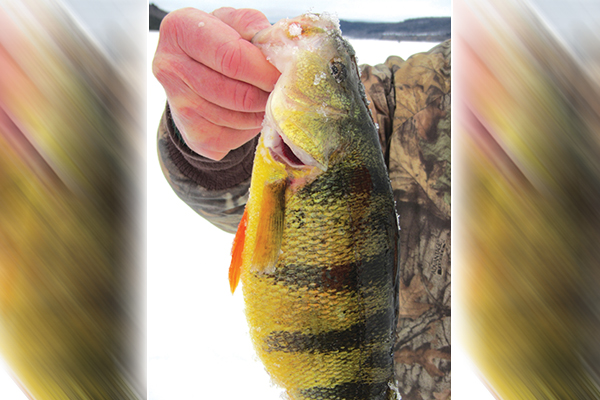
Devils is considered a top-drawer walleye fishery (it’s the most abundant fish in the system) and a winter mecca for yellow perch, a distinction that goes back decades. The big draw over the years has been their size, with some year-classes of perch growing to 12 inches or larger. They’ve been described as mini footballs, what with their ability to feast on the lake’s abundance of freshwater shrimp.
“That’s why anglers come here in winter – they want to fish for big perch,” said Kyle Blanchfield, the longtime owner of Woodland Resort on the shores of Devils, who caters to ice anglers and supports the stocking effort. “That’s what we’re known for.”
Fluctuating water levels
The new plan to stock perch in spring 2026 comes at a time when the Devils Lake perch population has dipped in recent years and overall lags behind historic averages.
Casper said based on results from NDG&F summer netting surveys, Devils Lake perch numbers have declined from 18.3 fish per net in 2021 to 8.8 fish per net in 2024. The downturn, he said, is most likely part of the cyclical nature of prairie lake production in general.
“We see ebbs and flows, ups and downs with all fish populations in prairie lakes, including perch in Devils Lake,” Casper said. “This isn’t out of the ordinary.”
State officials say perch favor flooded vegetation for spawning, although in recent years water levels have stabilized or declined. State officials point to the wet cycle of the early 1990s that raised Devils Lake by roughly 20 feet, which in turn created superb spawning conditions. That set the stage for quality year-classes of perch.
“I remember the boom after water levels spiked,” said Zippy Dahl, owner of Perch Patrol Guide Service. “It was something else.”
Born and raised in Devils Lake, Dahl, 57, has been a fishing guide for more than three decades. He’s part of the loosely organized committee of guides and various tourism stakeholders who met with officials from the NDG&F this summer about stocking Devils Lake with adult yellow perch – which Dahl calls the “bread and butter” fish for winter anglers.
“Certainly, perch are the No. 1 draw in the winter, and we felt it was time to address some of the population issues,” he said. “We still have plenty of numbers and quality fish in the system. But we wanted to see if we could give the population a boost.”
Both Dahl and resort owner Blanchfield gave the agency high marks for giving them time to air their concerns.
“They did a great job of answering our questions and listening to our input, and ultimately we came up with a plan,” said Dahl, adding that he knows there’s no guarantee it will succeed. “I was very impressed overall. They know how important fishing is to our economy.”
Will it work?
Historically speaking, Casper said, stocking adult perch into Devils isn’t unprecedented, although, he noted, it’s been roughly 20 years since the last effort.
According to state records, adult perch were stocked in Devils four times in the 1970s and again in 1992 and 1993. In 2005, the NDG&F stocked roughly 76,000 adult perch and 110,000 fingerlings into Devils Lake. The agency stocked hundreds of thousands of fingerlings in 2006 and 2007.
For the 2026 spring stocking effort, Casper said adult perch will be trapped and transported from lakes in the state’s southeast district. The target number is between 100,000 to 200,000 perch, he said. The effort will be evaluated over time.
“We’re still batting around how we’re going to do that, but we have some new techniques that we may utilize to evaluate the work,” he said.
State fisheries officials aren’t sure how the stocking effort will play out. Casper said the trapped and transported perch “will probably not contribute significantly to perch reproduction.”
“The reason for this is that perch have a high reproductive capacity already, so the number of adult fish already in the lake should be adequate,” he said.
However, stocking adult fish could boost perch numbers over the near term.
“The area where this stocking may do some good is in the numbers of fish that anglers will see in the next few years,” Casper said. “These trap and transported perch will all be at least one year old or older and they will have already survived their first winter. They should have a better chance to survive than, say, a fingerling perch would have.”
Casper said the X factor that may influence success “will be the strength of the naturally produced 2025 perch year-class.”
“We did see good numbers in our fall reproduction survey,” he said. “But we’ll have to see if they survive the winter.”
Added Casper: “Whether this stocking ultimately ends up being effective or not, now is a good time to try stocking these larger perch in Devils Lake since the statewide need for these trap-and-transport perch in 2026 should be low unless there are a large number of winterkills, which so far isn’t looking likely.”
Pennsylvania’s hunting license sales down so far this year
Hunting license sales are down nearly 4.5% at the end of August, although Pennsylvania Game Commission officials believe there is
Origin of road-killed armadillo in southwest Ohio a mystery
An armadillo found as roadkill in southwest Ohio has researchers scratching their collective heads wondering from where the non-native mammal
Bowhunt gets started in Ohio with additional opportunity in CWD surveillance area
Hunters in Ohio’s chronic wasting disease (CWD) surveillance area have additional dates this season to pursue white-tailed deer. The Ohio
