




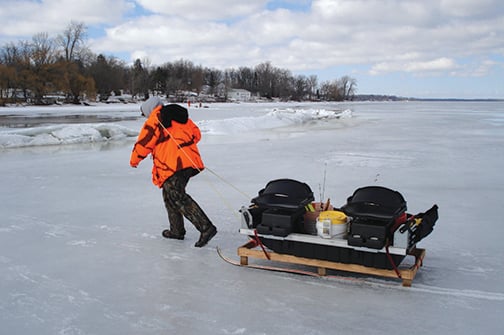
Suddenly, the ice you’re standing on makes a terrifying noise. It sounds like the snap of a rubber band magnified umpteen times.
A thin crack appears yards away. And before you can let out a shout, the crack races right between your cold, stiff legs!
You wobble and your muscles tighten. The snap then continues across the lake, like fading thunder or a distant tympani.
Some of the less experienced in your ice fishing group – you can see from the look on their faces – experience a moment of panic; others who have heard and seen this ice phenomena many times before smile. But maybe nervously, still they hold their ground – actually hold their ice.
It’s your duty now to calm the nervous.
“It’s all right,” you assure them. “That’s a good thing – that crack shows that the ice is expanding. The lake is making ice.”
Hopefully, they can suppress their natural and understandable fear and go back to fishing.
MORE ICE FISHING COVERAGE FROM OUTDOOR NEWS:
Steve Carney: Catching fish on the breaks
North Dakota’s Devils Lake to get stocked adult perch in spring ’26
Advances in mapping, mobility, and teamwork help today’s ice anglers cover more (hard) water
There are no other sounds in nature like those made by ice. Either in the creation or the deterioration of solid water, the music is unmistakable and open to interpretation – if you know what to listen for.
I love the sounds of ice, and fortunately at a ripening age, still have the ear agility to perceive them. For me, the sounds of ice are instructional. That does not mean, however, I go entirely by these sounds before stepping out on a cold sheet.
The physical test of whether or not ice is safe is the best, and for this I use a spud bar. Pound the long iron bar into the ice, and if it cracks through, turn around and go home to safety.
Sometimes, as you first walk from the very shallow edge of a pond or lake, the thin ice will crack or “crinkle” but still hold your weight. Now you must proceed with caution because the real test is when you’re a yard or two out, still over very shallow water. If the iron breaks completely through – go home.
On a cold night, early on in the ice-making process, a lake makes a racket. The rumbling will wake you up with a fright if sleeping in a cabin close to the wintering lake. I’ve heard these sounds echo around the surrounding hills like the bugles of mating bull elk.
One late-night experience reminded me of the smashing of hundreds of over-ripe pumpkins splattered on the ground.
It’s when you hear a crinkling sound – like glass breaking – that you really need to worry. That particular sound-signal can betray the thinning of ice beneath your feet for a couple of reasons.
For one, it can be caused by the shattering of a layer of recently formed super-thin ice from a night-time rain or warm spell. Walking on it at this time will probably cause the upper layer of ice to crackle and splinter.
Your feet and sled will break the thin crust and perhaps smash down on the thick ice sheet below it. This can be very messy as sometimes the sloshy layer of precipitation above the solid ice has not frozen. Like a water sandwich you are left with some unstable fluid between the thin crust and the solid ice.
Don’t take this situation for granted because the weight of the fresh rain can actually cause thick, solid ice to sink. Perhaps it sinks enough to be dangerous.
Once, on a farm pond, two of us were over 4 or 5 inches of good ice, but after a night of warmer temperatures and a light rain, water actually came up though our drilled holes.
As the morning wore on, this flowing water got deeper and deeper, a quarter of inch then another quarter of an inch. The fountaining around the holes spooked us enough that we got off the ice. What happened next, I can’t say because we were safely in my truck driving home.

A regular phenomena on the ice is the rising and falling of steep “pressure cracks.” These are splits, or elevations, in the ice sheet with heights from a few inches to several feet. So high I’ve had to climb over these cracks.
The very name of pressure cracks is misleading.
Yes, the separations may be caused by the increase of pressure from forming ice, or they may be the result of the shifting of large segments of the ice sheet, from winds, particularly on wider water. With particularly high cracks the common cause is the wind shift.
Later on in winter, shoreline edges will be the first to deteriorate while the lake proper is still safe. With the sun riding a higher declination in late winter sky, edges melt first.
Many times I’ve stretched a board from the shoreline to keep dry until far enough out for solid footing. Of course, spud bar testing as I go.
Understand that ice conditions can change overnight, either for the good or the bad. I love ice fishing but no fish is worth loosing a life. Be safe, be careful.

Minnesota Letters to the Editor: Hey, the editor missed with his crossbow comments
Reader-submitted letters to the editor published in the June 5, 2026 edition of Minnesota Outdoor News.
Commentary: An open letter to Minnesota Gov. Tim Walz on Conservation Partners Legacy grant changes
On behalf of the Pioneer Heritage Conservation Trust board of directors and members, I am writing to express our opposition

Free fishing begins this week with Minnesota’s new licensing system going live next Tuesday
Minnesota residents can fish without a license June 2-8 as the DNR transitions from its legacy licensing system to the
