




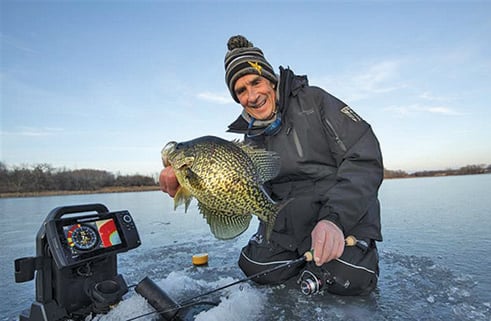
Full-blown ice season is coming quickly. As I sit down and write this, I expect to see ice-covered lakes across much of the Midwest in the coming weeks, maybe even days.
Similar to their open-water counterparts, ice anglers are far more effective than they’ve ever been when it comes to finding and catching fish. Generally speaking, we have technology to thank for that. It’s helped us to find lakes, find fish and, ultimately, catch fish more efficiently.
 One of the newest pieces of such technology is the onX Fish app. It allows users to gather a tremendous amount of information, all under one “roof” – everything from lake-specific fisheries data and access locations to weather conditions and recent satellite imagery, and a slew of other features.
The app is extremely advantageous for finding and catching fish. Currently, the app covers the states of Minnesota, Wisconsin, Iowa, Indiana, Illinois, Michigan, and North and South Dakota, with more offerings expected to come in the future.
One of the other factors relating to efficiency is getting around. Travel on the ice is highly dependent on area, climate, and other factors. The right mode of transportation can be impactful to overall success.
For us in central Minnesota, early ice kicks off with a lightweight, portable setup including a small sled, ice cleats, an auger, some rods, some tackle, and electronics. It’s more of a bootstrap affair, and it takes a lot of time to get to and from spots – even on those small- to medium-sized lakes.
MORE ICE FISHING COVERAGE FROM OUTDOOR NEWS:
Frigid weather aiding formation of ice for eager anglers across Minnesota
Here’s the weedy truth about early ice panfish
Top new gear for your 2025-26 ice-angling campaign
Efficiency is found in how we pack and travel by foot – more so than how quickly we can get to a spot. A reminder for early ice: Fish tend to be extremely spooky. It may sound counterintuitive, but often you’re better off sitting and waiting for fish to move through, as movement and noise will keep fish away.
As the season progresses, ATVs become the ideal mode of transportation, especially before there’s a lot of snow cover. These really help with efficiency because you can access areas and cover water at a much faster pace.

At this point, our typical system involves a team of four to six anglers. The goal: Break down water as efficiently as possible. This method allows us to find fish and figure them out so much faster than traveling solo.
Are they in weeds or roaming over a basin? What about transition areas? Can we fish fast or do we need to slow down? Will artificial options work or do we need to use live bait? Answering these questions comes more quickly when working as a team.
Once the real snow arrives, it often has a negative effect on efficiency. We’re forced to rely on tracked vehicles such as snowmobiles, or trucks if the ice allows. While you can generally get around, any sort of substantial snow will slow you down – at least to an extent.
Strategy for this timeframe is often a mix of both run and gun and sit and fish – it’s really dependent on snow cover. If we’re able to move efficiently, then the fast-paced, group breakdown method continues to be a top strategy.
If not, then a more methodical, sedentary approach is employed. It’s largely variable and can change from day to day.
In a perfect world, folks would have one of everything to get them where they want to go, no matter the conditions. The right tools and transportation have a big effect on efficiency and the success rate on the ice.
Regardless of time of year, safety should be a top concern. Be careful and remember that conditions can change quickly.
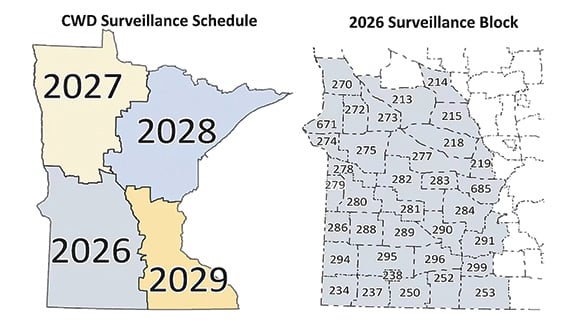
Minnesota DNR reminds firearms deer hunters to prepare for CWD sampling
Sampling is mandatory for southwest Minnesota the opening weekend of firearms deer season Nov. 7-8

Short on walleyes, but long on muskies: Beers Lake in Minnesota’s Otter Tail County
Otter Tail County’s Beers Lake is an excellent walleye fishery – nope. Beers is loaded with good-sized panfish and northern
Minnesota’s Outdoor Calendar
A look at upcoming outdoor-related events from across Minnesota published in the Oct. 23, 2026 edition of Outdoor News.
