Editor’s note: Outdoor News is sharing another how-to piece by popular columnist Gary Clancy, who passed away in 2016.
Prime time for rattling action in Minnesota occurs from late October through Thanksgiving. However, once gun seasons kick in and the woods fill with hunters, rattling success decreases while hunting pressure remains a dominant factor.
Now, that does not mean you cannot rattle in a buck during a gun season. I’ve done it and so have others. In fact, I once rattled in and killed a fine 8-point buck on Minnesota’s opening morning. That doesn’t happen often. But on that frosty November morning, there were no other hunters on the farm I hunted, conditions were ideal for rattling, and I figured I’d give it a try. The hunch paid off.
Lots of hunters don’t believe that rattling will work in farm country, but that’s not true.
Rattling will work anywhere.
MORE WHITETAIL COVERAGE FROM OUTDOOR NEWS:
The reality of the whitetail rut? Put time on your side
Wait is almost over as New York’s Southern Zone deer hunting opens Nov. 15
Dealing with hunting pressure is often inevitable during a gun opener; here’s how to deal with it
I’ve rattled in bucks in Minnesota, Wisconsin, Michigan, South Dakota, Iowa, Montana, Illinois, Kansas, Missouri, Georgia, Nebraska, Texas, Saskatchewan and Alberta. Rattling is more productive in some of those places than others, but rattling will work on whitetails anywhere.
Bucks are most responsive to rattling in areas where the buck-to-doe ratio is not heavily slanted in favor of the females. Competition between bucks for the available does makes for really good rattling action.
Another factor that influences your success is the number of mature bucks in the population. The more bucks at least 3.5 years old, the more response you will have with the antlers.
Most hunters give up on rattling too easy. Any time you’re calling game, you are going to be unsuccessful more than you are successful. Even in Texas, where rattling is more effective than anywhere I have hunted, few deer come to the horns.
If I’m hunting from a treestand, I’ll usually shake the antlers every hour. If I’m hunting terrain or cover where I can’t see very far, I’ll increase the frequency. After all, the whole idea behind rattling is to draw bucks that you otherwise probably would not have seen.
I start out with a few grunts and bleats on my grunt call. I’ll wait a minute or so to see if any deer come to the call, then I’ll begin rattling.
I’ll rattle for a long time, usually at least four or five minutes, sometimes twice that long. Every 30 seconds or so I stop to listen for any deer approaching. Most of the bucks I’ve rattled in have come in a hurry, but I’ve had them show up near the end of a long rattling session with their mouths open and breathing hard, which indicates they will sometimes come a long way to the sound of clattering antlers.
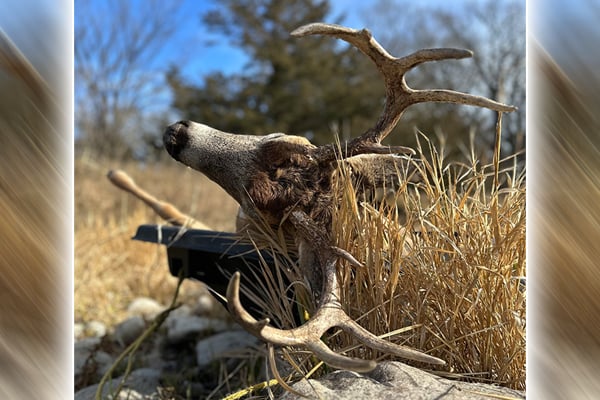
My favorite instruments when rattling are a set of real antlers. I once had a dandy set of about 135-inch heavy horns, but someone stole them from me at a seminar. I don’t think you need antlers that heavy, but they felt great in my hands and I had rattled in a bunch of bucks with them. I know that they were nothing but old bone, but doggone it, I miss those antlers!
Even though I prefer real antlers, I don’t think you’ll rattle in any more bucks with real antlers than with synthetics, a rattling bag, or any other rattling device. When a buck is ready to come to the horns, you can entice him by clattering a couple of arrows together (which has worked for me a time or two.)
My fanny pack or turkey vest always has a rattling bag in it.
Many times when I hunt for the day, I don’t plan to rattle much, so I don’t bother toting along my rattlin’ horns. On countless times on these days, I will decide to rattle a little or spot a buck out of range and get his attention. That is where the rattling bag comes into play. My biggest buck in 2000, a dandy 15-pointer, came running to a rattling bag.
Many hunters are reluctant to rattle because they think it will scare off more bucks than it will attract. I don’t think rattling scares deer often. Occasionally I’ve spooked deer that were close when I began rattling, deer that I should have seen before I ever brought the horns together. But at a distance, I doubt rattling scares deer. After all, they hear it all the time.
Rattling is no gimmick. It works. Commit yourself to rattling in a buck and stick with it. One day a buck will come charging into the horns and then, like me, you will be hooked on rattling for life. Happy horn-shaking!