Wednesday, November 11th, 2026

Breaking News for

Sportsmen Since 1968

Search
Wednesday, November 11th, 2026

Breaking News for

Sportsmen Since 1968

Illinois Mixed Bag: Trapping permit drawing for nine sites scheduled

Havana, Ill. — DNR will conduct a public drawing for the allocation of trapping permits for nine different Illinois locations on Oct. 11 at Siloam Springs State Park in Adams County.

Registration will begin at 10 a.m., and the drawing will follow at 11 a.m. People whose names are drawn must be in attendance.

Site permits for trapping will be good for a two-year period.

All trappers entering the drawing must be at least 16 years old and have a current 2025-2026 trapping license and habitat stamp. Site-specific trapping regulations for each site will be provided at the drawing. Available sites are:

Siloam Springs State Park

• Buckhorn Unit

• Fall Creek Unit

Ray Norbut Fish and Wildlife Area-Pike County

• East Hannibal Unit

• Dutch Creek Unit

Weinberg-King State Fish and Wildlife Area 

Scripps Unit at Weinberg-King

• Spunky Unit at Weinberg-King

For more information about the Oct. 11 drawing, call 217-894-6205 or 217-285-2221.

onX Mapping Expands Into Illinois

Minneapolis — onX Fish Midwest, a digital mapping and discovery tool for anglers, recently announced its expansion into the state of Illinois. With plenty of lakes and dozens of gamefish species to choose from, Illinois’ anglers now have a tool for finding the right lakes to target their desired catch.

“Illinois anglers know the real treasures are found close to home,” said onX Fish Head of Marketing, Joel Nelson. “From tucked-away park lakes to expansive reservoirs, the state offers incredible bass, crappie, and bluegill fishing, among other species, across hundreds of accessible waters. With onX Fish, we’re giving Illinois anglers a tool to uncover new spots and make every trip more rewarding – whether they’re fishing their favorite local lake or branching out to explore somewhere new.”

onX Fish Midwest is a new app developed by digital mapping and navigation powerhouse onX. The app aims to solve the biggest problem facing anglers, “Where should I go fishing?” onX Fish Midwest debuted in Minnesota in early 2024. Since then, the company has been adding more Midwestern states, while gathering feedback from anglers in each new state to improve the user experience before moving onto the next. The app is currently also available in Minnesota, Wisconsin, Michigan, North Dakota, Indiana, and Ohio, and will continue to expand across the region and country. Learn more: https://www.onxmaps.com/about.

B.A.S.S. Events Televised On Fox, FS1

Birmingham, Ala. — B.A.S.S. has announced the 2026 television schedule for the Progressive Bassmaster Elite Series and the Bass Pro Shops Bassmaster Classic.

This season delivers 12 hours of live bass fishing on FOX broadcast television, reaching more than 200 million U.S. households, along with almost 60 hours of additional weekend coverage on FS1. This comes on the heels of record-breaking viewership in 2025, which saw a 20% increase in live viewers over 2024.

The Elite Series season launches Feb. 7-8 with back-to-back live shows from Lake Guntersville on FS1. Just a week later, the tour heads to Lake Martin, another Alabama favorite, setting the stage for a seven-month run of live coverage from some of America’s most diverse bass fisheries.

Anchoring the broadcast lineup is the Bassmaster Classic on the Tennessee River in Knoxville, Tenn. Fans can tune in March 14 at noon ET and March 15 at 3:30 p.m. ET on FOX. For the remainder of the season, FS1 will continue to serve as the home for weekend live coverage.

Deer Factor in Reported Illinois ‘Tick Invasion’

Champaign, Ill. — Experts said Illinoisans should be aware of the increase in ticks in the state. A new study out of the University of Illinois shows multiple counties recording three different types of ticks: the lone star tick, the dog tick and the black legged tick.

Associate Professor of Epidemiology at the University of Illinois, Becky Smith, says they found between 2018 and 2022 there were over 1,700 human cases with Lyme disease infections.

“Deer is a big factor,” Smith said. “Deer provides such a good blood meal that they’re able to make a lot of eggs, and so then there’s a lot of babies, and so there’s just more ticks.”

SUBSCRIBER CONTENT

Read this article now.
Create a free Outdoor News account.

Create a free account below to get instant access to this article, thousands of Outdoor News stories, and our digital editions. Your 1-month trial starts the moment you sign up.

No credit card required

Email Address(Required)
Password(Required)
Name
What outdoor activities interest you?(Required)

No credit card required

No credit card required

Share on Social

Facebook
Twitter
LinkedIn
Email

Hand-Picked For You

Illinois hunters hope to time mallard movement with their midseason hunts. Photos courtesy of Bill Key Early-migrating northern pintails are a common sight along the Illinois and Mississippi rivers. Which birds move early and which wait for winter? By Russ Mason Contributing Writer Some waterfowl are programmed to leave the North well before winter arrives. Others stay as long as open water and available food make survival possible. Understanding the difference helps explain migration patterns – and gives hunters a better idea of when the next flight of birds might arrive. Biologists describe the differences in terms of migratory strategies. Understanding them helps explain why blue-winged teal disappear while mallards remain, or why snow geese move through an area even as some Canada geese settle in for winter. Obligatory and facultative migration Waterfowl migration falls along a continuum rather than into two rigid categories. Obligate migrants follow regular seasonal migration patterns largely governed by biological rhythms. Changes in day length initiate physiological and behavioral preparations for migration. These birds generally travel between northern breeding grounds and southern wintering areas even when northern weather remains relatively mild. Facultative migrants have greater flexibility. They can delay migration when conditions remain favorable, moving when deteriorating weather, frozen wetlands, snow-covered food supplies or other environmental changes make remaining in place less advantageous. Migration is expensive, consuming energy and exposing birds to hazards. When suitable habitat remains available farther north, staying put may offer a survival advantage. Research published in the Journal of Animal Ecology in 2024 confirmed that temperature and precipitation influence fall migration across multiple waterfowl species, although responses vary. Early departures: Teal and northern pintails Blue-winged teal are among North America’s earliest southbound duck migrants. Many begin leaving northern breeding areas in late summer, sometimes before most hunters begin thinking seriously about fall migration. Their departure is driven largely by seasonal biological rhythms rather than freezing temperatures. Bluewings winter primarily in the southern United States, Mexico, Central America and northern South America. Northern pintails are also relatively early migrants. Many begin moving south before winter conditions become severe, using shallow wetlands, flooded agricultural fields and other productive feeding areas along the way. Northern shovelers, gadwalls and wood ducks also frequently make substantial southbound movements before severe winter weather arrives. For hunters, the lesson is straightforward: Early-season opportunities can be excellent for teal and other early migrants. Waiting for the first major cold front may mean missing some of the best local concentrations. Snow geese: Travelers of long distances Snow geese provide a useful contrast to the more weather-dependent behavior of many Canada geese. Their populations follow pronounced annual migrations between Arctic and subarctic breeding grounds and wintering areas farther south. Greater snow geese, for example, breed in the eastern Canadian Arctic and winter primarily along the Atlantic Flyway. Other populations use the Central and Mississippi flyways. These journeys are part of an established seasonal cycle tied to breeding, molting, food availability and winter survival. Snow geese cannot remain indefinitely on northern breeding grounds simply because autumn happens to be mild. Canada geese: Not all geese are alike Northern-breeding Canada geese typically migrate between Canadian breeding grounds and wintering areas in the United States. Other populations breed in temperate regions of the United States and southern Canada and may remain in the same general area year-round. Large Canada geese are remarkably cold-hardy. They can remain in northern areas as long as they can reach waste grain in harvested fields and find open water for resting and roosting. Deep snow can cover food supplies, however, while extensive ice eliminates access to aquatic feeding areas and safe roosting habitat. When those conditions persist, geese often move south. This explains why a flock feeding in a Great Lakes cornfield in November may include northern migrants, local residents or both. Their behavior may look identical, but their subsequent movements can be quite different. Biologists point out that all ducks do not migrate on the same schedule – or for the same reasons. Weather is a major factor but is certainly not only factor, especially in Illinois. Photo courtesy of Bill Key Mallards: Classic migrants dependent on weather Mallards are among North America’s best examples of facultative migration. Their adaptable diet and ability to exploit agricultural foods allow many populations to remain farther north than less flexible species. They feed on seeds, aquatic vegetation, waste grain and other available foods. Where harvested fields provide grain and rivers, springs or other waters remain open, mallards can survive considerable cold. A brief freeze does not necessarily produce a major migration. Birds may wait out cold spells rather than expend the energy required for long-distance travel. The situation changes when persistent snow covers food supplies and ice eliminates access to wetlands. Moving south then becomes a practical necessity. Mallards can also move north again when winter thaws reopen feeding areas. This flexibility helps explain their unpredictable hunting patterns. Diving ducks: Waiting for the big water to freeze Canvasbacks, redheads, scaup, goldeneyes and buffleheads use lakes, bays, reservoirs and other waters. Many depend on aquatic food resources that remain accessible in deeper water after shallow wetlands begin freezing. Consequently, diving ducks can remain north after some dabbling ducks have moved south. Eventually, extensive ice cover forces movement, with timing depending on species, water depth and alternative habitat availability. For hunters, the arrival of diving ducks may depend less on the first hard frost than on conditions across the larger waters where these birds feed. Early November: The first major turning point Species to watch: canvasbacks, scaup, redheads, American wigeon, mallards and Canada geese. Large lakes and bays attract diving ducks, while northern-breeding geese increase in number. Mallards may also arrive following favorable winds. What hunters should look for: large rafts of diving ducks, increasing goose traffic and fresh mallard concentrations. Mid- to late November: Weather’s a bigger player Species to watch: mallards, Canada geese, late-moving diving ducks and remaining northern migrants. Persistent cold, snowfall and ice become increasingly important. Mallards and Canada geese often remain north while food and open water are accessible. What hunters should look for: shrinking open-water areas, abandoned marshes and new concentrations along larger rivers and lakes. A brief cold snap may redistribute birds locally. Prolonged freezing temperatures accompanied by deep snow are more likely to trigger substantial southward movements. December: The freeze-up migration Species to watch: late mallards, Canada geese, common goldeneyes and other late-moving ducks. Widespread ice can produce the final major southbound movements in the Great Lakes region. Some birds remain around open rivers, springs and reservoirs. What hunters should look for: remaining open-water refuges and fields where accessible grain remains available. The three signals worth watching Three field observations are often more informative than the calendar alone: 1. Open water: When shallow wetlands freeze, birds concentrate on deeper lakes and rivers. When those areas freeze, larger movements may follow. 2. Snow cover: Snow hiding waste grain can push mallards and Canada geese out of otherwise-suitable northern habitat. 3. Wind and weather systems: Favorable winds and passing fronts help migrants travel, while sustained cold and snow change where birds can feed and rest. Hunters should also distinguish migration from redistribution. Birds shifting among nearby lakes, marshes and agricultural fields have not necessarily begun a long-distance journey. The takeaway Some waterfowl move because the season tells them it is time to go. Others move when conditions make staying too costly. Early migrants, such as blue-winged teal, offer opportunities before severe weather arrives. Snow geese follow pronounced seasonal routes. Northern Canada geese and mallards wait until snow and ice restrict food and open water. Diving ducks can remain as long as their preferred waters remain productive. For waterfowl hunters, understanding these differences provides a better framework for predicting migration than watching the thermometer alone. The calendar tells you which birds may be coming; habitat and weather help explain when they are likely to move.

Related Articles

Illinois hunters hope to time mallard movement with their midseason hunts. Photos courtesy of Bill Key Early-migrating northern pintails are a common sight along the Illinois and Mississippi rivers. Which birds move early and which wait for winter? By Russ Mason Contributing Writer Some waterfowl are programmed to leave the North well before winter arrives. Others stay as long as open water and available food make survival possible. Understanding the difference helps explain migration patterns – and gives hunters a better idea of when the next flight of birds might arrive. Biologists describe the differences in terms of migratory strategies. Understanding them helps explain why blue-winged teal disappear while mallards remain, or why snow geese move through an area even as some Canada geese settle in for winter. Obligatory and facultative migration Waterfowl migration falls along a continuum rather than into two rigid categories. Obligate migrants follow regular seasonal migration patterns largely governed by biological rhythms. Changes in day length initiate physiological and behavioral preparations for migration. These birds generally travel between northern breeding grounds and southern wintering areas even when northern weather remains relatively mild. Facultative migrants have greater flexibility. They can delay migration when conditions remain favorable, moving when deteriorating weather, frozen wetlands, snow-covered food supplies or other environmental changes make remaining in place less advantageous. Migration is expensive, consuming energy and exposing birds to hazards. When suitable habitat remains available farther north, staying put may offer a survival advantage. Research published in the Journal of Animal Ecology in 2024 confirmed that temperature and precipitation influence fall migration across multiple waterfowl species, although responses vary. Early departures: Teal and northern pintails Blue-winged teal are among North America’s earliest southbound duck migrants. Many begin leaving northern breeding areas in late summer, sometimes before most hunters begin thinking seriously about fall migration. Their departure is driven largely by seasonal biological rhythms rather than freezing temperatures. Bluewings winter primarily in the southern United States, Mexico, Central America and northern South America. Northern pintails are also relatively early migrants. Many begin moving south before winter conditions become severe, using shallow wetlands, flooded agricultural fields and other productive feeding areas along the way. Northern shovelers, gadwalls and wood ducks also frequently make substantial southbound movements before severe winter weather arrives. For hunters, the lesson is straightforward: Early-season opportunities can be excellent for teal and other early migrants. Waiting for the first major cold front may mean missing some of the best local concentrations. Snow geese: Travelers of long distances Snow geese provide a useful contrast to the more weather-dependent behavior of many Canada geese. Their populations follow pronounced annual migrations between Arctic and subarctic breeding grounds and wintering areas farther south. Greater snow geese, for example, breed in the eastern Canadian Arctic and winter primarily along the Atlantic Flyway. Other populations use the Central and Mississippi flyways. These journeys are part of an established seasonal cycle tied to breeding, molting, food availability and winter survival. Snow geese cannot remain indefinitely on northern breeding grounds simply because autumn happens to be mild. Canada geese: Not all geese are alike Northern-breeding Canada geese typically migrate between Canadian breeding grounds and wintering areas in the United States. Other populations breed in temperate regions of the United States and southern Canada and may remain in the same general area year-round. Large Canada geese are remarkably cold-hardy. They can remain in northern areas as long as they can reach waste grain in harvested fields and find open water for resting and roosting. Deep snow can cover food supplies, however, while extensive ice eliminates access to aquatic feeding areas and safe roosting habitat. When those conditions persist, geese often move south. This explains why a flock feeding in a Great Lakes cornfield in November may include northern migrants, local residents or both. Their behavior may look identical, but their subsequent movements can be quite different. Biologists point out that all ducks do not migrate on the same schedule – or for the same reasons. Weather is a major factor but is certainly not only factor, especially in Illinois. Photo courtesy of Bill Key Mallards: Classic migrants dependent on weather Mallards are among North America’s best examples of facultative migration. Their adaptable diet and ability to exploit agricultural foods allow many populations to remain farther north than less flexible species. They feed on seeds, aquatic vegetation, waste grain and other available foods. Where harvested fields provide grain and rivers, springs or other waters remain open, mallards can survive considerable cold. A brief freeze does not necessarily produce a major migration. Birds may wait out cold spells rather than expend the energy required for long-distance travel. The situation changes when persistent snow covers food supplies and ice eliminates access to wetlands. Moving south then becomes a practical necessity. Mallards can also move north again when winter thaws reopen feeding areas. This flexibility helps explain their unpredictable hunting patterns. Diving ducks: Waiting for the big water to freeze Canvasbacks, redheads, scaup, goldeneyes and buffleheads use lakes, bays, reservoirs and other waters. Many depend on aquatic food resources that remain accessible in deeper water after shallow wetlands begin freezing. Consequently, diving ducks can remain north after some dabbling ducks have moved south. Eventually, extensive ice cover forces movement, with timing depending on species, water depth and alternative habitat availability. For hunters, the arrival of diving ducks may depend less on the first hard frost than on conditions across the larger waters where these birds feed. Early November: The first major turning point Species to watch: canvasbacks, scaup, redheads, American wigeon, mallards and Canada geese. Large lakes and bays attract diving ducks, while northern-breeding geese increase in number. Mallards may also arrive following favorable winds. What hunters should look for: large rafts of diving ducks, increasing goose traffic and fresh mallard concentrations. Mid- to late November: Weather’s a bigger player Species to watch: mallards, Canada geese, late-moving diving ducks and remaining northern migrants. Persistent cold, snowfall and ice become increasingly important. Mallards and Canada geese often remain north while food and open water are accessible. What hunters should look for: shrinking open-water areas, abandoned marshes and new concentrations along larger rivers and lakes. A brief cold snap may redistribute birds locally. Prolonged freezing temperatures accompanied by deep snow are more likely to trigger substantial southward movements. December: The freeze-up migration Species to watch: late mallards, Canada geese, common goldeneyes and other late-moving ducks. Widespread ice can produce the final major southbound movements in the Great Lakes region. Some birds remain around open rivers, springs and reservoirs. What hunters should look for: remaining open-water refuges and fields where accessible grain remains available. The three signals worth watching Three field observations are often more informative than the calendar alone: 1. Open water: When shallow wetlands freeze, birds concentrate on deeper lakes and rivers. When those areas freeze, larger movements may follow. 2. Snow cover: Snow hiding waste grain can push mallards and Canada geese out of otherwise-suitable northern habitat. 3. Wind and weather systems: Favorable winds and passing fronts help migrants travel, while sustained cold and snow change where birds can feed and rest. Hunters should also distinguish migration from redistribution. Birds shifting among nearby lakes, marshes and agricultural fields have not necessarily begun a long-distance journey. The takeaway Some waterfowl move because the season tells them it is time to go. Others move when conditions make staying too costly. Early migrants, such as blue-winged teal, offer opportunities before severe weather arrives. Snow geese follow pronounced seasonal routes. Northern Canada geese and mallards wait until snow and ice restrict food and open water. Diving ducks can remain as long as their preferred waters remain productive. For waterfowl hunters, understanding these differences provides a better framework for predicting migration than watching the thermometer alone. The calendar tells you which birds may be coming; habitat and weather help explain when they are likely to move.

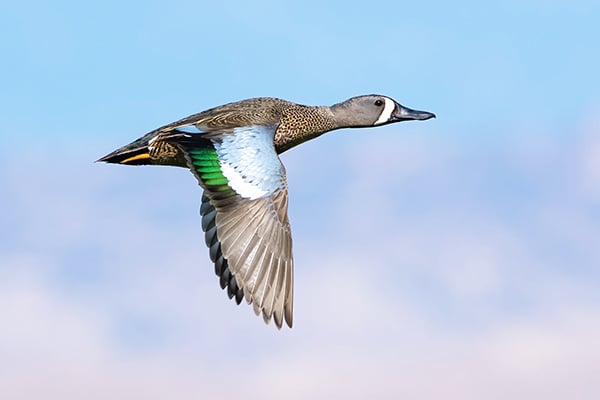
Blue-winged teal head south on a biological clock, while mallards and Canada geese wait until snow and ice cut off

GET THE OUTDOOR NEWS DELIVERED TO YOUR INBOX

Sign up for the Outdoor News Weekly Newsletter and get 2 months of FREE access to OutdoorNews.com – packed with hunting, fishing, and conservation news. No Catch.

This offer includes digital access only (not the printed edition)

Email Address(Required)
Password(Required)
Name
What outdoor activities interest you?(Required)

PLEASE READ

Accessing Your Full Subscription Just Got Easier. Introducing Single Sign On.

 We’ve simplified things. Now you only need one password to access all your Outdoor News digital content.

Here’s how it works:

  1. Click Continue below.
  2. You’ll be taken to the OutdoorNews.com sign-in screen.
  3. Don’t have an account yet? Create one—it’s quick!
  4. After signing in, click the E-Edition Login button again. When the pop-up appears, just click Continue.
  5. You’ll either:
    1. Land on the e-edition selection screen (you’re in!)
    2. Be sent to a help page if we didn’t detect a subscription.

If you hit the help page, follow the directions so you don’t miss out on any of our great content.

One login. Every edition. Easy.

Let’s get you reading!

PLEASE READ

 We’ve simplified things. Now you only need one password to access all your Outdoor News digital content.

Here’s how it works:

• Click Continue below.

• You’ll be taken to the OutdoorNews.com sign-in screen.

• Don’t have an account yet? Create one—it’s quick!

• After signing in, click the E-Edition Login button again. When the pop-up appears, just click Continue. You’ll either:

  1. Land on the e-edition selection screen (you’re in!)
  2. Be sent to a help page if we didn’t detect a subscription.

If you hit the help page, follow the directions so you don’t miss out on any of our great content.

Help Shape the Future of OutdoorNews.com!

We know you love the outdoors—now we want to make OutdoorNews.com the ultimate destination for all things hunting, fishing, and conservation.

Take our brief 3 minute survey to share your thoughts, and help us build the best outdoor website on the planet. As a thank you, we’ll send you a special offer!

Together, we can make OutdoorNews.com even better.

Introducing The Outdoor News Foundation

For a limited time, you can get full access to breaking news, all original Outdoor News stories and updates from the entire Great Lakes Region and beyond, the most up-to-date fishing & hunting reports, lake maps, photo & video galleries, the latest gear, wild game cooking tips and recipes, fishing & hunting tips from pros and experts, bonus web content and much, much more, all on your smartphone, tablet or desktop For just a buck per month!

Some restrictions apply. Not valid with other promotions. $1 per month for 6 months (you will be billed $6) and then your subscription will renew at standard subscription rates. For more information see Terms and Conditions. This offer only applies to OutdoorNews.com and not for any Outdoor News print subscriptions. Offer valid thru 3/31/23.

Already a subscriber to OutdoorNews.com? Click here to login.