




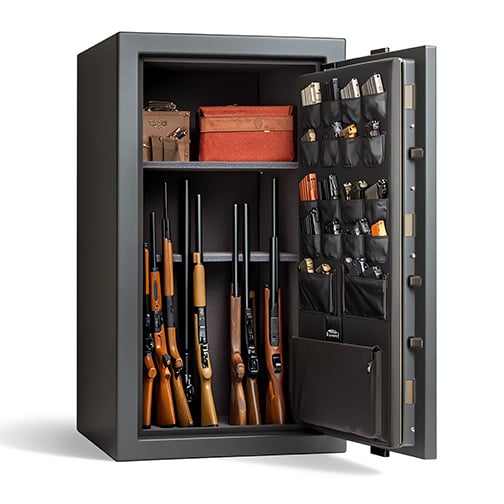
All of us who own firearms – whether it’s one gun or more than a dozen guns – bear the responsibility of keeping them all safe and secure. That means storing them in a proper gun safe.
The most important job of a gun safe is keeping people out and keeping firearms secure. Gun safes deter access to unauthorized family members and visitors, but they also can protect firearms and other valuables from storm damage, water damage, and fire.
We need to give at least as much thought to the purchase of a gun safe as we do when buying a new shotgun, rifle or handgun.
Here are several important features to consider when looking for a gun safe.
Size and weight

If you keep a handgun in your living area or bedroom for quick access in an emergency, pistol lock boxes offer affordable security for a handguns and other valuables. Most feature effective protection from unauthorized access. Many meet TSA requirements for handgun security and can travel in luggage.
However, most gun owners are wise to invest in a large steel floor safe that is able to securely store a mix of handguns, shotguns, rifles, and accessories. A safe in the 750-pound range, when loaded, offers a good combination of size and security.
An interior clearance of 58 inches of height should provide ample room for the longest shotguns and rifles and leave room for a top shelf. Interior widths of 30 to 40 inches should provide room for a couple dozen guns, or a dozen guns on one side and normal shelving on the other. A nice, wide interior also lets you place shorter rifles (or AR-15 uppers) horizontally on an upper shelf.
MORE HUNTING FEATURES FROM OUTDOOR NEWS:
Exercise your hunting dog’s mind and reap the rewards this fall
E-bikes change how hunters, anglers reach their spots quickly, cleanly, and quietly
Summer food plot maintenance: Lime, fertilizer, mowing and more
Shell strength
When you are evaluating which gun safe will be best for you, consider the shell strength of the safe, which is a combination of components, design, and construction quality. It’s also important to note that well-constructed safes are built with continuous welds – not “stitch welds” linked with body filler.
Because steel is very expensive, some low-end safes have very thin steel wall panels (12-gauge or even 14-gauge). Thin steel does not offer much of an obstacle to penetration.
A wall of 10-gauge steel is a recommended minimum, and 8-gauge, or 3⁄16-inch, is the preferred choice. You should compare the wall thickness on gun safes from various brands. Thicker steel is harder to cut, and more resistant to break-ins.
Capacity
Gun safe capacity refers to how many gun slots a safe has – not how many physical firearms the safe will hold. Due to the unique sizes and shapes of different gun styles, there is no one-size-fits-all solution.
It’s generally recommended to purchase a slightly larger safe than what you currently need. This way, you will have space to accommodate a growing gun collection, as well as store other valuable items.
Fire rating
A gun safe fire rating indicates how long a gun safe will protect weapons and valuables if engulfed in flames. Combining the amount and quality of the insulation and other aspects of safe construction are crucial to total fire protection.
There are a few key numbers to keep in mind when looking at a safe’s resistance to fire. The first number is 350° Fahrenheit, which is the temperature at which most wood products will begin to be damaged. The second number is how long the safe will keep the interior below 350° with a 1,200° exterior temperature.
Locking systems
Mechanical dial and electronic keypad locks are the two locking systems most often found on gun safes.
Mechanical dial locks have been around in their present form since the early 1900s.They are so effective because they are mechanical parts with a long lifespan, being free of batteries and electronics.
They are typically not as sensitive to adverse conditions such as short-term exposure to moisture, heat, or water. They will stand up better to fire than an electronic lock. However, they are not as quick to open as other locking systems.
Electronic locks are generally faster to operate on an everyday basis and under adverse conditions. They also allow multiple user-changeable combinations, enabling owners to grant or revoke access to the safe to others as needed.
Electronic locks generally have a shorter lifespan, and also require regular maintenance. Many of the locks use a 9-volt battery, and changing them annually also is recommended.
Biometric locks use a physical or behavioral characteristic to identify a person, like fingerprints, iris structure, hand geometry, facial recognition, eye retina, and even blood vessels.
RFID (radio frequency identification) locks work much the same way as the biometric safes, in that they are broadcasting a signal and looking for that unique code to be bounced back to them from the RFID chip.
Popular safes include Browning, Cannon, Fort Knox, Liberty, Remington, and Winchester. More information is available online, or you can check out these, and others, at larger sporting goods stores.
Quality safes are a wise investment in safeguarding your firearms and valuables. They offer secure storage and protection against theft, and they can enhance overall safety within your home.
Gun safes: another take
Here’s another take on gun safes.
A big, heavy, thick, steel gun safe can thwart curious juveniles and snatch-and-grab burglars, but a serious thief will either torch through safe walls, use an electronic device or app to open a digital lock, or simply haul the entire safe off your property. If burglars can break into commercial bank safes, what chance does your little gun safe have against them?
The poor man’s safe hinges on ingenuity and deception more than steel and concrete. Some radical redneck friends of mine coat their finer pieces in grease, wrap in plastic, and bury. That’s OK for long-term protection, but it’s a bit inconvenient should the need arise to shoot a rabid raccoon.
A more reasonable option is to scatter your small collection of hunting or target guns around the house. Use trigger or action locks/cables to prevent unauthorized use. You can remove bolts, levers, even barrels from many guns to make them inoperable and less attractive to thieves. Just label each part so you know where it goes. Store parts in a safe, secure hiding spot far from the accompanying firearm. Thadeus Thief is unlikely to rummage through your garage, workshop, attic, and bedroom closets searching for each bolt and barrel to match the gun he found in the closet.
To keep the necessary shootin’ irons at hand for home- and self-defense, maintain one or two firearms reasonably accessible, yet protected from urchins. Quick-access safes for handguns. Quick-detach trigger blocks for long guns. A lockable closet … Someplace you and other adults in the family can access quickly but a curious neighborhood kid cannot.
Look, you’re a responsible adult, a responsible gun owner. Contemplate why, where, and when you might need a gun vs. store, hide, and protect your guns and you’ll figure it out. Just don’t expect to find a mystical magical “gun safe” that is going to absolutely, positively protect your firearms against all misuse, theft, and destruction.
The world just doesn’t work that way.
– Ron Spomer

Way less land for hunting spurs action from Pennsylvania Game Commission
The Pennsylvania Game Commission has overhauled its Hunter Access Program this year in an effort to boost declining landowner participation

Where do big bucks go when they vanish?
Over the course of our three-months-plus bowhunting season, seeing just one wall-hanger buck can be cause for celebration. Trophy proportioned

WI Daily Update: Tips for catching cohos on river mouths of Superior
This is a great time of year to chase coho salmon on the river mouths on Lake Superior. Tim Lesmeister
