





The 2024 Minnesota waterfowl season left me unsatiated – a feeling that nagged at me until I began planning an out-of-state waterfowling foray.
Just like many other Minnesota waterfowlers, the myriad days of stagnant action this past season left me craving more, scheming to extend my duck-hunting days. My first thought was a trip to southeastern Texas to chase birds on vast Sam Rayburn Reservoir, a body of water I know well.
However, I had neither the time nor desire to trek 19 hours one way for a waterfowl trip.
The solution was made clear one evening while I viewed a quality duck-hunting video on YouTube: hunters dropping mallards over warm-water creeks while hunting in freezing weather. I avoid most hunting videos like the plague, but this one preached ethics, had excellent production value, and was chock full of genuine duck-hunting tips.
MORE WATERFOWL COVERAGE FROM OUTDOOR NEWS:
A downer duck season overall in Minnesota ends with a bang
Ralph Loos: Illinois hunters have mixed opinions on timing of spring light goose season
How do Canada geese respond to hunting pressure? They didn’t flee far in Pennsylvania study
The video was captured in northwestern Nebraska, near the Wyoming border, in what looked like a cow pasture studded with cottonwood and olive trees that lined a meandering creek. The creek was of the shallow, warm-water variety, coursing over springs and never freezing no matter how far temperatures plunged.
The best part was the Nebraska waterfowling season in that unit continued until Feb. 9. After hearing that, it took me about 5 minutes to check off a few days in late January for a hunt.
With limited days to hunt, I turned to social media friends and duck-hunting contacts to find a local Nebraska waterfowling guru with whom to hunt. In the end, I got lucky, eventually meeting up with pro walleye angler and duck-hunting fanatic Curtis McCormick, who had a few days free to show me the warm-water waterfowling ropes.
Veteran duck dog Cash and I loaded up the truck and embarked on a 9½-hour drive to northwestern Nebraska, arriving at an airbnb cabin near Bridgeport, Neb., at nightfall. Our first task was to visit a local grocery store.
We crossed the Platte River on our way into town and were awestruck by the thousands of ducks and geese loafing on the frozen river. Looking skyward, we saw hundreds more returning from fields to roost. It certainly looked like the long drive would pay off.
Curtis dropped me a navigation pin, and early the next morning I followed it 16 miles to our hunting area. The spot looked exactly like the video: a steaming, winding creek barely 8 inches deep, surrounded by short grass and studded with gray-barked cottonwood trees. On the north bank of the creek was a duck blind covered in dead tree limbs and full cedar branches. It looked like a lumber waste pile and was perfectly camouflaged in that environment.
We then got busy, placing six-dozen goose and 24 mallard decoys and then climbing into the blind. The temperature hovered at minus 7, with light winds that did not disperse the misty veil created by the warm water, and sun rays that made every droplet glow rusty orange.
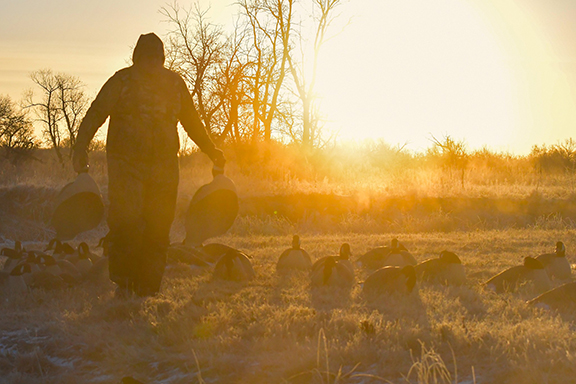
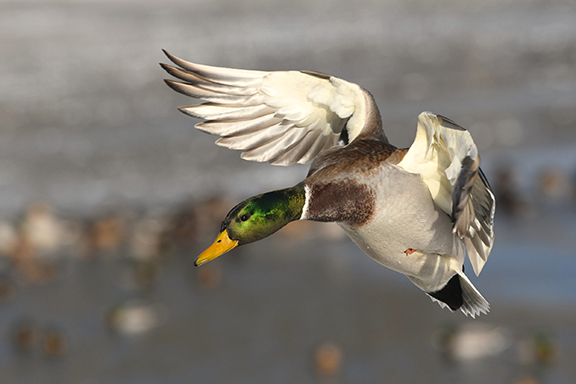
By the time guns were loaded and gear organized, it was past first shooting light. Moments later, a drake mallard swung through, and Curtis coaxed him down with expert calls. The greenhead shimmered in the early light as he prepared to land and, with a trigger pull, I secured my first warm-water creek mallard. I stepped out with Cash and sent him down to the bank to retrieve his first Nebraska mallard.
The mallards did not pile in, but singles and pairs arrived every 10 minutes as they left the frozen river for the open creek. On top of that, small flocks of Canada geese coursed above, on their way to feed in nearby cut cornfields.
After we’d secured our mallards, Curtis convinced some of those geese to set their wings over our dekes. My first goose was a king-sized bird that 50-pound Cash dragged a bit before tilting his head as if telling me to collect this one myself, which I did. I purposely shot the smallest goose in the subsequent flight and, after finding a good hold, diminutive Cash trotted right back with it.
The following morning was much warmer – 20 degrees with a steady breeze. Strangely, mallard activity was slow, but goose action was heavy. By morning’s end, I had three mallards, a limit of honkers, and Curtis added his own honkers to make more of his homemade smoked pastrami. Some of the geese were ultra-wary, circling repeatedly, flaring, but then returning, lured by Curtis’s amazing calling skills.
Our final morning found us a half-mile west, along the same warm-water creek. This really was a cow pasture without a hayfield as a goose-attractant feature. With coolers already stocked with geese, we concentrated solely on mallards.
This spot had no blind, no elaborate decoy set – just 12 mallards decoys bobbing on the little creek. We leaned against large cottonwood trees for camouflage, and Cash sat next to me in the short grass.
My final drake of the trip came as we were taking a break. A drake squawked high above, and I planted myself against a tree while Curtis called. The drake spiraled down, landing gear out, headed for a warm-water roost, not caring about the three forms in the sparse trees.
I lined up on the descending greenhead and shot quickly before he got too close. The drake struck the far bank and Cash streaked to retrieve. And, just like that, our 2024 waterfowl season was over, and the 2025 campaign was under way.
For restless waterfowlers who hate stowing their duck guns, my advice is to research nearby states where it’s possible to take advantage of later-running seasons. Of course, there are also upcoming spring light goose seasons to consider that will assuredly quench any waterfowler’s thirst for action.
Minnesota’s 2026 elk harvest reaches nearly half of allocated tags during early season
As the first half of the elk season winds down in northwestern Minnesota, nearly half the tags have been filled

Upper Herring Lake offers western Michigan bass anglers a legitimate fall option
Bass can be widely distributed through the vegetation, but cooling water often triggers more active feeding.
Michigan’s Outdoor Calendar
A look at upcoming outdoor-related events from across Michigan published in the Sept. 25, 2026 edition of Outdoor News.
