




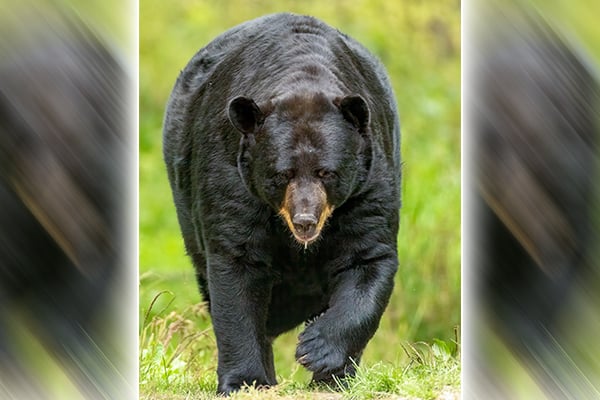
We could see it moving through the tall, dull green grass of late summer, moving in our direction. I told our photography group to move back and prepare cameras. The bear was a big one. Next, I told the group: “For this image to work, we will need to get down low and switch from horizontal to vertical format.”

A minute later, my prediction was correct; it was walking straight at us. Using a long lens so we could keep a distance, our group captured some impressive images of a male American black bear (Ursus americanus). This specimen was well over 500 pounds and preparing for hibernation.
The American black bear, or simply “black bear,” is – go figure – endemic (found only) in North America. Of the three bear species on this continent, it is the smallest but most widespread of the bears.
The black bear evolved from another bear species around 4 to 5 million years ago. Since that time, based on fossil records, the black bear has become smaller.
Historically, the American black bear roamed most of North America but today is restricted to most of the Northeast, going down the Appalachian Mountains, the northern states of Michigan, Wisconsin, and Minnesota. They are also found all across Canada and down the Rocky Mountains and down the west coast well into California. There also are populations in the Carolinas, Florida, portions of the Gulf Coast, plus Arkansas and Missouri.
READ MORE ‘NATURE SMART’ COLUMNS FROM STAN TEKIELA:
Nature Smart: Photographing condors
Nature Smart: One big, and extremely rare, brood of loons
Nature Smart: Backyard hummingbirds
Adult male black bears average between 200 to 500 pounds. Adult females are smaller and are between 100 and 375 pounds. Black bears found in northern states and Canada are larger than ones down South. This is a good example of Bergmann’s rule, a biological rule that states the larger the animal’s body, the easier it is to stay warm in the cold of winter and the smaller the animal’s body, the easier it is to keep cool during summer’s heat.
I find black bears fascinating. They’re perfectly adapted to living in North America. Bears can do things that other animals can’t.
For example, the black bear mating season was back in June (spring) and even now, at the end of summer, the females are still not pregnant. The species’ reproductive system holds the egg and sperm in a suspended state of animation and won’t become implanted in the female’s uterine wall until October.
The female’s overall health in autumn determines how many fertilized eggs will go on to become cubs and will be born in February after only about four months gestation.
At this time of year, bears are eating as much as they can to build enough fat to last through winter.
RELATED STORY FROM OUTDOOR NEWS: Bears are consumed by eating in the fall in quest to put on incredible weight
Hibernation is amazing. Here in the northland, a bear can hibernate for upwards of seven months. During this time, the bear’s metabolic activities are suppressed and the digestive system can come to a complete stop.
Other systems such as thermal (body core temperature) only slow down. Respiration and heart rate also suppress and lower.
Combined, when all of these systems are slowed down or stopped the bear saves enough energy to last until spring. Think of it as gasoline in your car: The more you conserve the longer it will last.
Many people envision a hibernating bear as being unconscious, mouth open, tongue hanging out, and snoring loudly. The reality is that bears are often awake and looking around. They move around regularly, and pregnant females give birth during hibernation.
After the cubs are born, the sow keeps them warm and will also nurse the young. Also, during hibernation, bears that have any injuries often heal nicely by springtime. If you and I were to lie down for seven months, our muscles would atrophy (muscle loss) so bad that we would need to learn how to walk again.
Bears lie down for the same amount of time and don’t have any issues with muscle loss. Bears are amazing creatures and have the ability to do things other large mammals cannot.
Until next time …
Stan@naturesmart.com

Ohio Cuffs & Collars: Stolen black walnut tree from Wallace O’Dowd Wildlife Area
Ohio cuffs and collars are field reports from the Division of Wildlife. These reports are from the Sept. 25, 2026
H2Ohio wetland to benefit St. Marys
As part of Ohio Gov. Mike DeWine’s H2Ohio Initiative, the Ohio DNR (ODNR) and the city of St. Marys held
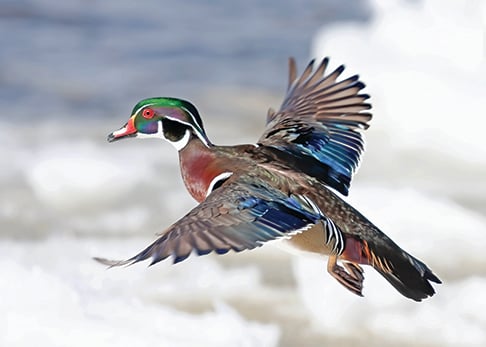
USFWS announces new duck season framework process
The Department of the Interior recently announced that the U.S. Fish and Wildlife Service (USFWS) is finalizing a streamlined process
