Search Results for: baitfish rule – Page 5
During the past month, angling guide Darren Troseth has been able to use more rod holders in his boat. On July 1, a new law took effect that allows the use of two-line fishing on part of the Minnesota River and Pool 2 of the Mississippi River.
Troseth, a fishing guide on the Mississippi, St. Croix, and Minnesota rivers, is taking advantage of the new law after advocating for it during the past decade. There have been many new changes and laws for rivers in Minnesota, including bait laws, but two-line fishing has been one of the biggest and challenging bills to pass.
Just as I had done a thousand times that week, I swung the big crankbait around in a figure-eight alongside the boat. As the crankbait hesitated in a turn, a fish flashed out from beneath the boat and T-boned the lure.
I set the hook and grunted “Fish!” to let my partner know I was hooked up to what I thought was about a 40-inch muskie, judging by the width of its head. But I was stunned to see a white tip on the fish’s tail waving much farther back in the water than it should have been.
I’m a muskie fisherman first, and all the walleyes that hit muskie baits were incidental catches. But when something occurs multiple times when fishing, you’ve discovered a pattern, and big walleyes on big baits is a great one.
As summer progresses start searching for fish in deeper depths and water with current JPT Head Coach Jason Revermann is a hardcore angler and he’s shared some valuable tips for keeping the bite hot when the water warms up during the summer months. As summer sets in the water temps continue to rise. Make sure
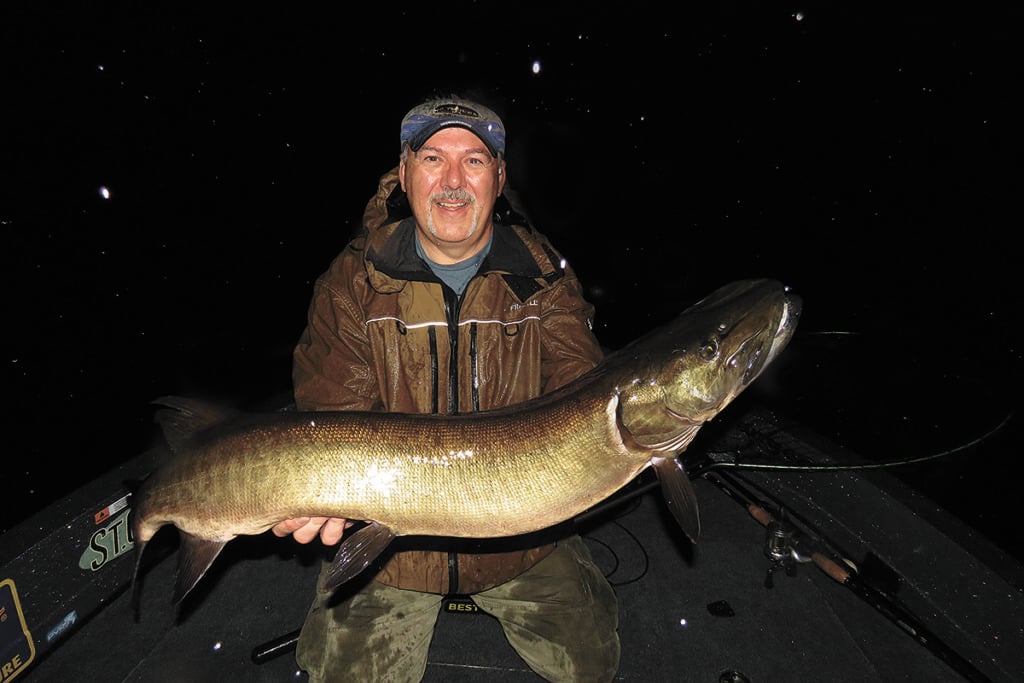
One of the great mysteries in muskie fishing is where to find them, or at least where to find fish that will bite today. Should we fish hard structure or soft? There is no simple answer that will apply to every day – where you should fish varies with the day and the season.
Structure as defined in fishing lexicon is the bottom of the lake that doesn’t change, like breaklines and rocks. “Cover” on the other hand, is the stuff that changes or disappears with time, such as weeds, fallen trees, man-made cribs, etc. All fish species use structure and/or cover at some point every year.
A shortage of bait minnows has been a common topic in recent years. The angling advocacy group MN-FISH hosted its annual summit on May 3 in Rogers, and the topic was first on the agenda.
Several bait shop owners, bait dealers, and minnow trappers attended and spoke about the topic during the summit. The Minnesota DNR also explained steps it’s taking to help relieve the shortage.
As more and more people take to the great outdoors, the spread of invasive species becomes an ever-increasing concern. Invasive species can wreak havoc on ecosystems, causing damage to native flora and fauna and disrupting food chains.
Let’s look at some of the best practices for stopping the spread of invasive species while enjoying our favorite outdoor pursuits.
It’s extremely rare for there to be ice on any of the state’s lakes during a May opener, even in the extreme northern portions of Minnesota. Yet, there are still additional considerations when ice-out is just days before we float the lakes it once covered.
We’ve all adjusted to what fishing cold water can mean: Shiners will be sold (where available), and jigs will be pitched. But other plans can work wonders.
By the time spring comes around, the fish have spent months with fewer food sources, and most have released a major portion of their energy during the spawning process. Adding to the challenge for anglers is the likelihood that a holdover steelhead has seen dozens of imitations and was likely caught and released several times while in the tributary. Each experience leaves an impression on the fish’s instinct to survive.
More finesse, a little luck, and a lot of persistence will be required to catch spring steelhead. Consider these items, which might help.
Last summer, as I sat at my desk overlooking Raritan Bay, I watched dozens of boats from small 17-foot center-consoles to 40-footers clustered near the Verrazano Bridge.
My son Matt was part of this fleet clobbering huge schools of striped bass at all depths from the surface to the bottom of the bay. The stripers would alternate from hitting surface lures to natural baits on the bottom.