


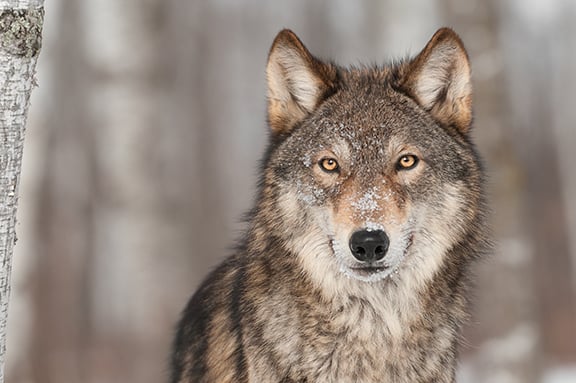
Superior, Wis. — State and federal wildlife experts have resorted to a little-used tactic in the Midwest called “night riding” in an attempt to lower the killing and harassment of livestock by wolves.
Imagine applying for a job where the description might read: “You get to work in the outdoors all night while riding an ATV in the wind, rain, sleet, and snow while shooting off firecrackers.” That’s essentially what the new night riders, hired by the USDA-Wildlife Services team, will be doing in Wisconsin’s Douglas County – riding around pastures on ATVs at night in hopes of keeping wolves at bay. The night riders will use thermal imaging devices to help locate wolves.
Night riders, also called range riders, provide a nonlethal management tool – more often seen in Western states – that uses a continuous human presence with the intent of deterring the marauders in areas experiencing a high level of wolf-killed livestock.
Dan Hirchert is the state director of USDA-Wildlife Services, the arm of the federal Department of Agriculture. The Wisconsin Department of Natural Resources (DNR) contracts with Wildlife Services to address wild-animal complaints.
“Range riding can be an effective tool and is used throughout the country to prevent predations where other methods are not feasible or have failed,” Hirchert said. “It’s a time-consuming endeavor that does have its own risks for staff, especially those working during night hours. Wildlife Services conducts range riding when other nonlethal options are not as effective as needed.”
MORE WOLF COVERAGE FROM OUTDOOR NEWS:
State Roundup: More details needed in what led to killing of nine wolves in Wisconsin’s Price County
Deemed a human safety threat, nine of Wisconsin’s Price County wolves trapped, killed
Minnesota’s wolf population remains stable, DNR considers new monitoring
Hirchert said ground crews have used drones in attempting to deter wolves, but that approach is not sustainable because of the multiple sites spread throughout the state where they could be used.
The DNR and Wildlife Services decided to go the range-riding route in Douglas County in the wake of repeated wolf attacks on livestock and multiple attempts at using other tactics to limit livestock deaths and injuries. Since Great Lakes Region wolves are still on the federal Endangered Species List and no state-managed hunting or trapping season is available at this time, wolves may only be killed by Wildlife Services personnel if the wolf behavior is considered a concern to human safety. Such was the case in September when Wildlife Services personnel trapped and killed nine wolves in the Price County town of Flambeau.
Hirchert confirmed that other nonlethal attempts to deter wolves on this farm had been tried in Douglas County. Fladry was one of them. Fladry is simply strips of colored flagging, usually red, tied to wire fencing. The visual change can slow wolves for a short time, but the effectiveness of fladry is usually temporary, which has been the case in Douglas County.
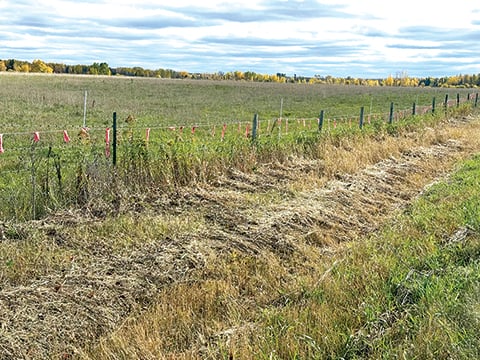
Even “turbo fladry,” an electrified fencing component to the fladry, was tried and failed.
“Nearly 5 miles of turbo fladry was deployed a week before wolves were captured on camera bypassing the fladry and entering the pasture,” Hirchert said. “Typically, our first response is to install a scare-radio in the pasture where conflicts have been documented. This is a solar-powered, all-weather system that randomly turns on at varied intervals to mimic human presence. We’ll often combine techniques and will also use LED flashers that also randomly turn on at varied intervals.”
In the Douglas County scenario on a farm near the town of Brule, three scare-radios were put out to fully cover the area that livestock have been using, along with night range riding and drone-assisted night range riding, and the turbo-fladry tactic for multiple weeks. Wildlife Service’s staff conducted the range riding efforts, according to Hirchert, who went on to say via email that range riding has been used in previous years when other nonlethal options were no longer working.
“Currently, we have Wildlife Services staff spending three nights a week on-site for most of the night. They do have various items to ensure their presence is obvious – lights, vehicle, and FLIR (forward-looking infrared). We also have staff qualified to fly drones at night and have used a drone equipped with FLIR, spotlight, and a speaker to patrol pastures,” he said.
Drones and range riding work in preventing the killing of domestic animals by wolves, but Hirchert said there are limitations: “These efforts are not sustainable with multiple conflict sites spread throughout the state.”
Perschbacher, Williams named Wisconsin Natural Areas’ top volunteers for ’26
The Wisconsin Department of Natural Resources (DNR) announced Diane Perschbacher and Rory Williams as the 2026 State Natural Areas Volunteers

Wisconsin Mixed Bag: Oct. 31 the Deadline to Buy Sturgeon Spearing License for Lake Winnebago
Anyone interested in harvesting a lake sturgeon from Lake Winnebago during the 2027 sturgeon spearing season must buy their license
Meet our Wisconsin conservation clubs: Butte des Morts Conservation Club
Founded in 1994, the Butte des Morts Conservation Club is a robust club dedicated to conservation in east-central Wisconsin. Its
