




Home » Home Page News » Deemed a human safety threat, nine of Wisconsin’s Price County wolves trapped, killed
Deemed a human safety threat, nine of Wisconsin’s Price County wolves trapped, killed
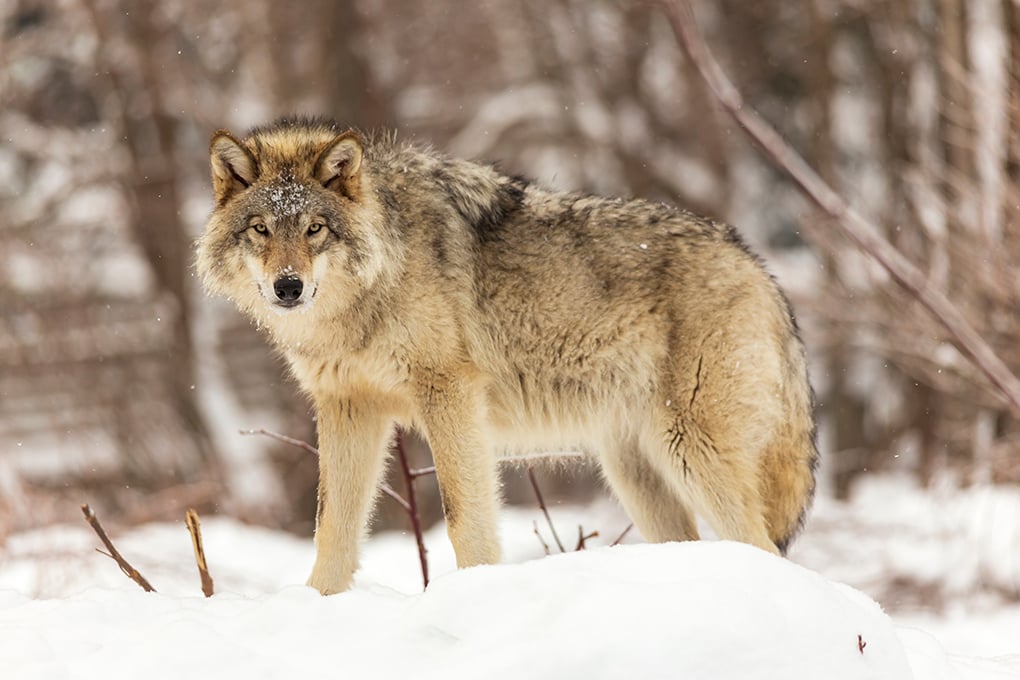
Phillips, Wis. — At a request from the Wisconsin Department of Natural Resources (DNR), the federal USDA-Wildlife Services team carried out the trapping and killing of nine Price County wolves due to a series of verified threats to human health and safety in the town of Flambeau.
DNR and Wildlife Services personnel documented those safety threats for more than a year before making the decision to remove the wolves.
Threats to human safety stand as the only reason lethal removal is allowed because of the continued protection of Great Lakes region wolves under by the federal Endangered Species Act.
The wolves, likely all from the same pack, had been displaying this concerning behavior from July 2025 through August. Other media outlets reported an incident on Aug. 12, when a homeowner in Flambeau captured trail camera photos of wolves directly behind his house, and another when a wolf stepped onto a trail 30 to 40 yards in front of a person on motorized equipment and continued to stare at the person.
This is considered abnormal behavior because wolves usually stay far away from people and people’s homes.
MORE WOLF COVERAGE FROM OUTDOOR NEWS:
Minnesota’s wolf population remains stable, DNR considers new monitoring
State Roundup: September wolf kills to report on from Wisconsin
Trump’s executive order on wolf delisting does not ensure state management yet
The Price County wolf pack demonstrated a pattern of behavioral escalation with a heightened acclimation of human presence and a complete lack of response to nonlethal deterrents that included noise harassment, increased lighting, and the removal of potential attractants. The residents of the affected area followed through with all DNR and Wildlife Services suggestions to deter the behavior, but none of those efforts worked.
The wolves began showing less response to the hazing attempts and became more acclimated to human presence, according to comments from Randy Johnson, the DNR’s large carnivore expert, via email.
Under the system used to characterize wolf threats, there are three types of human health and safety conflict rankings, Level 1 through Level 3. Level 3 behavior is classified as normal nonthreatening and nonhabituated behavior, but there’s more frequent human contact than is acceptable. Behavior such as hunting and killing wild prey near dwellings or in proximity to dwellings during daylight are examples. Level 2 threats show a nonaggressive habituation to people, while Level 1 threats display aggressive behavior toward a person.
By policy, neither Johnson nor Wildlife Services team members provided more detail about the wolf removal or location than the fact that the nine wolves were trapped and killed in Flambeau, although online reports show that Level 2 and 3 threats were documented in mid-August.
Laurie Groskopf, a Tomahawk resident who has been involved in Wisconsin wolf management for years, said lethal removal has been used in the past.
“A wolf was lethally removed from the train yards in Superior. Deer were drawn to spilled corn and a wolf saw this was easy pickings. There was also a dairy operation in Price County east of Fifield where wolves were walking right into a barn where people were working,” Groskopf said. “Sometimes trapping was successful and sometimes not.”
Groskopf also thought the DNR should be more transparent with the details of what happened in the Flambeau situation so the public has a better understanding of why the wolves were killed. She isn’t saying that the location or the names of threatened individuals should be released to the public, but the DNR or U.S. Fish and Wildlife Service (USFWS) explaining those details leading up to removal would “steal some thunder” from the social media keyboard warriors who can now speculate on what happened while browbeating the people who lived with wolf threats for more than a year.
“I feel the (USFWS) and DNR are not doing a good job of advising the public about these conflicts,” Groskopf said. “It doesn’t help increase public information and ability to take precautions.”
Groskopf added that these situations create serious negativity toward wolves and the agencies that manage them, and “that’s not a healthy approach to wildlife management.”
Adrian Wydeven headed the DNR’s wolf recovery program from 1990 through 2013. He said decision by USDA-Wildlife Service and DNR for removal was a reasonable approach.
“I’m sure Wildlife Services and DNR wanted to avoid level one threats and acted before that happened,” Wydeven said. “In this type of group learning, the most effective management would be the removal of the entire pack. Younger wolves having lost fear of people and being habituated to people are not likely to readily lose that behavior.
“Also leaving any young wolves behind after removing the adults would likely lead to more nuisance behavior or starvation of the young wolves.”
Earlier this year, the DNR said the state’s over-winter wolf population fell slightly this year from last with an estimate of 1,162 wolves in 321 packs, down from last year’s estimate of 1,225 and a 2024 estimate of 1,311.
The removal of the nine wolves is expected to “have no lasting negative biological impact on the wolf population in the area,” Johnson said.
The DNR is working with the USFWS to transfer the nine wolf carcasses wolves to the Great Lakes Indian Fish and Wildlife Commission.
SUBSCRIBER CONTENT
Read this article now.
Create a free Outdoor News account.
Create a free account below to get instant access to this article, thousands of Outdoor News stories, and our digital editions. Your 1-month trial starts the moment you sign up.
No credit card required
No credit card required
No credit card required
Subscriber? Login Here.
Share on Social
Hand-Picked For You
Vosburgh Swamp WMA a Hudson shoreline hangout in eastern New York
New York’s Outdoor Calendar
New York Outdoor News 2026 Rut Tracker: Second rut?
New York Cuffs & Collars: Out-of-state baiter busted
Steve Piatt: Scrolling, coughing, and hunting
New York DEC’s nature film gets an Emmy
Related Articles
Striped bass populations continue downward trend along East Coast
Montauk, N.Y. (AP) — Striped bass fishing has been Bill Jakob’s passion for more than 60 years, and he remembers
Steve Piatt: Scrolling, coughing, and hunting
Spend any serious time on Facebook – which I’m capable of doing on occasion – and it’s easy to begin
Christine Thomas: Will the preparation pay off on Wisconsin’s opening day of deer hunting?
It is hard to imagine that the Green Bay Packers did not do everything possible to get ready for the
