


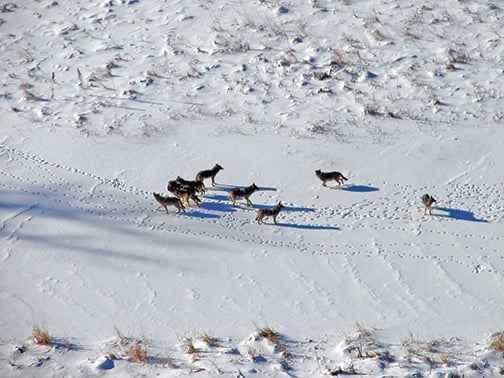
Key points from the story:
- Minnesota’s wolf population is statistically stable. The DNR estimates 2,431 wolves across roughly 26,000 square miles of wolf range, with a confidence interval of plus or minus 425 wolves.
- The 2026 estimate represents about 460 wolf packs, with an average pack size of 4.5 wolves and an average home range of 56 square miles.
- The DNR is considering new ways to monitor wolves. Researchers are discussing a statewide trail-camera survey modeled after Wisconsin’s Snapshot Wisconsin program, which could provide more consistent data and reduce reliance on weather-dependent snow tracking.
St. Paul — Minnesota’s wolf population remained statistically stable within confidence intervals from 2025 across nearly 26,000 square miles of wolf range, but it’s down slightly from historical numbers.
John Erb, furbearer and wolf research biologist for the DNR, said the population estimate for wolves within the state is 2,431, with confidence intervals at plus or minus 425 wolves. He said that leads to a range of about 2,000 to 2,800. In 2025, the point estimate was 2,294 wolves, with an interval ranging from 1,862 to 2,670 wolves.
Compared to last year, the average pack size rose slightly. Last year, it was 4.21 wolves per pack. For 2026, the average rose to 4.5.
The total range wolves inhabit throughout the state is about 26,000 square miles.
The average home range for each pack this winter is about 56 square miles, resulting in about 460 total wolf packs.
The number of square miles occupied by wolf packs is determined approximately every five years. The last estimate for the land occupied by wolf packs was completed during the winter of 2024-25.
Because that number hasn’t changed, Erb thinks the estimates over the past two years are lower. This is because the estimate of pack-occupied range from 2024-25 was likely underestimated because of the reduced snow tracking conditions and efforts.
“It’s one of those things that sometimes happens, and we’re working on some new methods to try and make it so that is less of a concern moving forward,” Erb said.
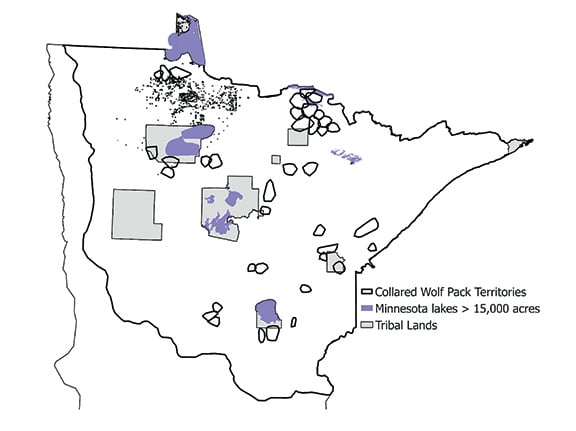
Researchers with the DNR, tribal nations, and university partners annually record population estimates of wolves residing in Minnesota. Researchers determine the population estimate through three pieces of information: the total area of land occupied by wolf packs, average wolf pack territory size, and average mid-winter pack size.
The last two pieces of information are gathered from radio-collared wolves, allowing delineation of pack territory and pack size counts from trail cameras and an aerial visual count over regions with collared packs during the winter.
Erb said population estimates are based on confidence intervals. That is because it would be nearly impossible to collar all the wolves and requires sampling the population.
“Confidence intervals are like a margin of error they talk about when they do a report on the news, they may report on a poll that 38% of people plus or minus 3% have a certain opinion,” Erb said. “In context of our wolf survey, it reflects that we’re sampling a subset of the packs and that therefore there’s uncertainty in some of our parameters.”
MORE COVERAGE FROM MINNESOTA OUTDOOR NEWS:
Minnesota’s sandhill crane hunt stays in northwest for 17th year
Wild game left in your freezer? Great recipes to try before refilling this fall
Ron Schara: Want pheasants? It’s always been a simple formula
Though the population is stable, Erb said that when looking at the point estimate without taking into account the confidence intervals, the numbers have been down over the past two years.
“In the winter of 2023-24, we didn’t get an estimate because snow was so bad we couldn’t get sufficient pack counts. But then these last two have been 2,200 to 2,400. That point estimate is down a fair bit from what it was, say, from 2016 all the way to 2022 resting at about 2,700,” Erb said. “But when you start looking at the confidence intervals and see how much they overlap, the actual conclusion is that none of these ups and downs represent statistically significant changes.”
Changes to monitoring?
Going forward, Erb said the DNR is in initial talks to improve how they monitor wolves.
He said the DNR has a wolf research committee made up of DNR, tribal nations and universities to help consider those potential changes. One example being discussed right now is a statewide camera survey, like Snapshot Wisconsin.
That’s a program where a trail camera is set up in townships throughout the state. It also has potential for private landowners and citizens to participate and offer more reliable data and a less weather-dependent assessment of wolves in Minnesota.
Though in initial talks about new ideas, Erb said monitoring species is the best way to address problems that arise within a population and it helps develop management practices to help them thrive.
“You have to have monitoring in place to be able to detect when new concerns have come up that need to be looked at,” Erb said. “Maybe it means some change to management, maybe it means more research. If you don’t kind of know where you’re at, it’s hard to make decisions on when something is wrong or where you need to go.”

Minnesota Letters to the Editor: Another View on Norquist’s firearms safety column
Reader-submitted letters to the editor published in the Oct. 9, 2026 edition of Minnesota Outdoor News.
Minnesota’s Lessard-Sams Outdoor Heritage Council advances 57 projects looking for funding
Members of Minnesota’s Lessard-Sams Outdoor Heritage Council recently discussed and took action on recommendations and allocations for the next cycle

Outdoor Insights: Beast of a marathoner runs 26.2 miles (8,390 rods) with a canoe
On Monday, Oct. 5, Travis Meier, 38, of Minneapolis, was fielding calls from Twin Cities media as well as the

1 thought on “Minnesota’s wolf population remains stable, DNR considers new monitoring”
The DNR needs to lobby to get the wolf taken off the endangered species list. They need to be controlled like any other predator.
They are having a tremendously negative impact on deer populations in northern Minnesota.
There is also a direct negative impact on hunting dollars going back into the local economy.
Hunters are not going to travel to, hunt in and spend money in northern Minnesota if they don’t see any deer.
What does the DNR value, hunters and local businesses in northern Minnesota or special interest groups in the Twin Cities who are pushing a pro wolf agenda ?