




“They busted us,” said my cousin, who could not contain his incredulousness.
It was a perfect late-autumn morning in the marsh – crisp, clear, mildly windy, full of promise. The day couldn’t have started any better. We had scouted this smaller peanut-shaped wetland surrounded by picked corn the night before as hundreds of mallards piled into it near dusk. With few other options, we decided to set up there the following morning.
Our mallard floaters – were set and listing in a J-hook pattern of sorts. We were able to play the wind so the ducks would land into the blocks (and into the wind) from the side rather than in our face. That way they wouldn’t be starring directly at us as they approached our makeshift blind, which we had brushed in during the early morning darkness with natural vegetation from stem to stern.
We wore facemasks and used some black and olive camo makeup on the tops of our hands so they wouldn’t act like glowing white strobe lights to incoming birds. We donned camo jackets that almost perfectly mimicked our surroundings. We agreed “our hide” was awfully good.
“I think we’re plenty concealed,” my cousin said.
Even my black Lab wore a camo neoprene hunting vest.
That crisp, clear morning that began full of promise – well, let’s just say it didn’t live up to the hype. It wasn’t for a lack of mallards.
Around 9:30 a.m. or so, several nice flocks gave our hole an intimate look-see, though none committed. They seemingly wanted to, but at the last minute they pulled out and vectored off, as if they were walled off by some invisible force. They clearly saw something they didn’t like.

Duck vision, explained
Getting busted isn’t breaking news for duck hunters. If you’ve hunted long enough, you’ve had it happen.
I relayed the story to John Coluccy, a Ducks Unlimited biologist who serves as the director of conservation planning at the Great Lakes/Atlantic regional office in Michigan. Coluccy is also an avid waterfowler.
I asked his thoughts on getting busted. He gave me a crash course on duck vision – an area that has been lightly researched over the years compared to waterfowl ecology. If ducks have one super power, it’s superior vision.
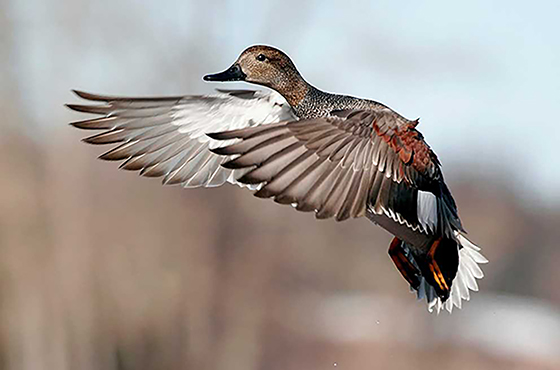
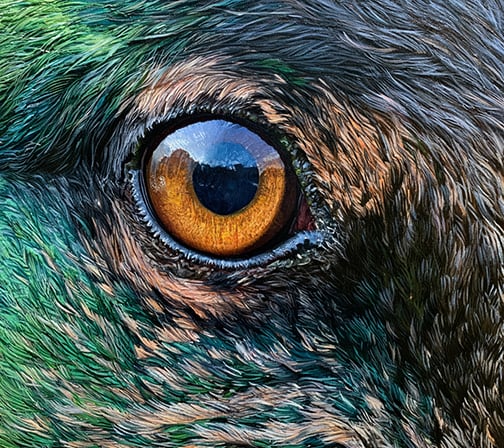
“Ducks live a high-speed aerial life and sight is their most important sense,” he said, adding they use their high-end eyesight to search for food, detect predators (including hunters) and engage in colorful courtship rituals.
“They saw something they didn’t like in your spread. Maybe it was something you were wearing that didn’t fit the environment,” said Coluccy, adding that waterfowl possess several visual adaptations that help them to be in-tune to their surroundings. Their visual superiority allows them to see the tiniest details as much as three times farther away than humans.
Consider: Cones and rods are the photoreceptors in the eye. Cones enable us to see color and see during daylight. Rods allow for vision in low light. Humans have three cone types that allow us to see what’s called the red-green-blue spectrum. Ducks and most other birds have an extra cone, which allows them to see in the ultraviolet spectrum.
“Ducks see an additional primary color that we can’t see,” he said. “They have this remarkable visual acuity. They see the colors we do, of course, but what they see is much more detailed and vivid.”
Ducks also have a high density of cones to see at night, an asset for their long migrations in spring and fall.
MORE WATERFOWL COVERAGE FROM OUTDOOR NEWS:
Tom Pink: Michigan waterfowlers face issues here – and ‘there’
The ins and outs of South Dakota nonresident waterfowl hunting
A look at a waterfowler’s gear wish list heading into the 2026 season
Despite their superb vision, most avian critters have to overcome one obstacle: monocular vision. While humans have binocular vision (both eyes view the same object at once), avian eyes are set on each side of the head and each eye is used separately. Birds are able to see better to the side than straight ahead.
“Monocular vision forces birds to observe objects and their environment one eye at a time,” said Coluccy said.
The end result is an image or sight picture that is often flat and lacks depth perception. Still, ducks have visual adaptations to monocular vision, including increased panoramic view, with birds having near or total 360-degree lateral viewing in which they can see more or less in a circle at all times.
Waterfowl also compensate for monocular vision with constant and rapid head movement. This allows ducks and other birds to observe with one eye from two angles very quickly, which greatly improves depth perception.
“It creates a three-dimensional picture, if you will,” said Coluccy.
Keeping concealed
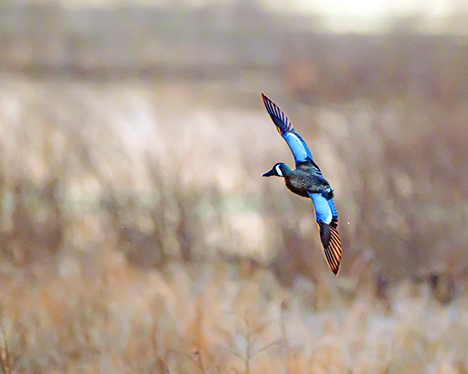
Given that ducks and other waterfowl have extraordinary vision, hunters must be mindful of the “eyes in the sky.” What are some mistakes that contribute to hunters getting busted? A big one, he said, is simple: many hunters leave faces and hands uncovered.
“Those things stick out to ducks – they see the fine details,” he said. “It is even more important to keep hands and face covered up when you have hunters moving around in the blind.”
That’s why a blind with overhead cover is important.
“It just minimizes potential detection,” he said. “When ducks like mallards come in, you can see their heads moving side to side – they’re checking for danger. Even when they’re moving away from your spread and you hit your call, don’t move. They can still see movement when they’re heading in the opposite direction.”
Another common mistake is not “blending in” to your surroundings. That includes everything from your blind material to clothing (coat, hat, gloves, waders, etc.).
Over the years for his job, Coluccy has flown over hunting areas during duck season and observed hunters in their blinds.
“When you don’t blend in, you stick out like a sore thumb from the air – especially on overcast days,” he said, adding that hunters should always use natural shade to conceal themselves and/or their blinds. “If I can see you that easily from the air, just imagine what ducks can see.”
Lastly, hunters should provide a distraction in their sets to help minimize a ducks’ visual acuity as much as possible. Motion – from spinning-winged decoys, pulsating decoys, quiver magnets, even old-school jerk strings – can help level the playing field.
“Anytime incoming ducks aren’t looking at something else, like movement you’ve created, that can give you a competitive advantage to a degree,” he said.
Final thoughts
I’m still not sure why my cousin and I got busted that day. If I had to guess, we didn’t have the requisite overhead cover to finish those always-on-alert mallards and they were side-eyeing us on the way in.

Dan Small Outdoors Radio: Show 2142
Ruffed grouse hunters report an average season so far, and woodcock hunters are finding lots of flight birds in northern

Pennsylvania’s archery elk hunters do better than in previous years
Twenty-two lucky hunters drew tags for Pennsylvania’s archery elk season Sept. 12-27, which included three Sundays for the first time.

Pennsylvania Mixed Bag: Allegheny National Forest, U.S. Forest Service donate firetruck
The U.S. Forest Service recently strengthened community safety and local partnerships through the donation of a fire engine from the
