




A few years back, when I was guiding college-age students into the Boundary Waters in Minnesota, I took a group to an outfitter’s store for last-minute supplies and to expose them to the vibe of canoe country, letting their excitement build.
At the check-out counter, the proprietor had stacked two or three varieties of natural insect repellent, labeled with “no artificial chemicals,” “nature’s natural,” “organic,” or “non-toxic,” in packages of shades of green. He knew his customers.
The displays did their job and caught the eye of my team, one of whom asked the older fellow manning the point-of-sale terminal what he thought of a particular natural bug dope.
“I love ’em,” he said. “They are great!”
A couple students gathered closer.
“They only have one drawback,” the man continued. “They don’t work worth a %#*!,” he said. “Buy DEET.”
And he was right.
MORE COVERAGE FROM MINNESOTA OUTDOOR NEWS:
An unforgettable fishing trip reveals the risks of the Ambler Road project in Alaska
Outdoor Insights: We don’t need more roads in wild places
Do more sightings outside core range equal hope for Minnesota’s moose?
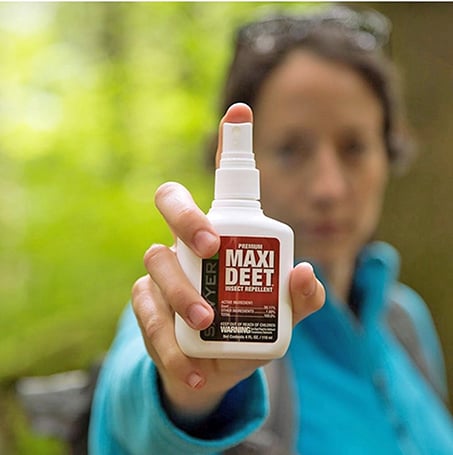
DEET (N, N-diethyl-meta-toluamide) gets a bad rap in some circles, but it works. A synthetic chemical, it was invented during World War II to keep the mosquitoes off our armed forces in the jungles, and it hit the mass market in 1957.
In the years since, other repellents have proved successful – picaridin for skin and permethrin (affiliate links) for clothing – but none have undergone the years of testing and real-world experience as DEET. It is the most-studied insect repellent ever. The Environmental Protection Agency estimates one-third of the U.S. population uses DEET at least once a year.
Used as directed, DEET is safe and effective. (Don’t drink it.) It should not be used on infants younger than 2 months old. For older children, no more than 30% DEET in the dose. Don’t put DEET on children’s hands to reduce the risk of accidental ingestion.
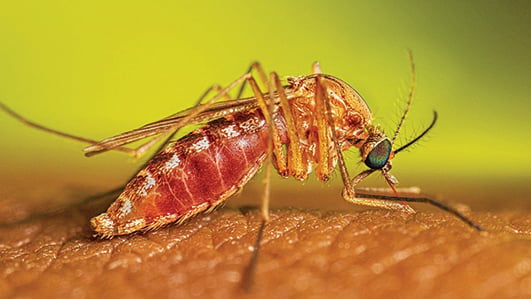
DEET does not kill insects; it works as a repellent by interfering with their ability to smell and locate humans. Many people mistakenly believe that DEET is effective against every type of bug, but that is not the case. DEET does not work against lice, fleas, and stinging insects, including bees, wasps, and hornets. Some studies also suggest that products combining DEET and sunscreen may reduce the effectiveness of sunscreen.
One of my students, a confident person in the ways of a 20-year-old, began a one-way detailed disputation with the clerk about the efficacy of oil of lemon eucalyptus (OLE), which has its supporters in the bug dope community. To his credit, the clerk listened politely to the polemic, said “um hmm” a couple of times, and sold an OLE spray to the young man and more to his friends.
Green marketing is a powerful tool.
So is folk knowledge. A farmer told me he chewed garlic to keep the flies off; I don’t know if it worked on flies, but it repelled other farmers quite successfully.
As we left the outfitter, the clerk looked at me with a “what can you do” gaze and a very slight shoulder shrug. I nodded, and off we went into canoe country, armed with natural oils and lighter wallets.

Bait sites versus food plots: Michigan study helps assess deer disease risks
The Michigan Natural Resources Commission spent time at its October meeting reviewing research on deer behavior at bait sites and
Star Watch: Naming the moon’s craters
What would you have to do to get a crater on the Moon named after you? First you would have

Michigan DNR seeks CWD samples from five counties
Michigan wildlife officials are asking deer hunters in five southwestern Lower Peninsula counties to help determine whether chronic wasting disease
