




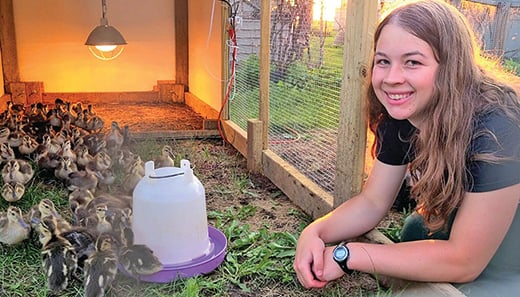
Madison Grimm said her first word was “duck.”
At least, that is what her parents tell her. Grimm told Outdoor News that she said it while looking at one of her father’s wildlife paintings hanging on the wall.
Now 19, the northeastern South Dakota wildlife artist has transformed her lifelong fascination into Second Chance Flight. It is a nonprofit that rescues waterfowl eggs from nests accidentally destroyed during haying and other agricultural work.
Grimm incubates the surviving eggs, raises the hatchlings, and releases them into wetlands.
Additionally, until this year, Grimm could accept only migratory waterfowl eggs, but not eggs from state-managed birds such as pheasants, grouse and turkeys. That led her to successfully advocate for a new South Dakota law during the 2026 S.D. legislative session.
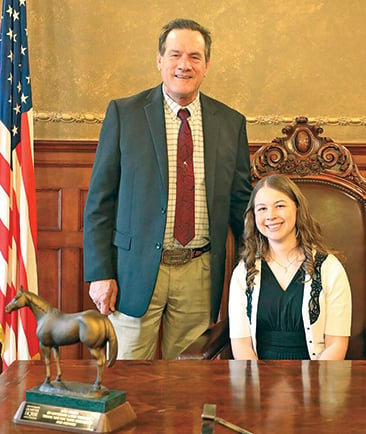
Grimm already held a U.S. Fish and Wildlife Service permit to rescue the eggs of migratory waterfowl. But state law prevented her from doing the same work with eggs from birds such as pheasants.
“I decided I really needed to get this law changed because there was a huge problem last year,” Grimm said.
The new law lets federal permit holders expand their work to other kinds of birds. South Dakota Gov. Larry Rhoden signed the bill in March, and it took effect July 1.
Grimm and her father traveled to Pierre to testify for the proposal. Although the S.D. Department of Game, Fish and Parks initially raised regulatory and survivability concerns, lawmakers overwhelmingly approved an amended version, and the bill was signed into law.
Grimm’s father, Adam, a nationally recognized wildlife artist and three-time winner of the Federal Duck Stamp Art Contest, had an influence.
Madison had her own private waterfowl aviary prior to Second Chance Flight, with over 100 birds from 21 species. It was originally built as a hobby and a source of reference material for her wildlife paintings. Madison is the only artist to ever win the U.S. Fish and Wildlife Service’s Junior Duck Stamp Contest three times.
“You get a full-color drake wood duck,” she said, “and it’s like, how do you top that?”
MORE WATERFOWL COVERAGE FROM OUTDOOR NEWS:
Video interview with Minnesota DNR’s Nate Huck on optional three-duck bag limit proposal
Dredging project to boost habitat begins Lake Onalaska restoration on Minnesota/Wisconsin border
North Dakota breeding waterfowl survey reveals slightly drier conditions, fewer ducks
The painting won South Dakota’s best-of-show award and advanced to the national competition, where the 6-year-old was competing largely against high school students. She won her first at 6 years old, becoming the youngest national winner in the program’s history.
“I would just sit there and paint for hours,” she said.
“They’re just such funny birds,” Grimm said of waterfowl. “They’re so quirky. They’ve got their individual personalities, and it’s just fun to capture that life in a painting.”
Farmers visiting the aviary knew she owned incubators. So when their farm equipment struck nests, they began asking whether she could save the surviving eggs.
At first, Grimm had to decline because she lacked the necessary federal waterfowl permit.
“It kind of broke my heart,” she said. “I didn’t know this was happening, and there’s apparently nothing anyone can do about it.”
Some farmers told her they could encounter 20 or 30 nests in a single field they are haying, particularly near water bodies. The machinery may kill the hen and crush some eggs, but other eggs often remain viable.
After researching a similar program in another state, Grimm secured a federal permit for Second Chance Flight.
When farmers strike a nest, they contact her, and she or a volunteer retrieves the eggs. She shines a light through to check the embryo’s development, disinfects cracks, and seals the shell with clear nail polish to block bacteria.
Grimm had accepted over 450 eggs as of late June, and nearly 700 since the program launched. She estimates that about 98% of the viable eggs placed in her incubators hatch.
She raises the ducklings for six to eight weeks and releases them in groups on wetlands. She releases them shortly before they can fly, so they remain together as they adjust to the wild.
Grimm has also applied for federal permission to place leg bands on released birds to help her learn if the birds survive.
Farmers like the program.
They have to cut hay to feed livestock, but many feel terrible when a hen gets caught in machinery and disappears in a burst of feathers.
“And they know she’s got a whole nest right there,” Grimm said.
She hopes to expand Second Chance Flight across the Prairie Pothole Region – an expanse of ponds and wetlands crucial for millions of migratory birds – and train others to conduct rescues.
Summer scouting mistakes whitetail hunters often make
With bucks bachelored up and showing the framework for this season’s headgear, it’s a great time to get your 24/7
Mike Raykovicz: Beavers establish a home on this small man-made pond
When I was in high school my best friend and I trapped beavers and other furbearers in the Pocono Mountains.
British, American Lab traditions converge at Minnesota’s Game Fair 2026
This year marks the 250th anniversary of the Declaration of Independence, when the United States separated itself from Great Britain.
