


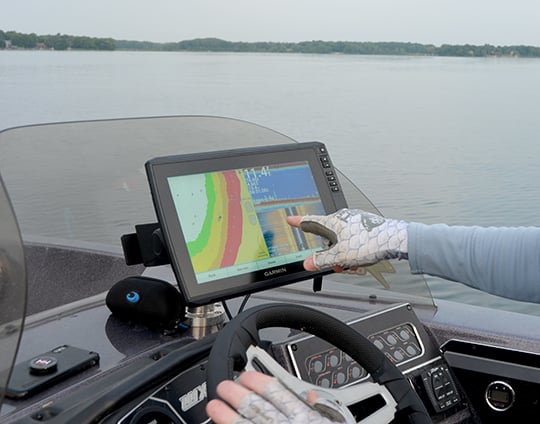
FFS STUDY. The retort regarding the effects of forward-facing sonar on fisheries consistently has been “Where’s the science?!” Well, the intrepid Maryland Department of Natural Resources just shared what it’s calling the most complete analysis of the technology to date. Thank Major League Fishing, which provided a unique data set via its 2025 bass tournament trail by restricting anglers to using live sonar during only one of three daily competition periods. That has provided a window for researchers to compare angler performance during periods of live-imaging sonar use against periods when it was not used.
Maryland DNR fisheries researchers including Ryan Gary and Joseph Love examined results from 73 professional anglers across eight MLF Bass Pro Tour events in 2025. Anglers in those events caught more than 12,000 fish. Then they published the results of the study in the North American Journal of Fisheries Management last month. They found the influence of live-imaging sonar (LIS) on catch rates varied by fishery, with notable increases occurring at lakes Conroe (Texas) and Murray (South Carolina). On Conroe, catch rates improved by 1.6 fish per hour using FFS, or nearly 10 extra fish in six hours of fishing. Generally, they found the weight of the bass caught did not differ much during the two periods.
Anglers caught an even greater percentage of bass using the technology in deep, open water areas with little habitat cover. That’s consistent with local concerns about the technology targeting muskies, big walleyes, and other suspended “deep nowhere” specimens that traditionally were tougher to catch on lakes like Leech and Mille Lacs. Anglers who caught fish in deep water (more than 9 feet) had nearly three times the likelihood of success by using the technology. In contrast, use of live sonar was less prevalent in shallow areas with abundant structure and habitat.
“Although anglers were more likely to catch fish with LIS in deeper, less structured environments, it appears to offer limited utility in shallow, complex shoreline habitats. Therefore, the risk of increased exploitation due to LIS may be inherent in fisheries with deeper, less structured habitats,” the researchers wrote.
On the MeatEater podcast last week, Gary said the seasonality of the events could have played a role in fish location and therefore the effectiveness of live sonar on a given water body at a given time of year. That said, using live sonar improved catch rates on six of the eight lakes, and it never hindered the tournament anglers.
“We never saw that live-scope negatively impact catch rates. At worst, it was a wash or equal to not having one,” he said.
So FFS may help anglers catch more, but not necessarily larger, bass. Also, the resulting catch increases more in deep, open water rather than shallow cover. Said the study authors: “Managers should evaluate how a lake’s depth and habitat influence the effectiveness of live-imaging sonar when considering the effects of widespread adoption of the technology on their fishery.”
Fisheries managers and anglers shouldn’t consider this one study the final word, but its observations also won’t strike avid anglers who’ve used this technology as surprising. FFS is allowing anglers to target suspended or deep-water fish that previously were like needles in a haystack. That’s why fisheries around the country, including (maybe especially?) in Minnesota have seen offshore fishing explode. The ability of FFS to easily identify solitary big fish is why Montana already has banned it for targeting paddlefish. MeatEater host Steve Rinella also noted that during a recent alligator hunt down south, live sonar allowed them to estimate bottom-hugging gators practically to the nearest inch.
For a full study, click here.

Michigan Mixed Bag: Officials renew venison warning for deer taken near Clark’s Marsh
Lansing — Michigan health and wildlife officials are reminding hunters not to eat venison from deer harvested within three miles
Michigan biologists investigate why 27 lake sturgeon got trapped
Lansing — Fisheries officials are embarking on a three-year project to understand why nearly 30 threatened lake sturgeon became trapped

Michigan Letters to the Editor: Residents deserve invasive carp transparency
Reader-submitted letters to the editor published in the Nov. 20, 2026 edition of Michigan Outdoor News.

2 thoughts on “Outdoor Insights: The forward-facing sonar study anglers have been waiting for is finally here”
The larger question in my opinion is how does the use of FFS affect harvest rates. According to the MN DNR, as the use of FFS increases and even if catch rates increase, harvest rates are decreasing at almost an inversely proportional rate across many species in Minnesota. Younger anglers like to catch fish but increasingly do not prefer to harvest fish.
So the question must be asked that if if more fish are caught but fewer are harvested, how exactly is a fish population affected?
I find FFS useful for crappie fishing, but it does not mean one is going to catch larger fish. I does help to one on the school more readily. For bass, helps to keep one on structure where bass maybe hiding out. I do not fish large lakes so I cannot speak to those. Most of the lakes I fish range from 20 to not quite 500 acres.