




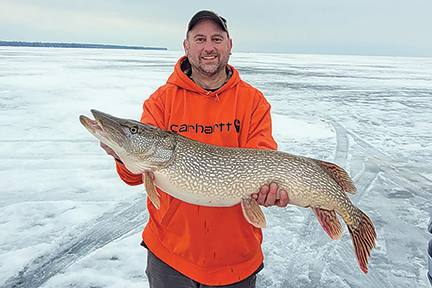
St. Paul — The Minnesota DNR has chosen Shannon Fisher as its new Fisheries section manager, replacing longtime manager Brad Parsons who retired in August.
Fisher is a Minnesota native who grew up on a dairy farm in Plummer, where he often took trips to the Clearwater River to catch suckers and redhorses. Those experiences would set the stage for his professional career.
“I’ve always had a love for fish and an interest in aquatic sciences and aquatic habitats,” Fisher said.
He attended Northland College in Ashland, Wis., where he earned a degree in biology. While there, he had an opportunity to work with the Wisconsin DNR through an internships at a fishery in Spooner and Bayfield, which solidified his love for aquatic work.
After graduating in 1994, he continued his education at South Dakota State University in Brookings. There, he earned a master’s degree in wildlife and fisheries sciences and a Ph.D. in biological sciences, completing his studies in 1999.
After gaining experience in neighboring states, Fisher returned to Minnesota and began his career with the DNR in 2000 as an accelerated walleye program specialist.
After three years, he moved into the regional ecologist role, where he worked on environmental reviews.
After a couple of years in that role, he moved to Minnesota State University-Mankato.
“I was the Water Resource Center Director and also the director of the Minnesota River Board.
I did that for 12 years and decided that it was time to come home to the DNR,” Fisher said. “I came back to Fisheries in 2017.”
Upon returning, he became the fisheries populations monitoring and regulations manager, working closely with Parsons for nearly a decade. After Parsons stepped down, Fisher applied for the Fisheries section manager position and was selected.
One of the experiences that stood out to Fisher as he prepared for his new leadership role was his work in Windom, where he helped establish a walleye fingerling production effort in a short time. He has also worked to demonstrate the value of native rough fish to residents. As an administrator for the fisheries unit, he took pride in efficient budget management and helping determine how the unit should allocate its resources.
As Fisheries section manager, Fisher will focus on simplifying fishing regulations where it makes sense. He is concerned that the DNR has made some regulations unnecessarily complicated.
A coworker once told him they were nervous about taking their children fishing because they did not understand the regulations.
Another priority for Fisher is evaluating fisheries management approaches in response to changing lake conditions and the effects of invasive species. He said some lakes are behaving differently than they have in the past, with some no longer supporting certain species at the levels the DNR has historically observed.
“One of the things I want to do is work through a process to evaluate the services that we provide, make sure we’re providing the services that are highest priority, and making sure that we can deliver them in a way that’s still effective,” Fisher said.
Fisher also mentioned finishing the walleye bag limit rulemaking process that will be going to a public hearing in early 2027.
In an email to agency staff, new DNR Fish and Wildlife Division Director Jason Moeckel said Fisher brings a deep well of experience and expertise to his new role.
“With 25 years of directly related experience both within and outside the DNR, Shannon has served in a wide range of fisheries-related roles and even worked as an environmental review ecologist earlier in his career. For the past nine years, he has led the Fisheries Populations Monitoring and Regulations program, where he has overseen statewide work in fish health, fish production, regulations, native fish management, commercial fisheries, fisheries management, and limnology,” Moeckel said.
Fisher described the position as the pinnacle of his career. He said he may never interview for another position and envisions himself retiring from the role. He added that the Fisheries section manager oversees fisheries habitat management, fisheries research and fisheries population management. He said that when all three work together, great things can happen for the state.
“The Fisheries section manager stands out as one of those positions that really needs the right person in there,” Fisher said. “And I would hope that I can I can be that person, provide an excellent service and be a great leader here for the fisheries unit.”

Wisconsin Letters to the Editor: Can CDAC’s survive June Natural Resources meeting?
Reader-submitted letters to the editor published in the Nov. 13, 2026 edition of Wisconsin Outdoor News.
New York sporting community mourns the loss of three prominent figures
Brookfield, N.Y. — Three prominent members of New York’s sporting community have passed away recently.
In central New York,

New York Mixed Bag: Erie Canal flow releases continue
The NYS Canal Corps is continuing its fall flow releases on four western New York streams to help create better
