




Speaking from his home in Algoma, roughly 30 miles east of Green Bay, Lee Haasch knows his days are numbered before he begins working seven days a week, starting each day at 3:30 a.m.
It is, as he says, the life he has chosen.
“I’m pretty much booked solid from Memorial Day to Labor Day,” said the Lake Michigan charter boat captain, who has been guiding anglers for trout and salmon since the mid-1980s. “I started as a deck hand in 1972 and eventually got my license in the 1980s. In 1985 I started my own business – and I’ve gone on from there ever since.”
Haasch is, however, more than just a fishing guide who navigates a 36-foot vessel on the big water for paying customers. He has a vast reservoir of Great Lakes historical knowledge, including the massive restoration effort (primarily through targeted stocking and eventual natural reproduction) to bring back lake trout after the iconic native species’ near-collapse in the middle of the 20th century.
“It’s a great conservation success story,” said Haasch, who has been appointed to several fisheries bodies that help govern the welfare of Lake Michigan’s trout and salmon populations. “Lake Superior has the best lake trout fishery right now of all the Great Lakes. But we’ve made progress in the other lakes, too.”
FISHING FEATURES FROM OUTDOOR NEWS:
Five keys to finding and catching more walleyes this spring
Battling Rainy River behemoths: Hundreds of pounds of sturgeon released over two days of fishing
Three muskie hotspots to target during the early season
Lake trout history
Indeed, long before Chinook, or “king,” salmon were stocked in Lake Michigan and other lakes beginning in the 1960s, lake trout were king.
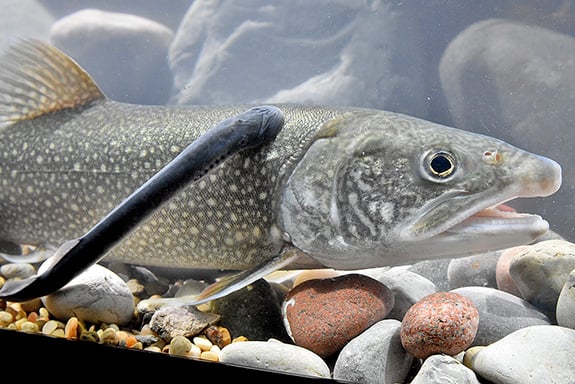
Lake trout are the largest of freshwater char, are native to northern North America (including the Great Lakes) and can live up to 50 years or more. They are slow to mature, taking up to eight to 10 years to reproduce.
But the native apex predator was nearly extirpated from the Great Lakes beginning in the 1950s. The two main causes: overharvest from commercial fishing and the invasion of sea lamprey.
“Rehabilitation was only a possibility because Canada and the U.S. signed a treaty forming the Great Lakes Fishery Commission and tasked that group with figuring out how to kill sea lamprey,” said Cory Goldsworthy, Minnesota DNR Lake Superior area fisheries supervisor, of the important body formed in 1955. “Lake Superior was the only Great Lake to retain any wild lake trout. In all the other Great Lakes, lake trout were completely wiped out, primarily by sea lamprey.”
Sea lamprey plan
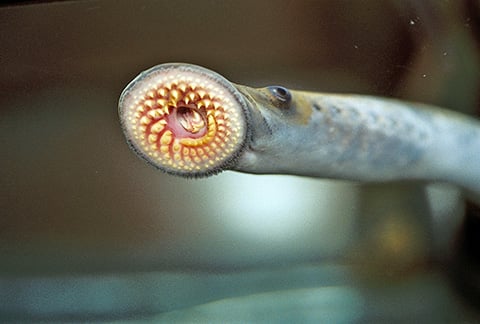
An invasive species, sea lamprey are ruthless killing machines.
Often called the vampires of the Great Lakes, the eel-like fish uses its concentric rows of teeth to suck the life out of other fish. According to published accounts and scientific papers, they were spotted in Lake Erie as early as 1921. They were found in the other Great Lakes at various points in the 1930s.
In the 1940s, “the parasitic devils were well on their way to taking over the Great Lakes.”
Indeed, lake trout populations eventually crashed. Commercial fishing abruptly ended, and sport fishing was eliminated. Scores of jobs were then lost throughout the Great Lakes basin. It was an ecological and economic calamity.
Scientific revival
Enter Vernon C. Applegate, a native New Yorker who today has the admiration of fisheries scientists throughout the Great Lakes.
Long story short: Applegate enrolled in the graduate biology program at the University of Michigan in the early 1940s. He became fascinated with the sea lamprey invasion, and decided to focus on it as part of his doctoral work. He was eventually tasked by the school’s Institute of Fisheries Research to, well, kill the killers.
It was multi-year process of fits, starts and dead ends. Well into the research, Applegate and his team eventually determined a chemical poison would be needed to kill sea lamprey en masse.
They tried hundreds of combinations, from as many as 65 different companies. Finally, Applegate’s team tried a poisonous chemical compound from Germany, which eventually become the lampricide known simply as TFM.
“They mixed it in a bag, and it killed the sea lamprey but not the lake trout,” said Goldsworthy. “That discovery really set the stage for a lake trout comeback.”
Comeback realized
According to the U.S. Fish and Wildlife Service (USFWS), lake trout today in Lake Superior are fully recovered and are inching closer to that goal in the other lakes.
Lake trout stocking, from national fish hatcheries run by the USFWS in the Great Lakes basin, has driven the recovery over the decades. Thanks to continued natural production, lake trout stocking ended in Lake Superior in 2015. Stocking in Lake Huron has been reduced by as much as 60% over the last five years due to natural production success.
Lake Michigan is seeing more natural production, too. But sustained natural reproduction has not gone as well for Lake Erie (which is primarily a walleye and yellow perch fishery) and Lake Ontario over the year. The recovery at both lakes has been more challenging, fisheries officials say.
State fisheries perspective
Dave Caroffino is the Lake Superior basin coordinator for the Michigan DNR, as well as the agency’s fisheries division tribal liaison. Caroffino has extensive experience in research and assessment of lake trout populations in lakes Michigan, Huron and Superior. It’s complicated, he said.
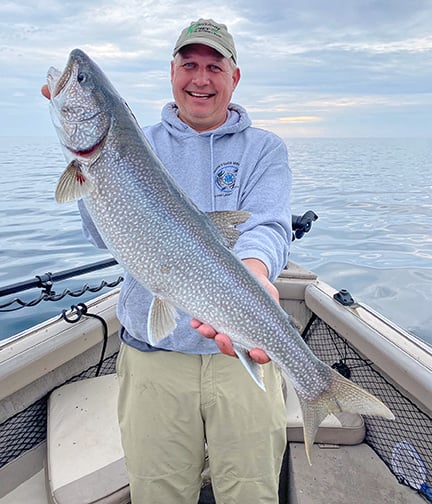
While Lake Superior is in a class of its own, Caroffino said Lake Michigan and Lake Huron are in a “state of rehabilitation.”
“We’ve seen higher levels of natural reproduction in Lake Huron than we have seen in Lake Michigan,” he said. “Both lakes have commercial fishing for lake trout. In Lake Huron, we have seen more natural reproduction in the northern part of the lake than the southern part of the lake. Stocking was reduced in the southern portion of Lake Huron, and natural reproduction has not been able to keep up and the sport fishery has declined.”
In Lake Michigan, Caroffino said fisheries officials have observed more natural reproduction in the southern part of the lake than the northern part. “Stocking strategies have changed over the years, but the natural reproduction we have seen is not at the level observed in Lake Huron,” he said. “In terms of ranking natural reproduction, Lake Superior is way out front, Lake Huron lags but is next, and Lake Michigan is just starting the race – but that’s positive that they are in the game. We went years without seeing any evidence of true natural reproduction.”
Contributing to the lack of lake trout natural reproduction in some Great Lakes is the overwhelming presence of the alewife, which is an important forage species for Chinook and coho salmon in Lake Michigan in particular.
Caroffino said alewife consumption severely hinders lake trout reproduction by causing thiamine (vitamin B1) deficiency, which leads to high mortality in eggs and fry. A diet heavy in alewives, which are rich in the enzyme thiaminase, results in poor reproductive success.
“The reasons we haven’t seen natural reproduction are a combination of habitat, ecology, other species like alewife and smelt possibly inhibiting natural reproduction, and mortality rates,” Caroffino said. “Lake trout are a long-lived fish and while they can sustain fisheries, high levels of mortality can impact their ability to reliably and consistently reproduce. There isn’t one single factor, and there is no finger pointing going on – fisheries management is complicated and many goals are trying to be met simultaneously.”
The future
Great Lakes fisheries officials and guides say the future of lake trout hinges first and foremost on keeping sea lamprey numbers under control. Sea lamprey have been reduced by 90% in most areas.
“Everyone involved with sea lamprey have done a remarkable job keeping them in check,” said Haasch, the charter captain from Wisconsin. “But we’re never going to fully get rid of them, either. So, constant monitoring and management will be crucial to ensure we don’t revisit the days when lamprey numbers exploded and crashed lake trout populations. I’m confident we will be able to do that.”
Goldsworthy of the Minnesota DNR agrees, though he has additional concerns for Lake Superior.
“The lake trout fishery is phenomenal,” he said of Lake Superior. “Anglers are very happy and have had the best fishing for lake trout in the past two years we have ever seen. The future is very bright for lake trout in Lake Superior as long as we continue to monitor and control harvest, especially with new technologies. We have to continue to be diligent in invasive species control, eradication and prevention, while also understanding the food web and what Lake Superior can produce given its limited forage base.”
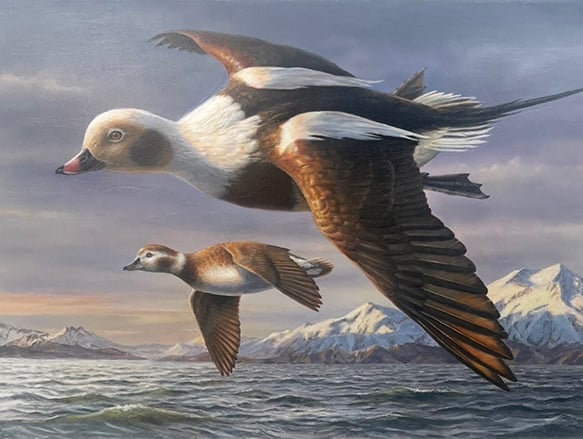
Minnesota artist Bob Hautman wins federal duck stamp contest for fourth time
Minnesota’s own Bob Hautman, from Delano, won the 2026 Federal Duck Stamp Art Contest today with his acrylic painting of
Confirmed cougar makes an even dozen sightings over 25 years
A mountain lion was spotted moving through southern Illinois, and this time wildlife officials believe the big cat crossed west
Illinois bow season opens Oct. 1 with few changes
The DNR has floated the idea of establishing additional Restricted Archery Zones in other parts of the state, but this
