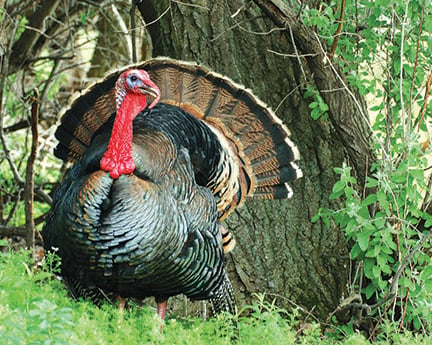
Harrisburg — History provides context on just how good Pennsylvania spring turkey hunters have had it lately.
During the state’s first spring turkey season in 1968, the total take was 1,636.
Compare that to last year, when hunters harvested an estimated 42,543 birds. Not only was that the largest spring turkey harvest in the last five years, it wasn’t far off the all-time record of 44,639, set in 2009.
This year is shaping up to be another good one, too.
From May 2-16, gobbler hunting hours are from one-half hour before sunrise to noon, and from May 18-30 hunting hours run from one-half hour before sunrise to one-half hour after sunset.
Hunters are allowed one gobbler with their general license. Those who purchase a second spring gobbler tag by May 1 can take a second bird, as well, though no more than one per day.
MORE TURKEY COVERAGE FROM OUTDOOR NEWS:
Minnesota’s early turkey kill drops from 2025 as hunters deal with poor weekend weather
Minnesota 9-year-old harvests a top three tom in state’s record book
Mastering turkey hunting’s game of ‘let’s find each other’
Hunters should be aware there is no Sunday hunting for spring gobblers this year. That will change in 2027 – the Game Commission in April approved the 2026-27 hunting seasons – but spring turkey hunting this season is open only Monday through Saturday.
Still, much opportunity awaits hunters.
Pennsylvania’s statewide turkey population has been on the upswing in recent years and harvests have climbed accordingly. That’s not just a result of there being lots of hunters either.
Pennsylvania had an estimated 170,265 spring gobbler hunters in 2025, 10,701 of them juniors.
But in monitoring turkey population trends, the Game Commission examines the number of birds harvested per 100 days of hunter effort, which accounts for changes in hunter participation, said Reina Tyl, the agency’s turkey biologist.
And in 2025, the statewide average of 5.46 gobblers taken per 100 days was higher than both the latest three-year (5.21) and five-year (4.72) averages.
The future looks bright, too.
The Game Commission tracks turkey productivity – how many new young birds are produced – through a summer sighting survey. It allows agency staff to calculate the number of poults observed per hen, to get a poults-to-hen ratio.
In 2024, every wildlife management unit across the state saw a poult-to-hen ratio higher than 2.0. The statewide average was 3.22.
That “indicates relatively good productivity statewide,” Tyl said.
It also translates – right now, this season – to opportunities to go head-to-head with plenty of fun, vocal toms.
“Those males that hatched in 2024 will be two-year-old gobblers this spring turkey season, which should make for some great turkey hunting,” Tyl said.
Nearly one in four hunters – 23% – harvested at least one gobbler last year, Tyl noted.
The birds often display near field edges and forest openings like logging roads that increase their odds of being seen, too, she added.
“Looking at topographic maps, land cover maps and satellite imagery can be a great way to identify possible roost locations and fly-down areas,” Tyl said.
“But putting in the work on the ground to confirm where gobblers are roosting and to locate their preferred displaying areas will take the guesswork out and increase your odds of success.”