





Denali Park, Alaska (AP) — A driver was killed and a passenger in his car injured after their vehicle a moose near the entrance to Alaska’s Denali National Park and Preserve.
The vehicle’s collision with the moose occurred around 1 a.m. Aug. 1, just south of the entrance to the Denali Park Road near Mile 235 of the George Parks Highway, also referred to as the Parks Highway, park officials said in a statement.
The 24-year-old male driver, who was from Bulgaria, was pronounced dead at the scene. The 24-year-old female passenger, who is from North Macedonia, was taken to a Fairbanks hospital.
“The collision serves as a sobering reminder of the hazards of wildlife along Alaska’s roadways,” the park statement said. “Moose, caribou, and other large animals are often active at dawn, dusk, and nighttime hours, and can be difficult to see.”
Park officials urged drivers to slow down in dark conditions and use high-beam headlights.
MORE COVERAGE FROM OUTDOOR NEWS:
Minnesota’s Brown County Pheasants Forever earns 2025’s Outdoor Leaders Award
North Dakota places new restrictions on nonresident waterfowlers at the urging of resident hunters
Wanted: Hunters to control deer numbers that are ‘decimating’ crops in southwest Pennsylvania
ZIMBABWE
Hunter Kills Research Lion, Sparking Anger
Harare, Zimbabwe (AP) — The killing of a collared research project lion in Zimbabwe by a hunter has been condemned by wildlife groups, echoing the infamous case of a lion called Cecil whose death at the hands of an American tourist in the same country a decade ago was met with international outrage.
The latest lion, known as Blondie, was part of an Oxford University study and wore a research collar sponsored by Africa Geographic, a safari company. Africa Geographic said Blondie was killed by a hunter in June close to the country’s flagship Hwange National Park after being lured out of a protected area and into a nearby hunting zone with the use of bait.
After Blondie’s killing became a new rallying cry for those opposed to hunting, a spokesperson for Zimbabwe’s National Parks told The Associated Press on in late July that the hunt was legal and the hunter had the necessary permits. Zimbabwe allows up to 100 lions to be hunted a year. Hunters, who are usually foreign tourists, pay tens of thousands of dollars to kill a lion.
Some countries in Africa, including Kenya, have commercial hunting bans, while others including Zimbabwe and South Africa allow it. Botswana lifted a ban on hunting six years ago.
Tinashe Farawo, the spokesperson for the Zimbabwe parks agency, said money from hunting is crucial to support the southern African nation’s underfunded conservation efforts. He defended the hunt and said they often happen at night, meaning the collar on Blondie may not have been visible.
Zimbabwe’s national parks agency says the country makes about $20 million a year from hunting, with a single hunter spending an average of $100,000 per hunt – which includes accommodations and hiring vehicle operators and local trackers.
MAINE
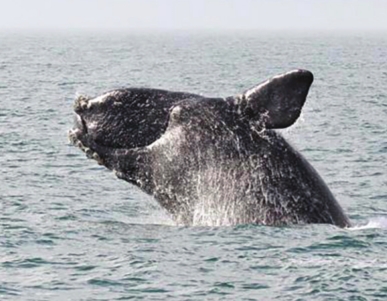
Fishing Groups Push to Delay Right Whale Protections
Portland, Maine (AP) — A Maine congressman and several commercial fishing groups are getting behind a push to delay rules designed to protect a vanishing species of whale for 10 years.
The North Atlantic right whale numbers only about 370 and has declined during the past 15 years. They have been the subject of proposed federal fishing laws that are backed by conservation groups because the whales are threatened by lethal entanglement in commercial fishing gear.
The federal government is in the midst of a pause on federal right whale rules until 2028. Democratic Rep. Jared Golden, of Maine, and a coalition of fishing organizations said in letters to congressional officials that they want to extend that moratorium out to 2035.
Golden, who played a role in the initial moratorium, said extending the pause would give the government the time it needs to craft regulations that reflect science. He also said it would protect Maine’s lobster-fishing industry, which is one of the fishing sectors that would have to comply with rules intended to protect right whales.
The extension of the moratorium was originally proposed by Alaska Republican Nick Begich. It’s one of several changes to the federal Marine Mammal Protection Act proposed by Begich, who like Golden represents a state with a large commercial fishing industry.
The whales were once numerous off the East Coast, but they were decimated during the era of commercial whaling and have been slow to recover. They are also threatened by collisions with large ships.
The population of the whales fell about 25% from 2010 to 2020.
NIGERIA
More Than 1,400 Canaries, Parrots Seized in Trafficking Bust
Lagos, Nigeria (AP) — Nigerian customs said they seized more than 1,600 parrots and canaries that were being transported from Lagos international airport to Kuwait without a permit, in one the biggest wildlife trafficking seizures in years.
The seizure is a sign of positive change in the fight against illegal wildlife trade, as Nigeria is a major hub in the global trade in protected species, Mark Ofua, West Africa spokesperson for the international non-governmental organization Wild Africa, told The Associated Press on Aug. 5.
Customs agents seized ring-necked parakeets and green and yellow fronted canaries, two protected species, at the airport July 31, the agency said in a statement Aug. 4. Nigeria is a signatory to the Convention on International Trade in Endangered Species of Wild Fauna and Flora, or CITES.
The statement by the customs agency said the shipment was not accompanied by a CITES permit and other documents to prove the birds were legally obtained.
Nigerian customs said an investigation to find those responsible for the illicit cargo is ongoing, and that the birds will be handed to the National Parks Service for rehabilitation and release into the wild.
Ofua said Nigeria’s porous borders, widespread corruption, and weak enforcement make it a key transit point for ivory, pangolin scales and other wildlife products destined for Asia.
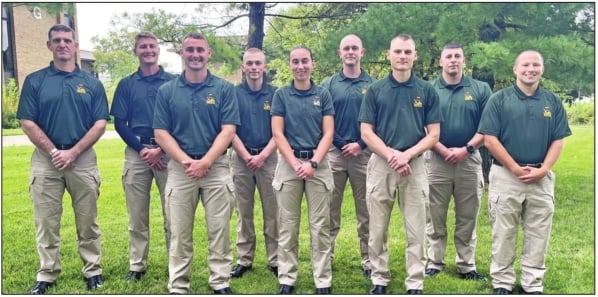
Nine Ohio DND Division of Wildlife officer cadets training
The 33rd Ohio Wildlife Officer Training Academy is underway with nine cadets training to become wildlife officers.

Ohio Mixed Bag: State finishes up wetland project in St. Marys on Ottawa River
As part of Ohio Gov. Mike DeWine’s H2Ohio Initiative, the Ohio DNR (ODNR) and the village of Ottawa Hills held

Ohio Letters to the Editor: Missing all of the old-school traditions of the fall season
Reader-submitted letters to the editor published in the Sept. 25, 2026 edition of Ohio Outdoor News.
