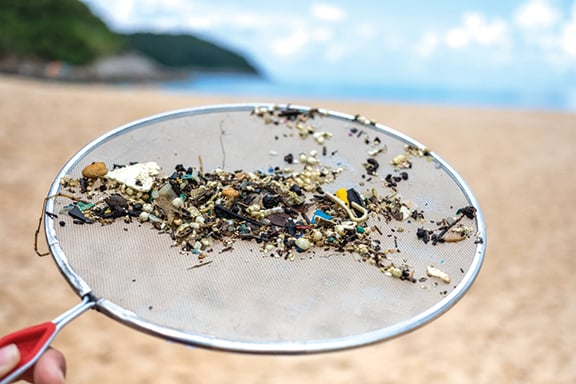
State College, Pa. — Microplastics have been steadily increasing in freshwater environments for decades and are directly tied to rising global plastic production since the 1950s, according to a new study by an interdisciplinary team of Penn State researchers.
The findings provide insight into how microplastics move and spread in freshwater environments, which could be important for creating long-term solutions to reduce pollution, the researchers said.
The work is available online now and will be published in the December issue of Science of the Total Environment.
“Few studies examine how microplastics change over time,” said Nathaniel Warner, associate professor of civil and environmental engineering and the corresponding author on the paper.
“Ours is one of the first to track microplastic levels in freshwater sediment from before the 1950s to today, showing that concentrations rise in line with plastic production.”
MORE COVERAGE FROM PENNSYLVANIA OUTDOOR NEWS:
Growing drought conditions take hold across Pennsylvania
101-year-old Pennsylvania hunter has a ‘tremendous drive’
Pennsylvania biologists ‘stunned’ to find invasive western mosquitofish in Glade Run Lake
Microplastics are tiny plastic particles that range in size from one micrometer, or 1/100th of the width of a human hair, to 5 millimeters, which is about the size of a pencil eraser.
They can come from larger plastics that break down into smaller pieces or be made directly by manufacturers.
For this study, the team examined freshwater sediment cores from four watersheds in Pennsylvania: Kiskiminetas River, Blacklick Creek, Raystown Lake and Darby Creek.
Contrary to the team’s expectations, the study found no correlation between population density or land use and high levels of microplastics.
“Based on other findings in the literature, what we thought would be important turned out not to be driving forces in microplastic variation across sites, notably the percentage of microplastics related to developed area and population density,” said Lisa Emili, associate professor of physical geography and environmental studies at Penn State Altoona and a co-author on the paper.
“Our (study) is one of the first to track microplastic levels in freshwater sediment from before the 1950s to today, showing that concentrations rise in line with plastic production.”
The researchers also said they were surprised to discover that while microplastic accumulation increased each decade through 2010, it decreased from 2010 to 2020.
“Although this is a preliminary finding that requires further study, this decrease could be related to increased recycling efforts,” Emili said.
According to the U.S. Environmental Protection Agency, recycling efforts for plastic increased significantly between 1980 and 2010. Although plastic production also increased, the percentage of recycled plastic increased from less than 0.3% in 1980 to nearly 8% in 2010.
Additionally, Raymond Najjar, a professor of oceanography and a co-author on the paper, said that this study could shed light on the “missing plastics” paradox.
This paradox challenges researchers’ understanding of plastic waste in the ocean because, while estimates suggest that 7,000 to 25,000 kilotons of plastic enter the ocean each year, only about 250 kilotons are believed to be floating on the surface.
“This suggests that estuaries, especially tidal marshes, may trap river-borne plastics before they reach the ocean,” said Najjar, who previously published in Frontiers in Marine Science on simulations of filter estuaries.
“This could explain why there is far less plastic floating around in the surface ocean compared to how much is expected to be there given the input to the ocean from rivers.”
Warner said these findings suggest that there will continue to be increasing amounts of microplastics in both water and sediment as people use more plastic.
“Humans are ingesting plastic when they eat and drink and inhaling it when they breathe, and the long-term impacts are just beginning to be studied,” Warner said.
“However, we need to figure out how to release less plastic into the environment and how to reduce consumption and exposure.”