





The fact that I caught my first mink at the age of 12 in a set I specifically made for mink made me very proud.
It still does, because there is a lot of work and strategy involved for a kid to pull that off. Some scouting (sometimes a lot of scouting), recognizing the mink sign, choosing an appropriate trap, and most of all, the boundless enthusiasm of a novice trapper all came together for me to catch what was then – and mostly still is – my ultimate prize.
In fact, my mother had that mink mounted for me as a birthday present. Even today, all these years later, it sits on my fireplace mantle.
Catching a mink still has much of that same sense of reverence and awe as I grew up with. The work and strategy required is the same, too.
Use a mink’s history to find them
Mink are loners, making it hard to catch large numbers of them.
Each female mink and her four to seven kits tend to have a home range that is typically comprised within a single drainage. The kits normally disperse by late summer. A male mink’s home range will be much larger, encompassing several drainages or more. Therefore, to catch numbers of mink, you have to cover a lot of ground.
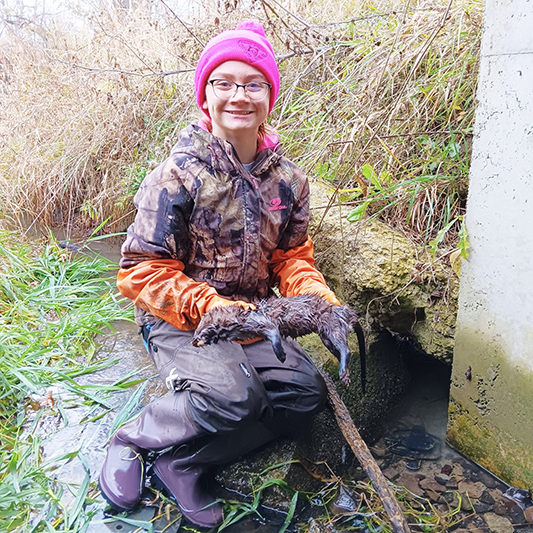
If you can, spend some time watching a mink do its hunting. Classified as a semi-aquatic mammal, they are constantly in motion, investigating every nook and cranny in their path. Knowing how they hunt will help you look for sign.
Not every little creek nor pond holds or attracts mink, so finding an indication that the mink are there improves your success. If you see where a mink has been, it will likely return to the same place at some point. They cover a lot of ground, so it may be days before they come back to the same spot, but odds are they will.
You’ll need a lot of different landowner permission to catch numbers of mink because you have to trap a lot of bodies of water. With luck, you are in a state that allows you to trap the road right-of-ways – bridges and culverts. You can trap a lot of drainages by setting at each place the road goes over water. Just bear in mind that all other trappers can do this, as well, so competition and trap theft can be an issue.
We’re going to concentrate on just two types of sets for mink – the pocket set and the blind set. Rarely will you encounter situations where neither will work.
The pocket set
The most complicated of the two sets is the pocket set.
This is a 4- to 6-inch hole dug straight into the bank of a waterway at the water’s edge with about an inch of water running into the hole. Incline the hole slightly upward to keep the bait dry at the back of the hole. A tile spade works great to make this hole although a trapping trowel will work as well – it just takes longer.
Pick a spot where the bank is pretty steep so the pitch forces mink traveling the water’s edge to pass by the pocket opening. Use some water and slick up the edge of the hole, adding a bit of eye appeal.
RELATED TRAPPING COVERAGE FROM OUTDOOR NEWS:
Trapping: Fall fur prices appear ‘stable to better’
Reason for optimism heading into Minnesota’s 2023 trapping season?
The pocket set will use exclusively foot-hold traps. I like No. 1½ coilspring traps, but lots of folks will use a No. 2. Although you can catch and hold mink in almost any long-spring or coil-spring trap, you’ll catch more raccoon at your pockets sets than you will mink simply because there are a lot raccoons, and they are attracted to the same baits and lures as mink.
Trap placement is important. Mink will investigate just about any hole they come across, but they may not enter. If your trap is too far inside the hole, you may be missing mink.
I like to place a No. 1½ coil-spring trap in an inch of water with the center of the pan about an inch or so outside the hole. I also place the trap so that the jaws are parallel to the bank. Since the mink will be traveling along the bank, this will have them stepping inside the jaws rather than over them. Press the trap down into the mud a bit to bed it solidly. No trap covering is needed – mink simply don’t care.
You can stake the traps solid or use a drowning weight (mink drown readily) – all it takes is a brick tied to weight the chain and that’ll do it; often just the weight of the trap will work. However, you have to stake for what you might catch, which in this case could be a 20-pound raccoon.
Drowning sets also will get a raccoon in the water away from the pocket which will make “remakes” a lot easier.
The pocket set is typically baited and lured. Most folks use fresh fish for bait. I like carp or catfish heads – the oily fish does not dry out as fast as panfish. I pin the bait with a short stick to the back of the hole above the waterline. Use a good mink lure. I would definitely use one with plenty of mink musk in it. Smear it on the lip of the hole.
Blind sets
A good blind set is simply a place where the mink is forced by the terrain over the trap. A blind set could be as simple as a trail through short grass, a narrow mud shelf along a creek, alongside a concrete bridge abutment, or any place where a mink’s movement is narrowed down and restricted.
Find it, stake a trap, and go.
Traps you use for pocket sets will work fine for blind sets. Much of the trap placement and staking discussed with the pocket set will be very similar. The same principles apply. Because you don’t have to take the time to dig a hole, blind sets go in place very quickly. Doing some scouting can save you time, as most blind sets don’t change a lot.
Ideally there is about an inch or so of water where you are placing the trap. Be wary of setting in water that is too deep. More than a few inches and mink will tend to swim over the trap. A half-inch to 1-inch diameter stepping stick, placed tight to each side of the trap, will tend to make the mink hop, often landing with both front paws on the pan.
The principle behind mink behavior at a blind set is almost opposite of what you are looking for with a pocket set. In a pocket set you want the mink to stop what it is doing and investigate the hole and the various smells from the bait and lure. At a blind set, the goal is not to interrupt the mink’s normal behavior. In fact, you don’t want to call any attention to the set at all – so no bait or lure. To make a catch, everything about the set depends on the mink traveling on its merry way.
One major difference with a blind set is that you will often find nice tight spaces where a No. 110 style bodygrip works perfectly. Holes in rootwads, narrow spots in small creeks, along bridge abutments – the possibilities are endless. You will likely catch fewer non-target furbearers – maybe muskrats, but probably no raccoon. Mink have a tendency to run right against walls and sharp banks, so if you set these places, set tight against the side. I usually stick a few sticks in the mud on the outside of the trap to keep them going through the trap route rather than around it. I do this using foot-hold traps, as well.
Mink fur prices
Roughly 90% of all the fur that is produced today comes from ranched furbearers – and almost the same percentage of ranch fur is mink.
One of the key problems with the fur industry in general is not that people aren’t interested in fur, it’s that so many things seem to conspire to keep fur prices low.
Most mink is sold to China. Not only are we having severe trade issues with the Chinese, their economy is still recovering from an almost complete shutdown during the COVID pandemic that seems to be hanging on longer in China than elsewhere.
Currently, China is having severe economic difficulties due to a collapsing of its real estate market. Things like Russian embargos and the war in the Ukraine aren’t helping either.
What will mink fur prices reach this year? Well, we’ll likely see $10 tops for males and probably half of that for the females. Averages will be less.
Will that keep me from trapping mink this fall and winter? Never.
Why? Because it’s a mink.
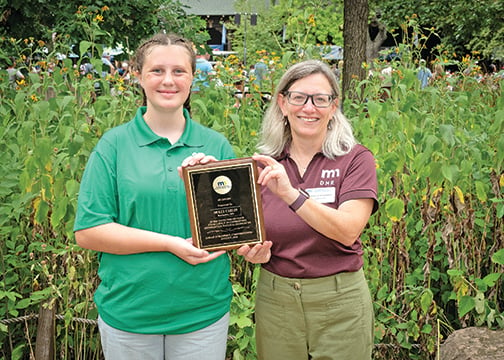
Minnesota DNR recognizes two youth for their conservation efforts
Minnesota DNR Commissioner Sarah Strommen and state Rep. Rick Hansen honored two youths for their outstanding conservation efforts Friday, Sept.

Minnesota Mixed Bag: DNR seeks pine cone collectors ahead of anticipated bumper crop
The DNR is asking the public to collect red pine cones and has increased its payment to $95 per bushel

Minnesota Letters to the Editor: Loons not surviving? Got eagles and trumpeter swans?
Reader-submitted letters to the editor published in the Sept. 11, 2026 edition of Minnesota Outdoor News.
