




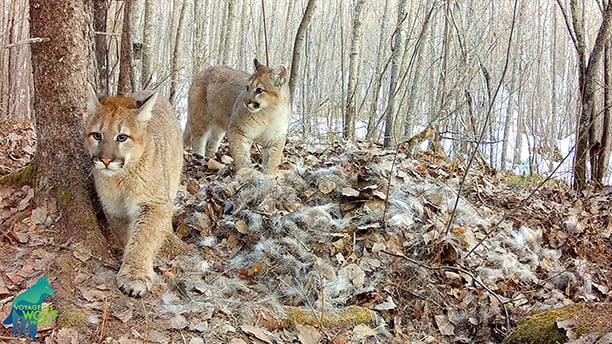
Voyageurs National Park — The Minnesota Department of Natural Resources announced today that for the first time in more than 100 years, evidence of cougars reproducing in Minnesota was documented in video captured by the University of Minnesota’s Voyageurs Wolf Project.
The footage, which was captured on March 25 and first seen by researchers when the cameras were collected this past Sunday, April 26, shows a female cougar with three large kittens.
The high-quality video (watch it below) shows the kittens up close and feeding south of Voyageurs National Park in northern Minnesota.
The Voyageurs Wolf Project has deployed hundreds of trail cameras in northeast Minnesota to help with wolf research. The DNR said in a release on Thursday that those cameras have recorded footage of lone cougars eight times since 2023, but none of those cameras had recorded footage of kittens.
The videos of the cougar with kittens were captured by two cameras that research scientist Sean Johnson-Bice placed over a GPS-collared deer that had been killed by a predator. Researchers with the Voyageurs Wolf Project started a study this past winter to examine survival and mortality patterns of deer in the area.
Several deer were collared in January as part of that work. In March, researchers received a mortality signal from a GPS-collared deer. Johnson-Bice found the deer carcass on a hillside buried under a pile of leaves. Burying, or caching, prey like this is typical of kills made by felines.
“We suspected it was likely a bobcat but thought, just possibly, it could be a cougar,” it says in the description under the video on the Voyageurs Wolf Project YouTube channel.
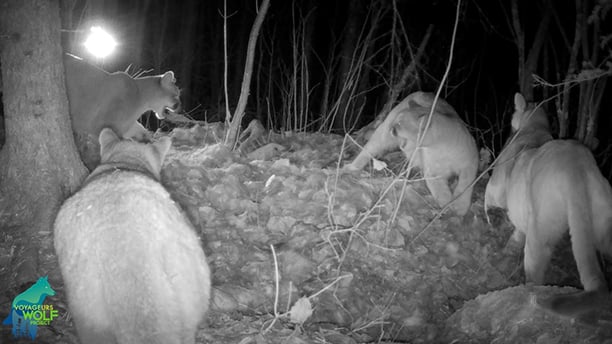
Johnson-Bice placed two trail cameras over the deer carcass and the first video of the cougars came just four hours later when two kittens returned to the kill. The entire family of cats appeared later that evening and spent hours in front of the cameras.
“Looking at the footage was and still is surreal,” said Thomas Gable, project lead of the Voyageurs Wolf Project. “We never anticipated seeing four cougars together in northern Minnesota. In total, we captured (just over seven) hours of footage of this cougar family at the kill, and it was fascinating to see and hear their interactions — the mother grooming her kittens, the kittens growling and hissing at each other. We feel incredibly fortunate we were able to capture such a wild moment in such detail.”
MORE COVERAGE FROM MINNESOTA OUTDOOR NEWS:
A Minnesotan’s waterfowling life: Remembering legendary wildlife artist David Maass
Minnesota’s early turkey kill drops from 2025 as hunters deal with poor weekend weather
Minnesota 9-year-old harvests a top three tom in state’s record book
None of the cameras used by Voyageurs Wolf Project researchers are cell cameras. They are primarily capturing HD video for their work, and high-quality video files are difficult, and expensive, to send over a cellular network.
Gable said he was taking advantage of a beautiful spring day in northern Minnesota this past Sunday when he decided to go for a walk in the woods to pick up the cameras that had been over the deer carcass for just over a month.
“I got to the camera and I watched first thing and I thought, ‘Oh my gosh.’ I was just absolutely floored,” Gable said in an interview with Outdoor News on Thursday. “I called Sean in the woods looking at this and I said, ‘You are just not going to believe this.’”
There were hundreds of video clips to look through. Gable got back home and pulled the videos up on his computer. That’s when he realized exactly what the cameras had discovered with what was now obviously a mother cougar and three kittens.
“It was just crazy. I don’t know how else to describe it,” Gable said of his initial reaction. “It was just absolutely surreal. That night I found out, I struggled to sleep it was just so exciting. As a wildlife biologist there’s not very many opportunities that you get to document something like that, especially in northern Minnesota. I just would have never believed we would get the kind of footage we did of four cougars.”
Cougars in Minnesota
Cougars were native to Minnesota before becoming locally extinct. There hasn’t been evidence of reproduction for more than 100 years in the eastern Midwest (east of the Dakotas and Nebraska) until recent reports from Michigan and now Minnesota.
“Based on traits observed in the video, we estimate the kittens to be 7-9 months old, so born last fall,” said John Erb, research biologist with the Minnesota DNR. “The only other confirmed kittens in Minnesota turned out to be captive escapees and involved a female with two kittens that showed up and hung around a homeowner’s porch in 2001.”
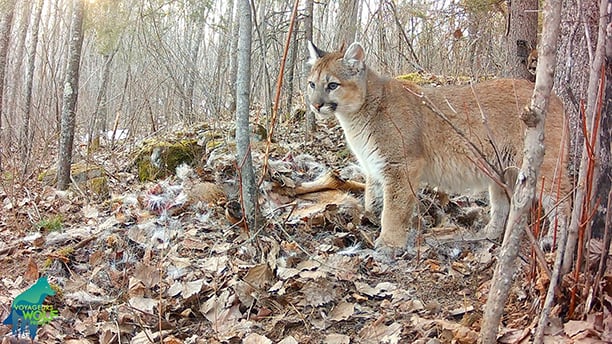
The DNR said detections of individual adult cougars, which are typically males, are now unsurprising across Minnesota and the western two thirds of the Midwest. Cougars can travel more than 40 miles in a day, and, to date, cougars documented in Minnesota appear to have all been transient animals from western South Dakota, North Dakota, or Nebraska.
“Although this is an important starting point for potential population establishment in Minnesota, predicting the future is extremely difficult,” Erb said. “These kittens might not survive, potentially getting killed by wolves, a male cougar or vehicles. They may also become part of the founding catalyst for a slow but steady increase in numbers. Time will tell, but we are clearly nearing a point where the probability of a self-sustaining population has increased.”
Cougars almost always tend to avoid human contact or confrontation, the DNR said. Even in states with resident populations, cougars are rarely seen. Suggestions of what to do if a person encounters a cougar are available on the Minnesota DNR website.
Citizens are reminded that cougars are protected in Minnesota, with no open harvest season. Public safety officials can lethally take a cougar if it is determined to be an immediate threat to public safety.
Funding for the Voyageurs Wolf Project
Funding for the University of Minnesota’s Voyageurs Wolf Project was provided by the Minnesota Environment and Natural Resources Trust Fund as recommended by the Legislative-Citizen Commission on Minnesota Resources.
With hours of video documenting the cougar family to work with, the Voyageurs Wolf Project said it will share more footage soon. Follow the VWP YouTube channel here.
“Huge thanks to the Minnesota Environment and Natural Resources Trust Fund for supporting the Voyageurs Wolf Project and the recent effort to understand deer survival in the area,” VWP noted in the description with the current video. “Their support was critical to this observation. Without it, we would never have captured this footage.
“And huge thanks to the more than 10,600 donors who have supported our project and enabled us to purchase trail cameras supplies. The cameras (and batteries, SD cards, mounts) we set at this kill were purchased with funds from donations.”

Ralph Loos: Another Illinois DNR director, another test for state’s natural resources
We all live in the past because it’s one of the few things we’re truly confident in – good or
Wisconsin Wardens at Work: Illegal baiter just can’t help himself
A convicted felon was quick to admit to David Bennett, a Sheboygan County, Wis., game warden, when he was presented
Tom Bahti: Time to reassess our priorities as deer hunters
I have become increasingly nervous about the future of white-tailed deer hunting in Wisconsin – and throughout North America, for
